-
Irish ballad – Carrickfergus
Here is a beautiful Irish song about a woman lamenting the loss of her lover. It is a sad and mournful song, but packs a lot of emotion and warmth.
This performance uses Irish Gaelic mixed in with English.
The very capable British choral group Voces8 performs featuring soprano Sibéal. She delivers a tender and poignant performance, perfectly in balance with the choir. The harmonization achieved in this performance is fantastic! Tenebrae and Voces8 are my two favorite contemporary choral groups, both British. I should mention that the space they are singing in has amazing, reverberant acoustics ideally suited for this type of performance.
Traditional: Carrickfergus (Arr. Pacey)
Lyrics:
CHORUS: I wish I was in Carrickfergus
I wish I was in Carrickfergus
Is fada ón áit seo go Baile Uí Chuain
Sailing over the deep blue waters
I ndiaidh mo ghrá geal is í ag ealó uaim.
For the seas are deep, love, and I can’t swim over
And neither have I wings to fly,
I wish I met with a handy boatman,
Who’d ferry over my love and I.[Chorus]
Tá an fuacht ag teacht is an teas ag tréigint
An tart ní féidir liom féin é do chlaoi,
Is go bhfuil an leabhar orm ó Shamhain go Fébur
Is ní bheidh sí reidh liom go Féil’ Mhichíl;
I’m seldom drunk though I’m never sober!
A handsome rover from town to town.
But now I am dead and my days are over
Come Molly, a stóirín, now lay me down![Chorus]
-
Allegri’s Miserere mei, Deus
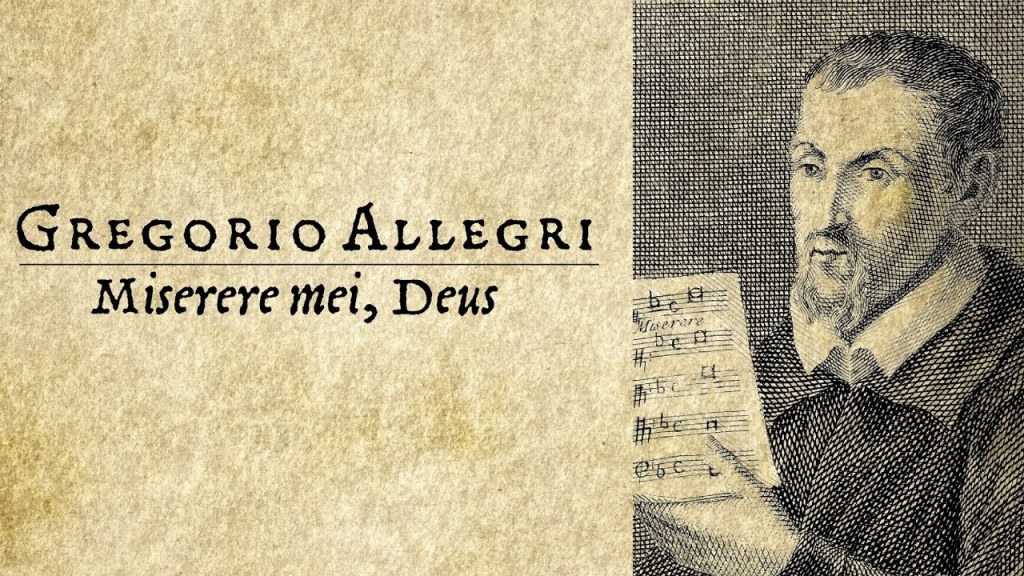
Here is Renaissance composer Gregorio Allegri’s masterpiece of vocal harmony and polyphony Miserere mei, Deus. This chant is performed by the British group, the Tenebrae Choir – conducted by Nigel Short. Chants are performed acapella – only the human voice is used, no instruments. Tenebrae gives a breathtaking performance with amazing pitch, clarity of voices, balance, and harmonization! This is Renaissance polyphony at its very best. This work was composed in the 1630s, during the papacy of Pope Urban VIII, at the tail end of the Renaissance. Pay special attention to the high C note the outstanding soprano hits at mark 1:34 through mark 1:38 of the video! Such purity of tone, and crystal clear articulation!
By the way, it’s very fascinating that this high C note which is so famous in this piece actually was the result of a musicological error in what is known as falsobordone. Below, Italian musicologist, Elam Rotem goes into detail explaining precisely how this pleasant ‘error’ arose! Another interesting note about this piece: originally the parts now sung by sopranos would have been sung by boys, or adult castrati (men castrated before puberty so they could still sing very high notes).
The piece was written for use in the Tenebrae service on Holy Wednesday and Good Friday of Holy Week. Pope Urban VIII loved the piece so much, that he forbid it to be performed elsewhere outside of the Sistine Chapel. For over 100 years, Allegri’s ‘Miserere mei, Deus’ was performed exclusively in the church. Anyone caught with a transcription of the piece outside of the chapel could be immediately excommunicated from the church. (In 1770, a 14-year-old Wolfgang Amadeus Mozart was present at one of the performances while touring Italy with his father. After hearing the piece, Mozart transcribed the work entirely from memory and even made corrections. He attended one more performance to make his final adjustments. The following year, after meeting with music historian and biographer, Dr. Charles Burney, Mozart gave him the sheet music. Burney took the score to London and published it, which resulted in the papacy lifting its ban.)
https://www.liveabout.com/miserere-mei-deus-lyrics-and-english-translation-723977The lyrics, sung in Latin, are from Psalm 51. One of the 7 penitential psalms. The first three words in the Latin text of this psalm are Miserere mei, Deus (“Have mercy on me, O God”), and musical settings of the psalm — of which there have been many — are often referred to simply as Miserere.
This performance was filmed at St. Bartholomew the Great, London. The church has phenomenal acoustics which are ideally suited for this type of music!
‘Miserere mei, Deus’ Original Latin Lyrics
Miserere mei, Deus: secundum magnam misericordiam tuam.
Et secundum multitudinem miserationum tuarum, dele iniquitatem meam.
Amplius lava me ab iniquitate mea: et a peccato meo munda me.
Quoniam iniquitatem meam ego cognosco: et peccatum meum contra me est semper.
Tibi soli peccavi, et malum coram te feci: ut justificeris in sermonibus tuis, et vincas cum judicaris.
Ecce enim in iniquitatibus conceptus sum: et in peccatis concepit me mater mea.
Ecce enim veritatem dilexisti: incerta et occulta sapientiae tuae manifestasti mihi.
Asperges me hysopo, et mundabor: lavabis me, et super nivem dealbabor.
Auditui meo dabis gaudium et laetitiam: et exsultabunt ossa humiliata.
Averte faciem tuam a peccatis meis: et omnes iniquitates meas dele.
Cor mundum crea in me, Deus: et spiritum rectum innova in visceribus meis.
Ne proiicias me a facie tua: et spiritum sanctum tuum ne auferas a me.
Redde mihi laetitiam salutaris tui: et spiritu principali confirma me.
Docebo iniquos vias tuas: et impii ad te convertentur.
Libera me de sanguinibus, Deus, Deus salutis meae: et exsultabit lingua mea justitiam tuam.
Domine, labia mea aperies: et os meum annuntiabit laudem tuam.
Quoniam si voluisses sacrificium, dedissem utique: holocaustis non delectaberis.
Sacrificium Deo spiritus contribulatus: cor contritum, et humiliatum, Deus, non despicies.
Benigne fac, Domine, in bona voluntate tua Sion: ut aedificentur muri Ierusalem.
Tunc acceptabis sacrificium justitiae, oblationes, et holocausta: tunc imponent super altare tuum vitulos.‘Miserere mei, Deus’ English Translation
Have mercy on me, O God, according to Thy great mercy.
According unto the multitude of Thy tender mercies remove my transgressions.
Wash me thoroughly from my iniquities, and cleanse me from my sin.
I knowingly confess my transgressions: and my sin is ever before me.
Against Thee only have I sinned, and done evil before Thee: that they may be justified in Thy sayings, and might they overcome when I am judged.
But behold, I was formed in iniquity: and in sin did my mother conceive me.
Behold, Thou desirest truth in my innermost being: and shalt make me to understand wisdom secretly.
Thou shalt sprinkle me with hyssop, and I shall be clean: wash me, make me whiter than snow.
Open my ears and make me hear of joy and gladness: and my bones that have been humbled shall rejoice.
Turn away Thy face from my sins: and remember not all my misdeeds.
Create in me a clean heart, O God: and make anew a righteous spirit within my body.
Do not cast me away from Thy presence: and take not Thy holy spirit from me.
Restore unto me the joy of your salvation, and uphold me with a willing spirit.
I will teach those that are unjust Thy ways: and sinners shall be converted unto Thee.
Deliver me from blood, O God, the God of my salvation: and my tongue shall sing of Thy righteousness.
O Lord, open my lips: and my mouth shall spring forth Thy praise.
For Thou desirest no sacrifice, where others would: with burnt offerings Thou wilt not be delighted.
Sacrifices of God are broken spirits: dejected and contrite hearts, O God, Thou wilt not despise.
Deal favorably, O Lord, in Thy good pleasure unto Zion: build Thou the walls of Jerusalem.
Then shalt Thou be pleased with the sacrifices of righteousness, with small and large burnt offerings: then shall they lay calves upon your altar. -
Modern Parenting
Most kids today are so spoiled, coddled, catered to. It’s disgusting. The way I hear kids in the supermarket talk back to their parents is disheartening. That was NOT tolerated in our home. My father made it very clear what would happen if we disrespected our mother.
And I see Moms cooking 10 different dinners to satisfy their picky kids! When I was a child you ate what you were served, and you didn’t leave your seat until you ate EVERYTHING! And whining and complaining were not tolerated.
In my entire life, I have never cursed or swore at my parents or talked to them in a disrespectful manner.
Most kids today are glued to their smartphones. Why does a 10 or 12-year-old need their own phone?! That is madness and sheer negligence by their parents. I didn’t have my first smartphone until I was 42 years old! And if they’re not sitting inside on the phones, they are playing computer games. I must admit I’m an avid gamer, but that is only because I’m an adult. Kids should not be gaming. And if they’re not playing games, they are watching TV!!
Parents: let your children play unsupervised outside. When I was 7 years old I had free reign of the neighborhood. So did my sisters. In the summertime, we left home after breakfast around 9am and didn’t come home until 7pm for dinner. That was 10 hours of unsupervised time playing games with our friends, exploring the woods, visiting neighbors, and generally having active fun. We were healthy, slim, fit, active kids! I see what a huge issue childhood obesity is now in America. This is 100% the parents’ fault! It’s child abuse!!
Overprotective anxiety-riddled parents drive their kids EVERYWHERE! Let them walk and get some exercise! And my parents made it very clear to us kids that our education was a very top priority. We did homework during the summertime and prepared for the coming school year. We could not play until we had finished our homework and studying. Looking back now as a 46 year old man, I realize what a true blessing my parents are. They raised us to love and fear God and to respect other people, and ourselves, and to treat each other right.

Here’s a great meme I found on Facebook! -
COVID and The Lunatic Fringe

During the past 2 years since the SARS-Cov-2 virus emerged as a global pandemic, I’ve been sharing news stories on Facebook. I faced, from the start, enormous and immediate pushback by anti-vaxers. They mocked, belittled, and ridiculed me. I didn’t stoop to their level. I presented the facts with my take on them. This anti-vaxx sentiment is rooted in fear and ignorance.
Imagine if, in the 1950s, a huge portion of the American population refused the polio vaccine for themselves or their children. Polio would still be with us as a scourge. Thank God for vaccines! The ignorance of some people is astounding! And then they try to spin it into a political/patriot issue as if they are brave freedom fighters for refusing to wear a mask, or for refusing to get vaccinated. I’m sick of all of them. This disease is deadly and I’ve lost too many loved ones to see anti-vaxxers lie about the disease that killed them.
Our childhood friend Chris Ordos died from COVID before the vaccines were developed. He was 51 and in great shape physically. He died within 48 hours of having trouble breathing. I’ve seen dozens of reports of people in their 20s, 30s, 40s, and 50s who were healthy, yet died from COVID. This virus is not the same as the influenza viruses we see every year. It is at least 30-50 times as deadly. And the science is clear, the percentage of people who are vaccinated and develop serious enough symptoms to warrant hospitalization, or who die from COVID, are magnitudes lower than the percentage of people who are either hospitalized or who die who are unvaccinated.
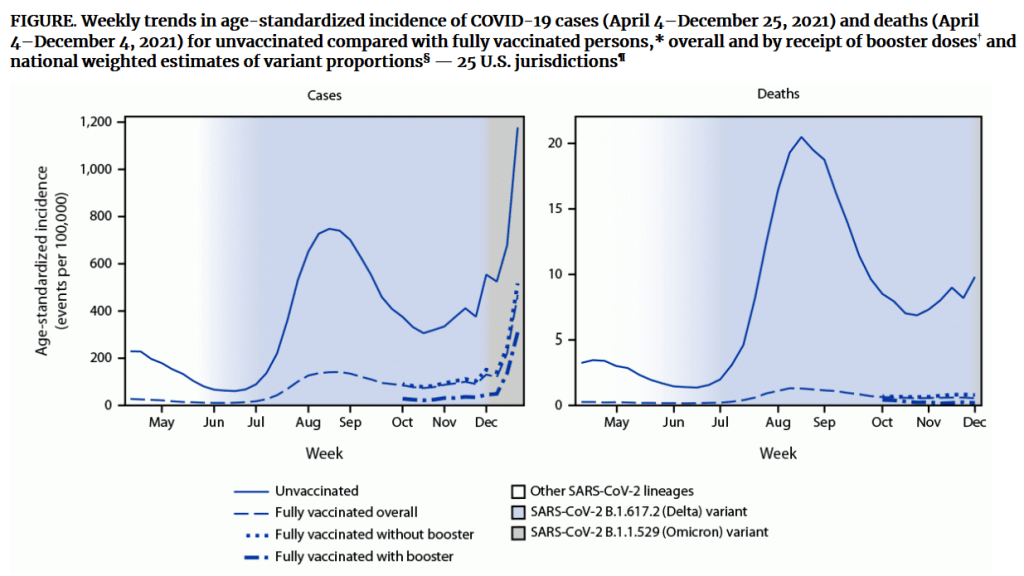
Here we see a CDC graph of deaths of the vaccinated versus the non-vaccinated. The difference is clear. Getting vaccinated saves lives.
The majority of Americans realize that the vaccines are safe and effective, with very few vaccine-related injuries, compared to the tens of millions of people vaccinated. What I call the lunatic fringe are the diehard Trump supporters who take their medical advice from their favorite politicians, or from their pastor, instead of listening to the overwhelming global consensus of doctors and scientists who specialize in virology. Such people are willfully ignorant, and literally cannot be reasoned with.
I saw on CNN cases of COVID patients in the ICU who were dying and they still denied they were sick because of COVID. At a certain point cognitive dissonance sets in and they believe the opposite of the media, educators, business, and most importantly doctors and scientists. When you attempt to debate them you see it’s futile. They respond with about a half dozen canned responses, which they heard their favorite political pundit or politician repeat. You can bring up sophisticated arguments, and literally, show them objective data that contradicts their narrative and they just dig their heels in harder and repeat the same tired canards! It’s extremely frustrating to interact with such people.
Trump, early on, politicizing COVID, and making it into a Democrat versus Republican issue, was a great tragedy and a serious mistake which some scientists have estimated makes Trump responsible for 200,000 to 300,000 deaths which could have been averted.
We’ve seen how deadly and unpredictable COVID variants can be, the first delta and now omicron. As the virus keeps sweeping through the global population and continues to mutate who knows what we might face in a future COVID variant. We need everyone to wear masks (these same people who opposed the vaccines are also opposed to wearing masks to reduce the transmission of the virus), social distance, wash their hands and get fully vaccinated. My parents, 2 sisters, and I are triple vaxxed with the first two shots and then the booster. Please, I urge you to take these necessary steps to protect yourself, your families and friends, and even strangers from this deadly and brutal virus. America has surpassed 900,000 COVID deaths with no end in sight. We could’ve had herd immunity by now if only those ignorant and deluded anti-vaxxers had taken the vaccines!! So disgusting.
I should also note how COVID has been handled in the Church. I still see on YouTube, Facebook, and Twitter, pastors railing against the vaccines as the prophesied Mark of the Beast mentioned in the book of Revelation in the Bible. I’ve heard pastors say that taking the vaccines indicates a lack of faith and a lack of trust in God. This is deeply damaging and very immoral. People have literally died because they trusted their pastor, who has a position of authority that they abused! This is wicked and we need to speak out against this, and refuse to tolerate it.
I’ve also read many crazy conspiracy theories saying the vaccines have microchips to track you or toxic substances like graphene, or that they are made from aborted babies. All of these are absolutely false! We need to confront these insane theories and denounce them when we see them.
The COVID virus may be with us for a very long time. Experts are saying it could become a cyclical virus, like flu, which we’d need to be vaccinated against every year to match the genetic structure of the mutated viruses. I pray that we once more will live in a COVID-free world, but if not, my trust is firmly rooted in the sovereign Triune God.
And contrary to what many on social media have told me, no I am not living in fear by being educated and seeing the benefits of masking, social distancing, and taking COVID vaccines. My beliefs about COVID vaccines are not rooted in fear. I am not fearful. I trust God and I trust the science He has blessed us with. Jesus would tell you to get the vaccine if He was on earth right now! LOVE THY NEIGHBOR!!! I saw recently thousands of truckers in Canada driving to the US-Canada border to protest the mandates in their country. This was dubbed the Freedom Convoy. It’s ridiculous, and if the stakes weren’t so high, it would be laughable. These truckers are not modern-day Minute Men fighting to preserve liberty. They are fighting to preserve ignorance, superstition, and an anti-science anti-intellectual worldview. You are not a patriot because you’re an anti-vaxxer or an anti-masker. Both of my grandfathers fought in World War 2 for this great nation of ours. They are true patriots, not anti-vaxxers!
If you have any comments or wish to react to this post, please leave a comment below. Thank you, readers.
-
Favorite Christmas Songs
These are some of my favorite songs! Which are your favorites? Please enjoy!
Silver Bells
Silver Bells, Silver Bells
It’s Christmas time in the city
Ring-a-ling, hear them ring
Soon it will be Christmas DayCity sidewalks
Busy sidewalks
Dressed in holiday style
In the air there’s
A feeling of Christmas
Children laughing
People passing
Meeting smile after smile
And on every
Street corner you’ll hearSilver Bells, Silver Bells
It’s Christmas time in the city
Ring-a-ling, hear them sing
Soon it will be Christmas DayStrings of street lights
Even stoplights
Blink a bright red and green
As the shoppers rush home
With their treasures
Hear the snow crunch
See the kids bunch
This is Santa’s big scene
And above all
This bustle you’ll hearSilver Bells, Silver Bells
It’s Christmas time in the city
Ring-a-ling, hear them sing
Soon it will be Christmas DaySilver Bells, Silver Bells
It’s Christmas time in the city
Ring-a-ling, hear them sing
Soon it will be Christmas DaySoon it will be Christmas Day
Soon it will be Christmas Day
Soon it will be Christmas DaySoon it will be Christmas Day
The First Noël
The first Noel the angels did say
Was to certain poor shepherds
In fields as they lay,
In fields where they,
Laying their sheep
On a cold winter’s night
That was so deep.
Noel Noel Noel Noel!
Born is the King of Israel!They looked up and saw a star
Shining in the East beyond them far,
And to the earth it gave great light,
And so it continued both day and night.
Noel Noel Noel Noel!
Born is the King of Israel!And by the light of that same star
Three wise men came from country far,
To seek for a King was their intent
And to follow the star
Wherever it went.
Noel Noel Noel Noel!
Born is the King of Israel!This star drew nigh to the northwest
Over Bethlehem it took its rest,
And there it did both stop and stay
Right over the place where Jesus lay.
Noel Noel Noel Noel!
Born is the King of Israel!Then did they know assuredly
Within that house the King did lie:
One entered in then for to see,
And found the Babe in poverty:
Noel Noel Noel Noel!
Born is the King of Israel!Then entered in those wise men three
Full reverently upon their knee,
And offered there in His presence
Their gold, and myrrh and frankincense.
Noel Noel Noel Noel!
Born is the King of Israel!Then let us all with one accord
Sing praises to our heavenly Lord,
That hath made heaven
And earth of naught
And with His blood
Mankind hath bought.
Noel Noel Noel Noel!
Born is the King of Israel!Hark! The Herald Angels Sing
Hark! the herald angels sing,
Glory to the newborn King,
peace on earth, and mercy mild,
God and sinners reconcile.
Joyful, all ye nations, rise,

Join the triumph of the skies;
with the angelic host proclaim,
'Christ is born in Bethlehem'
Hark! the herald angels sing,
Glory to the newborn King.

Christ, by highest heaven adored,
Christ, the everlasting Lord,
Late in time behold him come,
Offspring of a virgin's womb.
Veiled in flesh the Godhead see;

Hail, the incarnate deity,
Pleased as Man with to dwell,
Jesus, our Emmanuel!
Hark! the herald angels sing,
Glory to the newborn King.

Hail, the heaven-born Prince of peace!
Hail the Sun of righteousness!
Light and life to all he brings,
Risen with healing in his wings.
Mild he lays his glory by,

Born that man no more may die,
Born to raise the suns of earth,
Born to give them second birth.
Hark! the herald angels sing,
Glory to the newborn King.
Good Christian Men Rejoice
Good Christian men, rejoice,
With heart and soul and voice!
Give ye heed to what we say:
Jesus Christ is born today!
Ox and ass before him bow,
And he is in the manger now.
Christ is born today,
Christ is born today!Good Christian men, rejoice,
With heart and soul and voice!
Now ye hear of endless bliss:
Jesus Christ was born for this!
He hath op’ed the heavenly door,
And man is blessed forevermore.
Christ was born for this,
Christ was born for this!Good Christian men, rejoice,
With heart and soul and voice!
Now ye need not fear the grave;
Jesus Christ was born to save!
Calls you one and calls you all
To gain his everlasting hall.
Christ was born to save,
Christ was born to save!Adeste Fideles (Oh Come All Ye Faithful)
Adeste fidelis
Laeti triumphantes
Venite, venite in Bethlehem

Natum videte regem angelorum
Venite adoremus
Venite adoremus
Venite adoremus Dominum.

O come, all ye faithful,
Joyful and triumphant,
O come ye, o come ye to Bethlehem.
Come and behold Him,
Born the King of Angels!

O come, let us adore Him,
O come, let us adore Him,
O come, let us adore Him,
Christ the Lord.

Sing, choirs of angels,
Sing in exultation
O sing, all ye citizens of Heav'n above.
Glory to God
In the highest!

O come, let us adore Him,
O come, let us adore Him,
O come, let us adore Him,
Christ the Lord.
Silent Night
Silent night, holy night
All is calm, all is bright
Round yon Virgin, Mother and Child
Holy Infant so tender and mild
Sleep in heavenly peace
Sleep in heavenly peaceSilent night, holy night
Shepherds quake at the sight
Glories stream from heaven afar
Heavenly hosts sing Alleluia
Christ the Savior is born
Christ the Savior is bornSilent night, holy night
Son of God, love’s pure light
Radiant beams from Thy holy face
With the dawn of redeeming grace
Jesus Lord, at Thy birth
Jesus Lord, at Thy birthGod Rest Ye Merry Gentlemen
God rest you merry, gentlemen,
Let nothing you dismay,
Remember Christ our Savior
Was born on Christmas Day,
To save us all from Satan's power
When we were gone astray.

(Oh tidings of comfort and joy)
(Comfort and joy)
(Oh tidings of comfort and joy)
(Comfort and joy)

In Bethlehem in Jewry,
This blessed Babe was born
And laid within a manger
Upon this blessed morn

The which His Mother Mary
Did nothing take in scorn
(O tidings of comfort and joy)
(Comfort and joy)
(O tidings of comfort and joy)

From God our Heavenly Father
A blessed Angel came;
And unto certain shepherds
Brought tidings of the same,
How that in Bethlehem was born
The Son of God by name.
(O tidings of comfort and joy)
(Comfort and joy)
(O tidings of comfort and joy)
I’ll Be Home For Christmas (If Only In My Dream)
I’ll be home for Christmas
You can plan on me
Please have snow and mistletoe
And presents on the treeChristmas Eve will find me
Where the love light gleams
I’ll be home for Christmas
If only in my dreamsI’ll be home for Christmas
You can plan on me
Please have snow and mistletoe
And presents on the treeChristmas Eve will find me
Where the love light gleams
I’ll be home for Christmas
If only in my dreamsJingle Bells
Dashing through the snow
In a one-horse open sleigh
O’er the fields we go
Laughing all the way
Bells on bobtails ring
Making spirits bright
What fun it is to ride and sing
A sleighing song tonight
Jingle bells, jingle bells
Jingle all the way
Oh, what fun it is to ride
In a one-horse open sleigh, hey
Jingle bells, jingle bells
Jingle all the way
Oh, what fun it is to ride
In a one-horse open sleigh
A day or two ago
I thought I’d take a ride
And soon, Miss Fanny Bright
Was seated by my side
The horse was lean and lank
Misfortune seemed his lot
He got into a drifted bank
And then we got upsot
Jingle bells, jingle bells
Jingle all the way
Oh, what fun it is to ride
In a one-horse open sleigh, hey
Jingle bells, jingle bells
Jingle all the way
Oh, what fun it is to ride
In a one-horse open sleigh
A day or two ago
The story I must tell
I went out on the snow
And on my back I fell
A gent was riding by
In a one-horse open sleigh
He laughed as there I sprawling lie
But quickly drove away
Jingle bells, jingle bells
Jingle all the way
Oh, what fun it is to ride
In a one-horse open sleigh, hey
Jingle bells, jingle bells
Jingle all the way
Oh, what fun it is to ride
In a one-horse open sleigh
Now the ground is white
Go it while you’re young
Take the girls tonight
And sing this sleighing song
Just get a bobtailed bay
Two forty as his speed
Hitch him to an open sleigh
And crack, you’ll take the lead
Jingle bells, jingle bells
Jingle all the way
Oh, what fun it is to ride
In a one-horse open sleigh, hey
Jingle bells, jingle bells
Jingle all the way
Oh, what fun it is to ride
In a one-horse open sleighChristmas in Killarney
The holly green, the ivy green
The prettiest picture you've ever seen
Is Christmas in Killarney
With all of the folks at home

It's nice, you know, to kiss your beau
While cuddling under the mistletoe
And Santa Claus you know, of course
Is one of the boys from home

The door is always open
The neighbors pay a call
And Father John before he's gone
Will bless the house and all

How grand it feels to click your heels
And join in the fun of the jigs and reels
I'm handing you no blarney
The likes you've never known
Is Christmas in Killarney
With all of the folks at home
It’s Beginning to Look a Lot Like Christmas
It’s beginning to look a lot like Christmas, everywhere you go
Take a look in the five and ten glistening once again
With candy canes and silver lanes aglow
It’s beginning to look a lot like Christmas
Toys in every store
But the prettiest sight to see, is the holly that will be
On your own front doorA pair of Hop-a-long boots and a pistol that shoots
Is the wish of Barney and Ben
Dolls that will talk and will go for a walk
Is the hope of Janice and Jen
And Mom and Dad can hardly wait for school to start againIt’s beginning to look a lot like Christmas
Everywhere you goThere’s a tree in the Grand Hotel, one in the park as well
The sturdy kind that doesn’t mind the snow
It’s beginning to look a lot like Christmas
Soon the bells will start
And the thing that will make them ring
Is the carol that you sing, right within your heartIt’s beginning to look a lot like Christmas
Toys in every store
But the prettiest sight to see, is the holly that will be
On your own front door
Sure, it’s Christmas once more -
Pittsburgh the City of Bridges
My city of Pittsburgh has the distinction of having the most bridges which support cars of any city in the world! I’m talking about large sized bridges not tiny wood or stone small bridges over ponds and streams! All of our bridges are capable of handling cars. Other cities have small footbridges, small bridges over streams, canals or ponds, but they can’t support cars. To learn more click here!
-
Emma Kirkby
Jauchzet Gott in allen Landen by J.S. BachThe first time I heard this performance was in autumn of 1995 at the store Audio Options on Forbes Ave. in Squirrel Hill, a neighborhood of Pittsburgh, with my dear friend Bany. We used to frequently stop by there to see what CDs they had for purchase, to chat with the very friendly and knowledgeable proprietor Mark, and listen to his excellent component stereo system. Bany and I were students at Carnegie Mellon University. We’d make the long trek of about 1.5-2 miles up Forbes Ave. I was absolutely blown away by English soprano Dame Emma Kirkby’s virtuosity and warmth in this recording! She has the bright and clear tones of a boy soprano, yet with the technical and artistic maturity of an adult. And the really amazing thing about her singing is that there is virtually no vibrato! Which I prefer. The work is Bach’s sacred cantata
Biblical quotations in green font, chorales in purple
1
Aria [Soprano]
Tromba, Violino I/II, Viola, Continuo
Jauchzet Gott in allen Landen!
Shout for joy to God in every land!
Was der Himmel und die Welt
An Geschöpfen in sich hält,
All the creatures contained in heaven and earth
Müssen dessen Ruhm erhöhen,
must exalt his glory,
Und wir wollen unserm Gott
and to our God we would
Gleichfalls itzt ein Opfer bringen,
now likewise bring an offering
Dass er uns in Kreuz und Not
since in affliction and distress
Allezeit hat beigestanden.
at all times he has stood by us.2
Recitative [Soprano]
Violino I/II, Viola, Continuo
Wir beten zu dem Tempel an,
We pray at the temple
Da Gottes Ehre wohnet,
where God’s honour dwells,
Da dessen Treu,
where his faithfulness
So täglich neu,
that is renewed every day
Mit lauter Segen lohnet.
Rewards us with unmixed blessing.
Wir preisen, was er an uns hat getan.
We praise what he has done for us.
Muss gleich der schwache Mund von seinen Wundern lallen,
Even if our weak mouths have to babble about his wonders,
So kann ein schlechtes Lob ihm dennoch wohlgefallen.
yet imperfect praise can still please him.3
Aria [Soprano]
Continuo
Höchster, mache deine Güte
Most High God, make your goodness
Ferner alle Morgen neu.
new every morning from now on.
So soll vor die Vatertreu
Then to your fatherly love
Auch ein dankbares Gemüte
a thankful spirit in us in turn
Durch ein frommes Leben weisen,
through a devout life will show
Dass wir deine Kinder heißen.
that we are called your children.4
Chorale [Soprano]
Violino I/II, Continuo
Sei Lob und Preis mit Ehren
May there be praise and glory and honour
Gott Vater, Sohn, Heiligem Geist!
For God the Father, Son and Holy Spirit!
Der woll in uns vermehren,
May it be his will to increase in us
Was er uns aus Gnaden verheißt,
what he promises us through his grace,
Dass wir ihm fest vertrauen,
so that we firmly trust in him,
Gänzlich uns lass’n auf ihn.
rely completely on him,
Von Herzen auf ihn bauen,
from our hearts build on him,
Dass uns’r Herz, Mut und Sinn
so that our heart, spirit and mind
Ihm festiglich anhangen;
depend steadfastly on him;
Drauf singen wir zur Stund:
about this we now sing:
Amen, wir werdn’s erlangen,
Amen, we shall achieve this,
Glaub’n wir aus Herzensgrund.
if we believe from the bottom of our hearts5
Aria [Soprano]
Tromba, Violino I/II, Viola, Continuo
Alleluja!
English Translation by Francis Browne (June 2008)
-
Bach Magnifcat
Note: This work is not to be confused with Bach’s Magnificat in D Major (BWV 243) which is a revision of BWV 243a.
The Magnificat in E-flat major, BWV 243a, also BWV 243.1, by Johann Sebastian Bach is a musical setting of the Latin text of the Magnificat, Mary‘s canticle from the Gospel of Luke. It was composed in 1723 and is in twelve movements, scored for five vocal parts (two sopranos, alto, tenor and bass) and a Baroque orchestra of trumpets, timpani, oboes, strings and basso continuo including bassoon. Bach revised the work some ten years later, transposing it from E-flat major to D major, and creating the version mostly performed today, BWV 243.
The work was first performed in Leipzig in 1723. In May that year Bach assumed his position as Thomaskantor and embarked on an ambitious series of compositions. The Magnificat was sung at vesper services on feast days, and, as suggested by recent research, Bach’s setting may have been written for a performance on 2 July, celebrating the Marian feast of the Visitation. For a Christmas celebration the same or a later year, he performed it at the Nikolaikirche with the insertion of four seasonal movements.
As a regular part of vespers, the canticle Magnificat was often set to music for liturgical use. Bach, as some of his contemporaries, devotes individual expression to every verse of the canticle, one even split in two for a dramatic effect. In a carefully designed structure, four choral movements are evenly distributed (1, 4, 7, 11). They frame sets of two or three movements sung by one to three voices, with individual instrumental colour. The work is concluded by a choral doxology (12), which ends in a recapitulation of the beginning on the text “as it was in the beginning”. In Bach’s Leipzig period, Magnificat is the first major work on a Latin text and for five vocal parts. – Wikipedia
Choir of Christ Church Cathedral Oxford
The Academy of Ancient Music – conducted by Simon Preston
Judith Nelson – Soprano
Emma Kirkby – Soprano
Carolyn Watkinson – Alto
Paul Elliott – Tenor
David Thomas – BassRecorded in 1978 at St Jude’s, Hampstead, London, England.
Please enjoy the performance!
00:00 1. Chorus
Magnificat anima mea Dominum
03:15 2. Aria (Soprano 2)
Et exsultavit spiritus meus
05:29 2a. Chorus
Vom Himmel hoch, da komm ich her
07:51 3. Aria (Soprano 1)
Quia respexit humilitatem
10:32 4. Chorus
Omnes generationes
11:58 5. Aria (Bass)
Quia fecit mihi magna
14:02 5a. Chorus
Freut euch und jubiliert
15:29 6. Aria (Alto, Tenor)
Et misericordia a progenie
19:17 7. Chorus
Fecit potentiam in brachio suo
21:24 7a. Chorus
Gloria in excelsis Deo!
22:32 8. Aria (Tenor)
Deposuit potentes de sede
24:30 9. Aria (Alto)
Esurientes implevit bonis
27:26 9a. Aria (Soprano 1, Bass)
Virga Jesse floruit
30:21 10. Aria (Soprano 1, Soprano 2, Alto)
Suscepit Israel puerum suum
32:08 11. Chorus
Sicut locutus est ad Patres nostros
33:36 12a. Chorus
Gloria Patri, gloria Filio
34:40 12b. Chorus
Sicut erat in principioBiblical quotations in green font, chorales in purple
1
Chorus [S, S, A, T, B]
Tromba I-III, Timpani, Flauto traverso I/II, Oboe I/II, Violino I/II, Viola, Continuo
Magnificat anima mea Dominum.
My soul proclaims the greatness of the Lord.2
Aria [Soprano II]
Violino I/II, Viola, Continuo
Et exsultavit spiritus meus in Deo salutari meo
and my spirit has exulted in God my saviour.2a
Coro
Vom Himmel hoch, da komm ich her,
From heaven above to earth I come
Ich bring euch gute neue Mär;
To hear good news to ev’ry home;
Der guten Mär bring ich so viel,
Glad tidings of great joy I bring,
Davon ich sing’n und sagen will.
Whereov I now will say and sing:
3
Aria [Soprano I]
Oboe d’amore I, Continuo
Quia respexit humilitatem ancillae suae;
because he has regarded the lowly state of his slavegirl;
ecce enim ex hoc beatam me dicent
for look! from now on [they]will say that I am blessed4
Chorus [S, S, A, T, B]
Flauto traverso I/II, Oboe d’amore I/II, Violino I/II, Viola, Continuo
Omnes generationes.
every generation.5
Aria [Bass]
Continuo
Quia fecit mihi magna qui potens est, et sanctum nomen eius.
because he who is mighty has done great things for me, and holy is his name.5a
Chorus
Continuo
Freut euch und jubiliert;
Rejoice and exult;
Zu Bethlehem gefunden wird
In Bethlehem we found
Das herzeliebe Jesulein,
Dear little Jesus
Das soll euer Freud und Wonne sein.
Which will bring you joy and happiness.
6
Aria (Duet) [Alto, Tenor]
Flauto traverso I e Violino I all’ unisono, Flauto traverso II e Violino II all’ unisono, Viola, Continuo
Et misericordia a progenie in progenies timentibus eum.
and his mercy [continues ] from generation to generation for those who fear him.7
Chorus [S, S, A, T, B]
Tromba I-III, Timpani, Flauto traverso I/II, Oboe I/II, Violino I/II, Viola, Continuo
Fecit potentiam in brachio suo, dispersit superbos mente cordis sui.
He has made known the power of his arm, scattered those who are arrogant in the thoughts of their heart.8
Aria [Tenor]
Violini all’ unisono, Continuo
Deposuit potentes de sede et exaltavit humiles.
He has put down the mighty from their seats [of power] and raised up those who are lowly.9
Aria [Alto]
Flauto traverso I/II, Continuo
Esurientes implevit bonis et divites dimisit inanes.
The hungry he has filled with good things, and the rich he has sent away empty.10
Aria (Terzetto) [Sopranos I and II, Alto]
Oboe I/II all’ unisono, Organo e Violoncelli senza, Violone e Bassoni
Suscepit Israel puerum suum recordatus misericordiae suae.
He has taken under his protection Israel his boy, and remembered his mercy.11
Chorus [S, S, A, T, B]
Continuo
Sicut locutus est ad Patres nostros,
in accordance with what he said to our fathers,
Abraham et semini eius in saecula.
to Abraham and to his seed for ever.12
Chorus [S, S, A, T, B]
Tromba I-III, Timpani, Flauto traverso I/II, Oboe I/II, Violino I/II, Viola, Organo e Continuo
Gloria Patri, gloria Filio,
Glory to the Father, glory to the Son
gloria et Spiritui Sancto!
glory also to the Holy Spirit!
Sicut erat in principio et nunc et semper
As it was in the beginning and [is] now and always
et in saecula saeculorum.
and throughout ages of ages.
Amen.Note:
Many translations of this text use familiar versions based on translations of the Greek text of Luke 1: 46-55. This translation may seem different because it is intended to offer help to those who wish to follow the Latin and is therefore literal in some places and elsewhere expansive in making explicit the implications of some wordsEnglish Translation by Francis Browne (September 2006) -
More on Bach's Mass in B Minor
I just posted recently about Bach’s Mass in B Minor (BWV 232), but I had to post again after discovering my favorite recording of this work on YouTube!
Here is a recording by the Taverner Consort and Players directed by Andrew Parrott in which historically informed performance (HIP) practices are used. The alto parts are sung by boys, and the choir is all boys, no girls, just as Bach would have used when this piece was written. Also the tempi are markedly faster than those used in most performances in the 19th and 20th centuries. Also Baroque original instruments, or reproduction copies are used instead of modern instruments. This makes for a fresh and lively performance. And the vocal lines are beautifully clear and distinct and more readily convey Bach’s counterpoint and harmonies. This recording features my all time favorite soprano of Early music and Baroque music the incomparable Dame Emma Kirkby. David Thomas is also outstanding as bass, and one of my favorite bass singers. And, I must mention that the tenor soloist Rogers Covey-Crump is phenomenal.
This stellar, groundbreaking recording from 1985, used one voice per part and a set of ripieno singers for the forte sections. Taverner Consort and Players, conducted by Andrew Parrott.
- Emma Kirkby – soprano
- Emily van Evera – soprano
- Panito Inconomou – alto (child)
- Christian Immler – alto (child)
- Michael Kilian – alto (child)
- Rogers Covey-Crump – tenor
- David Thomas – bass
Recorded in 1984 in St John’s Smith Square, London.
The recording is in 2 parts.
Part 1
Part 2
I. MISSA
Kyrie eleison (Chorus)
Lord, have mercy upon usChriste eleison (Duet – Soprano, Mezzo-Soprano)
Christ, have mercy upon us.Kyrie eleison (Chorus)
Lord, have mercy upon us.Gloria
Gloria in excelsis Deo. (Chorus)
Glory be to God on high.
Et in terra pax hominibus bonae voluntatis. (Chorus)
And on earth peace to men of good will.
Laudamus te, benedicimus te, adoramus te, glorificamus te. (Air – Mezzo Soprano)
We praise thee, we bless thee, we worship thee, we glorify thee.
Gratias agimus tibi propter magnam gloriam tuam. (Chorus)
We thank thee for thy great glory.
Domine Deus, rex coelestis, Deus Pater omnipotens. Domine Fili unigenite, Jesu Christe, Altissime, Domine Deus, Agnus Dei, Filius Patris. (Duet Soprano and Tenor)
Lord God, heavenly King, Father Almighty. O Lord, the only begotten Son, Jesus Christ Highest, Lord God, Lamb of God, son of the Father.
Qui tollis peccata mundi, miserere nobis. Qui tollis peccata mundi, suscipe deprecationem nostram. (Chorus)
Thou who takest away the sins of the world, have mercy upon us. Thou who takest away the sins of the world, receive our prayer.
Qui sedes ad dextram Patris, miserere nobis. (Air – Mezzo Soprano)
Thou that sittest at the right hand of God the Father, have mercy upon us.
Quoniam tu solus sanctus, tu solus Dominus, tu solus Altissimus, Jesu Christe. (Air – Bass)
For thou only art holy, thou only art the Lord, thou only, Christ, art most high.
Cum Sancto Spiritu in gloria Dei Patris. Amen. (Chorus)
With the Holy Ghost in the glory of God the Father. Amen.INTERVAL
II. CREDO – SYMBOLUM NICENUM
(Credo in unum Deum) Patrem omnipotentem, factorem coeli et terrae, visibilium omnium et invisibilium. (Chorus)
(I believe in one God) The Father Almighty, maker of heaven and earth, and of all things visible and invisible.
Et in unum Dominum, Jesum Christum, Filium Dei unigenitum, et ex Patre natum ante omnia saecula, Deum de Deo, lumen de lumine, Deum verum de Deo vero, genitum, non factum, consubstantialem Patri, per quem omnia facta sunt, qui propter nos homines et propter nostram salutem descendit de coelis. (Duet – Soprano, Mezzo Soprano)
And in one Lord, Jesus Christ, the only begotten Son of God, begotten of his Father before all worlds, God of God, light of light, true God of true God, begotten, not made, being of one substance with the Father by who all things were made: who for us men and for our salvation came down from heaven.
Et incarnatus est de Spiritu Sancto ex Maria virgine, et homo factus est.(Chorus)
And was incarnate by the Holy Ghost of the Virgin Mary, and was made man.
Crucifixus etiam pro nobis sub Pontio Pilato, passus et sepultus est. (Chorus)
And was crucified also under Pontius Pilate, suffered, and was buried.
Et resurrexit tertia die secundum scripturas, et ascendit in coelum, sedet ad dexteram Patris, et iterum venturus est cum gloria judicare vivos et mortuos, cujus regni non erit finis. (Chorus)
And the third day he rose again according to the Scriptures, and ascended into heaven, and sitteth on the right hand of the Father: and he shall come again with glory to judge both the living and the dead; whose kingdom shall have no end.
Et in Spiritum Sanctum, Dominum et vivificantem, qui ex Patre Filioque procedit, qui cum Patre et Filio simul adoratur et conglorificatur, qui locutus est per prophetas. Et unam sanctam catholicam et apostolicam Ecclesiam. (Air –Bass)
And I believe in the Holy Ghost, the Lord and Giver of Life, who prodeedeth from the Father and the Son, who with the Father and the Son together is worshipped and glorified, who spake by the Prophets. And I believe in one holy Catholic and Apostolic Church.
Confiteor unum baptisma in remissionem peccatorum. (Chorus)
I acknowledge baptism for the remission of sins.
Et exspecto resurrectionem mortuorum et vitam venturi saeculi. Amen. (Chorus)
And I look for the resurrection of the dead, and the life of the world to come. Amen.III. SANCTUS
Sanctus, sanctus, sanctus Dominus Deus Sabaoth. Pleni sunt coeli et terra gloria ejus.(Chorus)
Holy, holy, holy, Lord God of hosts. Heaven and earth are full of Thy glory.IV. OSANNA, BENEDICTUS, AGNUS DEI
Osanna in excelsis. (Chorus)
Glory be to Thee, O Lord most high.
Benedictus qui venit in nomine Domini. (Air-Tenor)
Blessed is he, who cometh in the name of the Lord.
Osanna in excelsis.
Glory be to Thee, O Lord most high.
Agnus Dei, qui tollis peccata mundi, miserere nobis. (Air-Mezzo-soprano)
O Lamb of God, that takest away the sins of the world, have mercy upon us.
Dona nobis pacem. (Chorus)
Grant us peace.Almost all Bach’s works were composed for specific functions: the instrumental works for Prince Leopold of Anhalt-Köthen and for the Leipzig Collegium Musicum, the cantatas and Passions for religious services at Weimar or Leipzig. The exceptions are the works written for keyboard and the Mass in B minor. This gigantic work was not intended to be sung in its entirety at any specific liturgical ceremony. As Roland de Candé says, “listening to it is not compatible with the duration of the liturgy, not even as part of the most solemn ceremony.” While several of its movements are borrowed from previously written cantatas, it remains a free-standing gratuitous religious work, without specific liturgical function. In this, it is unique not only among Bach’s works, but indeed in the history of music.
Let us look at the circumstances and events of its genesis. Bach, from the first, had in mind a very precise goal. He was annoyed by the numerous vexations to which he was subjected by the authorities in Leipzig where, for nearly ten years, he had been working as Thomaskantor. The ‘most wise’ city council insisted more on his teaching Latin at the St. Thomas school than on the quality of music he was required to prepare for Sunday and holy day services at the St. Thomas and St. Nicholas churches.
On the other hand, the court of Dresden — the capital of Saxony, the state in which Leipzig was located — possessed one of the best orchestras in Europe. Musicians such as Weiss, Zelenka, Pisendel, Hasse Heinichen, plus Italians on tour (including Veracini and Lotti) assured the city a musical life of very high quality. Bach would have loved to add his name to this long list. Thus it was that, on July 27, 1733, he dedicated to the Elector of Saxony a Kyrie and a Gloria — the equivalent of a Lutheran mass — in a bid to obtain the post of court composer. The Saxon court had been Catholic since 1697, when Elector Augustus I converted so as to gain the throne of Poland, becoming King Augustus II. However, except for the question of religious obedience, there was in principal no problem of liturgical usage, for the standard texts were common to both religions. Luther had rejected neither the respective parts of the mass nor the numerous Latin texts: the Kyrie was sung on the first Sunday in Advent, the Gloria and the Magnificat on Christmas, and the Sanctus on all major feasts.
Just as Bach was dedicating his work, Augustus II died and his successor, Augustus III, was crowned King of Poland in 1734. The first two parts of what would be the B-minor Mass were probably first performed during the ceremonies in which Augustus III swore the oath of fidelity, or possibly when he came to Leipzig. Some commentators have seen the Kyrie as funeral music for the dead Elector, and in the Gloria a wish for good portents for the new one. Still with the same goal in mind, Bach was unstinting in writing homages. Within two years he had composed and directed the Leipzig Collegium Musicum in several secular cantatas composed in honor of the Elector: for the birthday of the sovereign, for that of his royal consort, for the birth of an heir, and for his coronation as King of Poland in Krakow. Despite all these efforts, it is highly unlikely that the 1733 Kyrie and Gloria were ever played in Dresden. At last, in 1736, Bach obtained the coveted post at the Dresden court; but he had to remain in Leipzig, for the post turned out to be more an honorary title than a real job. In the opinion of musicologist L.A. Marcel, the position was not a feather in Bach’s cap.
Perhaps at the request of some Dresden friends, Bach decided at the end of the 1740s to finish the B-minor Mass by setting the texts of the mass for which he had not yet written music — with the exception of the Sanctus, which he had set to music for Christmas, 1724. Thus between 1747 and 1749 — certain musicologists prefer an earlier date, however — all the sections were completed. Carl Philipp Emanuel Bach reassembled them a bit later under the name of Große Katholische Messe (Great Catholic Mass), and arranged for the Credo to be performed in Hamburg in 1786. Between 1833 and 1845 Nägeli and Simrok published the first edition of the mass in Bonn. It was entitled Hohe Messe in h-moll (High Mass in B Minor), and described as “the greatest masterpiece of all time and all people.” It was not until 1859, though, that the work was first performed in its entirety — but in a modified version, ‘improved’ according to 19th-century standards and translated into German!
Although it had not been composed in one stroke, the B-minor mass shows formidable unity. Sumptuously orchestrated — and far more often in a gleaming D major, ideal for trumpets, than in B minor, the key of the Kyrie — it is like a gigantic cantata with neither recitatives nor chorales. Only in the Credo, and there only in a few places, did Bach utilize a Gregorian cantus firmus. He recycled pieces, choruses and arias, from a dozen cantatas, but these borrowings are always rethought and reworked both as settings for Latin texts and for their general sense; and by adding a fifth voice to some four-voice choruses, Bach made them almost more perfect than the originals.
The genre of the mass demands a different and more objective treatment than that appropriate for a motet or a cantata. The emotion that Bach breathed into his mass may not have the intensity of that in his Passions, but it is more intense than the masses of his predecessors, whose polyphonic compositional techniques he used. His choral writing is contrapuntal and expresses the full range of emotions, from affliction to triumph, registered in the text, while the airs and duos are more modern and lighten the work’s general texture.
Musical symbolism, so prominent in the Passions and cantatas, is present too in the B-minor Mass. However, it serves more to underline the general sense of a section than to illustrate a specific word or expression. For instance, the violin motifs in Et incarnates est evoke the grace of the Virgin; the consubstantial nature of Father and Son is represented by imitation at the unison of the two voices in the duo Et in unum Dominum; the six-voice chorales of the Sanctus symbolize the six wings of the seraphims as described by the prophet Isaiah; and the change of tonality on the words homo factus est represents the change of being associated with the Incarnation.
But the reasons pushing Bach to write this Mass, the only religious vocal work of his not tailored to the needs of a specific function, remain an open question. Because of its dimensions, because of certain words not acceptable to the Catholic liturgy (for instance, altissime after Jesu Christe in the Gloria), it suits neither the Lutheran rite, in which nothing is sung after the Sanctus, nor the Catholic. Bach must have known that his work could not be played, at least in his lifetime. Maybe he wanted to rival or surpass composers, such as Caldara, Lotti, or Zelenka, who had written similar grand masses; or perhaps in the evening of his life, he wanted to propose, through his musical art, a rapprochement between the Christian churches, a musical solution to their quarrels, so contrary to the spirit of the Gospels. The two oboes d’amore in unison on unam sanctam catholicam ecclesiam would seem to suggest this.
Built on an architecture worthy of its subject and to the high standards of Bach’s genius; expressive of his personal idealism; distilling in the form of a testament the quintessence of his religious opus — many consider the Credo of the B-minor Mass to be Bach’s very last composition, later even than The Art of Fugue: the confluence of all these factors make this monumental work one of the absolute summits of Western music.
– François Filiatrault – English Translation by Douglas Kirk
The following is taken from Dr. Uri Golomb’s PhD dissertation at King’s College,Cambridge. Expression and Meaning in Bach Performance and Reception: An Examination of the B minor Mass on Record. It discusses this 1984 recording by Andrew Parrott which you are listening to.
5.2.2.
Parrott’s recordingAndrew Parrott recorded the Mass in 1984. In an interview with Christopher
Cook (for BBC Radio 3’s Bach Year series), he says that he initially planned to use
the Taverner Choir, as he had done in previous live performances (see p. 129 above).
However, as he became convinced by Rifkin’s arguments, he decided to re-shape his
performance accordingly. He consulted directly with Rifkin (who allowed him to use
his edition), and with Hugh Keyte, his erstwhile musicological advisor.
Parrott’s forces still differ from Rifkin’s on three issues:1.
Ensemble size: Rifkin uses ripienists only when they are explicitly called
for in the manuscript sources (i.e., in the Dona nobis); Parrott makes
selective use of ripienists in several choruses. [25] As far as I could tell, only
the Second Kyrie, Gratias, and Dona nobis are doubled throughout, but
many other movements featured selective doubling. Parrott also employs a
larger string section.2.
Continuo scoring: Keyte (1985: 11) enumerates two deviations from a
strict adherence to the parts (in the Missa) or the score (in the rest): adding
bassoons throughout, despite their being specified only in the Missa parts;
and using a double-bass throughout, despite its absence from the parts.3.
Vocal scoring: Rifkin is convinced that Bach used counter-tenors in
Leipzig; Parrott is convinced that he did not. Having disqualified Rifkin’s
solution, Parrott decided to use boy altos as his concertists, and a mezzo-
soprano for the ripieno.The first two decisions resulted in a richer, more solid and cohesive sonority
than Rifkin’s. The cohesion was partly undermined by the third decision: the boy altos
– especially Panito Iconomou – have a distinct timbre which dominates part of the
texture. Parrott did not retain this idea in his later recordings: in his Johannes-Passion,
he scored the alto for female concertists and boy ripienists; in subsequent Bach
recordings, he used female mezzo sopranos only.[25] Keyte (1985: 10) justified this by claiming that “the Mass gradually floated clear of practical
restraints […] so we are scarcely obliged to re-impose them”. I doubt if Parrott would feel comfortable
with this rhetoric today. Rifkin describes Parrott’s recording as “an arrangement […] openly
acknowledged as such” (2000: 66n). Notwithstanding his own avoidance of such arrangements, he
considers them a legitimate option – one that could actually “bring us closer to eighteenth-century
practices than does the modern all-or-nothing use of the chorus” (ibid: 39).– 142 –
On the whole, however, Parrott’s forces project a firmer sonority (probably
affected by the recording as well). The voices form a more closely blended group
(even in passages scored for concertists only), and the orchestra is more dominant.
Parrott also projects a firmer rhythmic profile, with more solid underlining of metric
accentuation and more incisive articulation. His tempi are usually close to Rifkin’s;
when they differ, Parrott is usually faster (notable exceptions include the Sanctus, and
central triptych of the Symbolum Nicenum). Parrott’s rendition thus features few of the
attributes which led me to associate Rifkin’s version with Renaissance church music;
indeed, it is sharper than Parrott’s own performances of earlier repertoires.Parrott is, generally speaking, the more “interventionist” of the two conductors
(notwithstanding their similar philosophies of interpretation). This tendency is,
however, revealed more consistently elsewhere in Parrott’s discography (e.g.,
Johannes-Passion, Oster-Oratorium) than in his Mass. In some movements (see p.
140 above), Rifkin’s performance is more nuanced and shaped, as he encourages (or
at least allows) greater freedom to his singers. In several orchestrally-dominated
movements, however, Parrott’s interpretation is more detailed: in Cum sancto spiritu,
Sanctus and Osanna, for example, Parrott reveals more local polyphonic detail, and
projects the movements with clearer directionality.Parrott (2000: 151) cites the ease of achieving flexible phrasing as one of the
main advantages of employing a smaller vocal ensemble; again, the best illustrations
in Parrott’s own discography can arguably be found outside the Mass (most notably
his 1997 Trauer-Ode and funeral motets). Interestingly, several movements in the
Mass seem to acquire greater flexibility (i.e., an increasing range of dynamics and
articulation, with more local inflections within phrases) as the performance proceeds
(e.g., Et in terra, Laudamus, Incarnatus, Et in spiritum, second Osanna). It is not easy
to tell to what extent this reflects a deliberate interpretive decision, rather than the
dynamics of the recordings sessions.These features also affect directionality in both performances. Rifkin and Parrott
alike believe that performers should be sensitive to patterns of tension and resolution,
underlining them without being too intrusive. In practice, Rifkin is rarely active in this
direction. His performance features local directionality in individual phrases, but he
does not seem to direct the ensemble with this goal in mind. Parrott projects these
patterns more firmly in later recordings, but his Mass already features several– 143 –
instances (the clearest being the build-up of tension in the fugal expositions of Cum
sancto spiritu, esp. bars 112ff).The combination of clearer directionality and sharper articulation also makes
several movements in Parrott’s recording seem more distinctly light-hearted or dance-
like than Rifkin’s – notable examples being their readings of Christe eleison, Domine
deus (especially the respective shaping of the bass line) and Qui sedes (see also my
discussion of Parrott’s shaping of the First Kyrie’s subject, pp. 172f below). In this
sense, while Rifkin reveals some commonalities with Herreweghe, Parrott sometimes
approaches Koopman’s stylistic priorities. -
Bach Mass in B Minor
Mass in B minor (Messe in h-Moll)
BWV 232
Bach composed this work in Leipzig, 1747-1749; It was mostly assembled from previous materials from 1724 onward.
Netherlands Bach Society – Jos van Veldhoven, conductor
- Hana Blažíková, soprano 1
- Anna Reinhold, soprano 2
- David Erler, alto
- Thomas Hobbs, tenor
- Peter Harvey, bass
This performance was recorded December 15th 2016 at the Grote Kerk, Naarden, Netherlands.
This choral masterpiece is the last major work Bach wrote. It was finished in 1749, just one year before Bach’s death. It was likely not performed in its entirety during Bach’s lifetime It is the only total mass (missa tota) Bach ever composed! In Bach’s day, Masses composed for Lutheran services usually consisted only of a Kyrie and Gloria. It’s for a Lutheran service/mass, but it will be very familiar to Roman Catholics who attend the Latin Mass. I think Bach was showing his admiration for Renaissance composers of the mass such as Palestrina, and Bach advanced the style in his own characteristic manner. I think also it was in part due to a ecumenical spirit in Bach which recognized that Christian faith existed beyond just the Lutheran church. Bach here achieves rich, multi-layered, and fine-tuned counterpoint and produces complex polyphony which delights. Bach’s B Minor Mass is one of the towering achievements of the Baroque era, and indeed of all Western classical music. It is the summation of Bach’s creative output and displays a level of technical mastery. stylistic fluency and imagination unparalleled in music.
As usual for its time, the composition is formatted as a Neapolitan mass, consisting of a succession of choral movements with a broad orchestral accompaniment, and sections in which a more limited group of instrumentalists accompanies one or more vocal soloists. Among the more unusual characteristics of the composition is its scale: a total performance time of around two hours,[2] and a scoring consisting of two groups of SATB singers and an orchestra featuring an extended winds section, strings and continuo. Its key, B minor, is rather exceptional for a composition featuring natural trumpets in D. – Wikipedia
Significance
The Mass in B minor is widely regarded as one of the supreme achievements of classical music. Alberto Basso summarizes the work as follows:
The Mass in B minor is the consecration of a whole life: started in 1733 for “diplomatic” reasons, it was finished in the very last years of Bach’s life, when he had already gone blind. This monumental work is a synthesis of every stylistic and technical contribution the Cantor of Leipzig made to music. But it is also the most astounding spiritual encounter between the worlds of Catholic glorification and the Lutheran cult of the cross.
Scholars have suggested that the Mass in B minor belongs in the same category as The Art of Fugue, as a summation of Bach’s deep lifelong involvement with musical tradition—in this case, with choral settings and theology. Bach scholar Christoph Wolff describes the work as representing “a summary of his writing for voice, not only in its variety of styles, compositional devices, and range of sonority, but also in its high level of technical polish … Bach’s mighty setting preserved the musical and artistic creed of its creator for posterity.”
The Mass was described in the 19th century by the editor Hans Georg Nägeli as “The Announcement of the Greatest Musical Work of All Times and All People” (“Ankündigung des größten musikalischen Kunstwerkes aller Zeiten und Völker”). Even though it had never been performed, its importance was appreciated by some of Bach’s greatest successors: by the beginning of the 19th century Forkel and Haydn possessed copies.
Please enjoy this performance!
1. Program notes on the B Minor Mass by Douglas Bush In 1817 the Swiss critic Hans-Georg Naegeli praised Bach’s Mass in B Minor as “the greatest work of music in all ages and of all people.” Though some may wish to qualify Naegeli’s statement, the Mass is one of the greatest monuments in western art music. This notwithstanding, there are some intriguing considerations when viewing the Mass from a historical perspective.
In contrast to its present fame, the work was largely unknown well into the nineteenth century. Its delayed reception by later generations was perhaps the result of the general unavailability of a score (Beethoven tried unsuccessfully on several occasions to obtain a copy of the Mass). The first published edition appeared in 1845, with a second and improved edition appearing in 1856 as the sixth volume in the newly-formed Bach Gesellschaft’s publication of Bach’s complete works.
Although most Mass settings stem from the Roman Catholic tradition, the Mass in B Minor originated within the Lutheran liturgy. While Luther had sought to reform points of doctrine, he did not oppose the liturgy of the Roman Church. His Formula missae of 1523 retained the five musical portions of the Latin Mass Ordinary Ü that is, the Kyrie, Gloria, Credo, Sanctus (with Osanna and Benedictus), and Agnus Dei. In his Deutsche Messe of 1527 Luther provided an alternative German vernacular mass, but he seems to have considered the Latin Mass a higher form of worship.
The immense dimensions of the B Minor Mass render it virtually unusable within the liturgical rites of either the Roman or Protestant churches. Even in Bach’s day, when the main church services lasted approximately three hours, there would have been insufficient time to perform a work of this scope (the sermon alone usually lasted more than an hour). Bach worked on the Mass over a period of more than fifteen years (1733-1749), collecting, revising, and composing new music that would provide a “summa” of artistic achievement in his sacred vocal music, one that would unite his creed as a Christian with his creed as a musician. The resulting work represents an anthology of Bach’s finest vocal music and at once displays all the variety and beauty of his instrumental writing. Part III of the Clavier-Uebung, published in 1739 and containing a collection of organ works of the highest quality, was dedicated to “the spiritual delectation of the lovers and, especially, the connoisseurs of this kind of work.” This seems to have been Bach’s purpose in the Mass in B Minor as well.
With mounting perplexity pertaining to his position as the Cantor of St. Thomas Church in Leipzig, Bach wrote a letter (dated 27 July 1733) to the new Elector of Saxony, Friedrich August II, stating: “In deepest Devotion I present to your Royal Highness this trifling product of that science which I have attained in Musique…” Seeking to secure the patronage of the Elector, the “trifling product” proffered was a beautifully prepared presentation score for a Missa, comprising the Kyrie and Gloria sections of what is now known as the Mass in B Minor. This pair of movements joined four other such settings, in the keys of A, G, G Minor, and F. In Lutheran worship the Kyrie-Gloria Mass was the preferred norm.
It appears that towards the end of the 1740s Bach became interested in completing a “Missa tota”, setting the complete text of the Mass Ordinary. Bach’s large-scale plan for a complete Mass setting can already be seen in the structure of the Kyrie-Gloria Mass of 1733. This is evident not only in the five-part choral writing or in the large orchestral forces, but especially in the expansive and varied structure of the individual movements. The three sections of the Kyrie typify the variety characterizing the entire Mass. The initial “Kyrie eleison” seems to bear a similarity to the opening of the St. John Passion, perhaps representing the imploring multitudes of humanity in an urgent plea for mercy. The opening massive chords are followed by an expansive fugue with an obligato orchestral part. The “Christe eleison” employs the modern operatic duet style. The duet may also refer to Christ as the second member of the Trinity and to the duality of his divine and human natures. The final “Kyrie eleison” tends towards the older style of vocal polyphony, therefore dispensing with independent orchestral accompaniment. Not only are these three movements greatly differentiated in style and compositional technique, they also establish the sequence of the keys of B minor, D major and F-sharp minor, thus unfolding the broad harmonic frame of the whole.
The Gloria continues the stylistic diversity of the Kyrie, and in addition to four large choral movements (“Gloria in excelsis Deo”/”Et in terra pax”; “Gratias agimus tibi”; “Qui tollis peccata mundi”; “Cum Sancto Spiritu”) contains four equally large solo or duet movements accompanied by obligato instruments (violin, flute, oboe, and horn) and orchestra. Thus the Kyrie-Gloria Mass of 1733 is musically complete in itself, all five voices having a solo and each different group in the orchestra having an obligato part.
The “Symbolum Nicenum” or Credo, added to the score in the years 1748-49, consists of nine movements. Originally there had been only eight movements, the “Et in unum Dominum” movement also contained the words “Et incarnatus est.” But after the completion of the “Symbolum Nicenum,” possibly even after the completion of the entire score, Bach wrote a separate movement for this latter segment of the text, likely making this the last vocal composition he ever wrote. The nine movement structure of this section is architecturally symmetrical: at the beginning and end a pair of choral movements form a frame (“Credo in unum Deum,” having a liturgical chant melody or cantus firmus, and “Patrem omnipotentem”; these two opening choruses correspond to “Confiteor unum baptisma,” lso having a cantus firmus, and “Et expecto” at the conclusion of the “Symbolum”). Two solo movements stand next to these outer framing sections, while three choral movements stand in the center, underlining the Christological nucleus of the Credo (“Et incarnatus est” [And was incarnate]; “Crucifixus” [And he was crucified]; “Et resurrexit tertia die” [And rose again on the third day]).
Bach seemed to have a particular interest in numerology, a system of occultism (hidden or concealed meaning) built around numbers. Each letter of the word “Credo” was assigned a number according to its respective position in the alphabet Ü hence C=3, R=17, E=5, D=4, and O=14, the total sum of the numbers equaling 43 (i and j having the same number since they were interchangeable in eighteenth-century German). Interestingly, there are 43 entries of the plainsong melody. Further, there are 45 measures in the first Credo section, and 84 measures in the “Patrem omnipotentem” totaling 129 measures, or 3 times 43, thus giving a threefold repetition of the Credo number. This reflects the textual meaning of “Credo in unum Deum” (I believe in one God), so that the reference is to the Holy Trinity, Father, Son and Holy Ghost. Bach scribbled the number 84 in the autograph score, 84 being the sum of 7 times 12 (the holy number of the church multiplied by the number of the apostles), obviously concerned with the number of measures in the second Credo.
The Sanctus and the following pieces also belong to the 1748-49 completion of the Mass, but nearly all have earlier origins. The Sanctus had been written for Christmas in 1724, in an easily alterable version for three sopranos, alto, tenor, and bass. The “Osanna” is the only double choir movement in the Mass, and it is a remodeling of the opening chorus from the secular cantata No. 215. The Benedictus is perhaps a reworking of a lost piece. The Agnus Dei also began as a parody of an older movement from the Ascension Oratorio (BWV 11), but in addition to radical alterations of the original material, it contains extensive newly composed sections. The concluding “Dona nobis pacem” repeats the music of the “Gratias agimus tibi” section, thus emphasizing the composer’s conception of this section being an expression of gratitude.
As Bach grew older, the Mass in B Minor must have seemed to him to be a bequest to his successors and to the future. His primary interests now lay in the pursuit of “musical art and science,” and the fulfillment of the scholar-composer’s obligation to formulate a summary of his work. The Mass encapsulates as does no other composition Bach’s choral artistry Ü it is the “summa” of all his sacred music. It offers a compositional spectrum whose breadth and depth reveal both academic and spiritual penetration. A complex system of thought at many levels went into the creating of this great Mass. It seems to exemplify in every detail Bach’s statement that “the final aim and reason of all music is nothing other than the glorification of God and the refreshment of the human spirit.”
2. George Stauffer – “The Universality of the B Minor Mass” Although we may not be able to pinpoint Bach’s specific reason for writing a Missa tota, we can be reasonably sure that in turning to the Latin Ordinary for his last large-scale project, he wished to devote his final energies to music that would transcend the parochialism of his German-texted vocal pieces. As Bach must have realized toward the end of his life, his German-texted vocal works were local fare, based on libretti by town poets and aimed at are rites and celebrations. Removed from their original contexts, the pieces lost much of their meaning. In 1753 Caspar Ruetz, Kantor of the Marienkirche in Luebeck, described how a huge pile of church music he had inherited from his predecessors has been diminished by half from its use for stove fires and scrap paper. “Who would give anything for it,” he lamented, “other than someone who needs scrap paper, since nothing is more useless than old music.” Surely Bach was aware that vast quantities of music suffered this fate, especially vocal works with circumscribed utilty. One can imagine him sitting in his study in the late 1740s, sullenly scrutinizing the 350 or so German-texted vocal pieces he had labored so diligently to produce and realizing that the entire lot might be consigned to flames or the scrap paper pile after his death.
The Latin Ordinary offered an alternative. Its text was universal, unbound by day, event, or location. It was a public, not private, proclamation, with Biblical citations removed from their incident-specific contexts and transported to a more generalized realm. The opening lines of the Gloria, connected with Christ’s birth in the Book of Luke, are transformed into an ecstatic hymn of praise in the Ordinary. The words of the Sanctus, spoken by Isaiah in the Old Testament, become a broad, congregational affirmation. Writing a Mass gave Bach the opportunity to transfer his endeavors from the Lutheran Proper to the Catholic Ordinary, from the specific to the universal. In the half-century following his death, it was the B Minor Mass that traveled to Vienna and London, not his German-texted cantatas. “The Great Catholic Mass” presented the possibility of geographical and historical transcendence.
The project also allowed Bach to survey his own vocal composition, from the first mature cantatas of Weimar (the “Crucifixus,” from Cantata 12), to the five Leipzig church cycles of the 1720s (the “Qui tollis,” from Cantata 46 or the “Patrem Omnipotentem,” from Cantata 171), to the galant Collegium pieces of the 1730s (the “Osanna,” from BWV Anh. 11), and finally to the Latin-texted studies of the final years (the “Credo”). It also gave him the opportunity to draw on music written for church (Cantatas 46, 171), for bureaucratic rituals (Cantatas 29, 120), and for ceremonial events (Cantatas BWV Anh. 9, BWV Anh. 11, and the wedding serenade Auf! suessentzuckende Gewalt). Whether or not it was the goal of the work, the Mass does represent a Bach “specimen book,” as Wolff put it, a highly select sampling of vocal music culled from four decades of sacred and secular composition.
Then, too, the parody procedure gave Bach a final chance to rework and refine his earlier scores. Bach’s first biographer, Johann Nikolaus Forkel, expressed delight in the composer’s ability to make “little by little, the faulty good, the good better, and the better perfect.” In the B Minor Mass, we find the type of perfection that appears in the skillful parody revisions of the 1730s and 1740s. But there is something else. During the revisional process Bach normally expanded preexisting material, embellishing lines, thickening textures, adding measures, composing new sections. His indefatigable inventiveness seemed to propel him in that direction. The opening movement of the Concerto in A Minor, BWV 1044 (fifty-one measures longer than its harpsichord prelude original), Contrapunctus 10 from the Art of Fugue (twenty-two measures longer than its original), or the parody movement “Sicut erat in principio” from the Gloria in excelsis Deo (six measures longer than its “Cum Sancto Spiritu” original) are typical examples of his tendency to enlarge.
In the B Minor Mass, Bach moved in the opposite direction, toward concision. The “Osanna in excelsis” is thirty-three measures shorter than its model (the “A” section of the chorus “Es lebe der Koenig”), the “Agnus Dei” thirty measures shorter than its model (the aria “Entfernet euch, ihr kalten Herzen”), the “Qui tollis” fifteen measures shorter than its model (the chorus “Schauet doch und sehe, ob irgend ein Schmerz sei”). In many cases, the succinct character of the Latin text and the sectional nature of a Mass setting called for torsos rather than full movements. No matter what the motivation, however, in making abridgments Bach not only rescued some of his best “old music”: he also distilled it. The B Minor Mass is more than a cross-section of Bach’s art. It is his art in highly concentrated form.
The synthesis of styles also contributes to the universality of the B Minor Mass. At the outset of the Baroque Era, Monteverdi effectively demonstrated the potential of stylistic pluralism Ü the idea that composers should use both the a capella [without instruments] writing of the sixteenth century and the
filled [with instrumental backup] writing of the seventeenth Ü in the Vespers Collection of 1610. The Vespers Collection is just that, however: a collection of independent liturgical pieces illustrating the various stylistic possibilities of the time. The B Minor Mass, which might be viewed as Bach’s answer to the Vespers of 1610, goes beyond Monteverdi’s principles. It is a true “reunion des gouts” (to play on Francois Couperin’s term of 1724), a true joining of tastes, in which ancient and modern; Italian, French, and German; vocal and instrumental are amalgamated in a single continuous work. Styles are sometimes juxtaposed, as in “Credo” or “Confiteor,” in which a Renaissance chorus and a Baroque walking bass are combined. Other times they are placed side by side, as in the operatic “Christe eleison” and the Palestrina-style “Kyrie” II. Yet as we have seen, he work has overarching organizational bonds that fuse the movements into a harmonius whole. The inclusive eclecticism of the B Minor Mass, with its blending of diverse elements, points to the cosmopolitan idiom Ü and Enlightenment ideals Ü of the Classical Era.
Furthermore, the B Minor Mass has a directness that counterbalances the complexity of Bach’s writing. The key scheme is unusually straightforward for a large-scale vocal work. The emergence of and eventual dominance of D major after the dark B minor/F# minor opening produces a sensation of triumph not unlike the apotheosis that takes place in Beethoven’s minor key symphonies. The instrumental band of the B Minor Mass has a distinctly modern cast, with a four-part Italian string body and pairs of woodwinds Ü two flutes, two oboes (aside from the “Sanctus”), and (presumably) two bassoons Ü that point forward to the late-eighteenth-century public ensemble of Haydn’s “London” Symphonies. With the exception of the oboe d’amore, Bach avoided the colorful specialized instruments found in many of his earlier vocal works. The absence of recitative, too, contributes to the broad appeal of the B Minor Mass. The text and music do not address personalized emotions, the role of recitative in Bach’s cantatas. Rather, they speak more generally, in public terms. In place of recitative, the “formless form” of the Baroque, Bach employed strong, unambiguous structures: fugue, da capo, motet, ritornello, ground bass. The architectural clarity of each movement adds to the directness of the whole.
The presence of dance and dance-like idioms further broadens the appeal of the B Minor Mass. As Doris Finke-Hecklinger has shown, Bach’s attraction to dance music began in earnest in he Coethen years, when galant dances first appeared in substantial numbers in his secular cantatas. The B Minor Mass is permeated with dance: the giga- or gigue-related nature of the “Gloria in excelsis Deo” and “Qui sedes,” the passepied qualities of the “Pleni sunt coeli” and “Osanna,” the rejouissance character of the “Et resurrexit,” the passacaglia bass pattern of the “Crucifixus,” the pastoral hues of the “Et in Spiritum Sanctum,” and the gavotte-like rhythms of the “Et expecto” point to a work that is very much a part of the present world. Bach used the secular to portray the sacred, and in so doing he lifted both to an all-embracing plane. His repeated use of chamber meters Ü 3/8 in the “Gloria,” “Pleni sunt,” and “Osanna” and 6/8 in the “Qui sedes” and “Et in spiritum” in particular Ü shows that he was attuned to the growing appeal of light, galant instrumental dances and did not hesitate to draw on their persuasive power.
Indeed, much of the attraction of the B Minor Mass comes from the instrumental nature of Bach’s writing. Thrasybulos Georgiades has reasoned that as Mass settings evolved from the Middle Ages to the Baroque Era, they moved from a literal reiteration of the text to a more ambiguous interpretation. In the Middle Ages, the monophonic lines of plainchant reflected Latin speech patterns. In the Renaissance, chant was retained in polyphonic settings and used as the basis for composition, but it was objectified Ü that is, placed into a mensural rhythm. With the advent of concerted settings in the Baroque, the text of the Mass Ordinary was further distanced from its speech origins and placed in a fully instrumental context. Taking the “Et incarnatus” from the B Minor Mass as an example, Georgiades argues that its depth of expression goes far beyond normal Baroque text settings. The “Et incarnatus” expresses the inexpressible because Bach created music that serves as symbol, symbol not specifically tied with speech. The opening instrumental figure not only outlines in advance the general shape of the vocal theme, but establishes the Affekt of the entire movement, an Affekt of mystery and wonder. Thus the instrumental writing determines the outcome of the setting, even though the setting is highly vocal in nature.
One can easily point to other examples: although the fugue theme of “Kyrie” I reflects the rhythmic declamation of the word “Kyrie”, the melody itself is strongly instrumental, with leaps that do not come naturally to the voice. Indeed, the piece initially proceeds for twenty-nine measures in a purely instrumental manner. When the voices enter…, they add complexity and expressiveness to the movement. But the Affekt has been set by the instrumental band. In the “Gloria,” the opening instrumental fanfare establishes the atmosphere of triumph before the voices are heard. The instrumental parts in the “Gloria” could well stand alone, a fact which led Smend to propose that the music stemmed from an instrumental concerto. Even in Palestrina-style movements we find that Bach uses instrumental lines to ameliorate the severity of the vocal counterpoint: violin parts and a walking bass line in the “Credo,” a walking bass in the “Confiteor,” a battery of trumpets and timpani in the “Gratias” and “Dona nobis pacem,” and an independent continuo part in “Kyrie” II.. The stile antico [antique-style] preludes of Clavieruebung III, written ten years earlier, are much more austere. They are more strongly modal and without instrumental additions Ü “unsympathetically old-fashioned,” as Peter Williams has put it. The a capella movements of the B Minor Mass are different. Bach has enriched the [older] Palestrina idiom with Baroque instrumental counterpoint.
All of this contributes greatly to the Mass’s universal appeal. The intense instrumentalization of the score gives the work an attractiveness that goes beyond its text and helps to account for its success in the concert hall as well as the church, before listeners who know no Latin. Wilfrid Mellers credits the remarkable impetus of the music to its linear energy and “rhythmic ecstasy.” The forward drive comes from the instrumental character of Bach’s writing.
In the B Minor Mass, Bach realized the full potential of the Neapolitan idiom Ü the same idiom that gave birth to the enduring instrumental form of the Classical Era. Surveying the significance of Beethoven’s symphonies in 1813, the well-known writer and critic E. T. A. Hoffmann praised instrumental music as the highest art, because “scorning every aid, every admixture of another art (the art of poetry),” it “gives pure expression to musicÍs specific nature.” This is a Romantic view, of course, and Hoffmann praised Beethoven’s instrumental music most of all because it opened a realm “of the monstrous and the immeasurable.” Bach’s “Great Catholic Mass,” with its strong instrumental foundation, does not open the realm of the monstrous. It does, however, transport the Latin Ordinary to the realm of the immeasurable.
3. John Butt, from Bach: Mass in B MinorCounterpoint and fugue are often the first things that the music of J. S. Bach calls to mind. Yet while it is extremely important to recognise BachÍs remarkable achievements in the field of counterpoint, it is perhaps a mistake to give these first priority in a broader analysis of his work. Counterpoint remained the primary compositional procedure of BachÍs age (whether studied or practised in its strictest form or in the shorthand of figured bass) and constitutes the basic fabric of all compositions, however chordal or “harmonic” they may appear. Therefore counterpoint and fugue itself were techniques rather than forms: the means of passing from one note or conglomeration of notes to the next, the means of controlling and displaying the principal thematic material, the inventio. Certainly many works of BachÍs may be described as fugues, but the relevance of fugal procedure to the structure as a whole is often only local. For instance the Kyrie of the Mass in B Minor is a large-scale ritornello movement as well as a fugue, so an analysis purely in terms of fugal process would necessarily be superficial.
Nevertheless, counterpoint is the next focal point in this study, standing as it does between the larger formal principles which influence the structure of individual movements, and the motivic detail of the instrumental and vocal lines. Many elements of BachÍs compositional style will emerge that are already familiar: the sense of proportion, economical use of the material, and the subtle frustration of expectation. A study of counterpoint also addresses the question of BachÍs historical position and his own attitude towards older styles and techniques.
As a product of the Lutheran musical environment of Thuringia, Bach would automatically have assimilated the standard compositional procedures of the late seventeenth century. The background to all styles would still have been the “strict” counterpoint of the late sixteenth century, but this had been greatly modified by the freedoms established with the Italian seconda prattica and also by the principle of the figured bass. This tended to reduce the contrapuntal integrity of the inner voices, thus emphasising the melodic importance of the outer ones. Throughout the Baroque era theorists and composers tended to temper the degree of freedom introduced according to the function of the music (chamber and dramatic music were respectively freer than church music), and Bach would always have been familiar with the stricter contrapuntal style traditionally associated with church music. However this residue of the Renaissance style was essentially “second hand”, seen through the eyes of tradition and the ruling stylistic assumptions. BachÍs study of the stile antico proper represents a conscious desire to imitate the sixteenth-century models themselves.
Christopf Wolff’s thorough examination of Bach’s assimilation of the stile antico shows that he began to imitate the style in the early 1730s, after having already written the bulk of the Leipzig cantatas. The first significant product of BachÍs attempts was the second “Kyrie” of the Missa (1733 Ü but the music might be older), the last being the “Credo in unum Deum” and “Confiteor” of the Symbolum Nicenum. Although recent revisions to the chronology and the recognition of composing score in the “Confiteor” modify WolffÍs opinion that BachÍs study of the ancient style was complete by the early 1740s, it still seems that the Mass constitutes the focal point of BachÍs activity in this field and that the manuscript collection of sixteenth-century polyphony might have been assembled with this project in mind. Clearly the high profile of the stile antico in the Mass as a whole shows that Bach was making a conscious effort to incorporate all the styles that were available to him, to encompass all music history as far as is was accessible. In this respect it has much in common with the third part of the Clavieruebung (1739), which similarly comprises an anthology (and cycle) of music derived from the liturgy, covering all available historical styles, and having no practical function as a single work…
The studied neutrality of BachÍs stile antico is often juxtaposed with music of a strikingly expressive style. Just as the setting Kyrie, Gott heiliger Geist BWV 671 from Clavieruebung III concludes with an unexpected chromatic coda, alluding to the human plea of “eleison” (have mercy), the “Confiteor” ends with an intensely chromatic bridge, one of the most remarkable examples of its kind. While the integrity of the part-writing and chromaticism are not foreign to the madrigal style of the late sixteenth century, this passage is essentially tonal in its background structure. Indeed its enharmonic progressions seem to stretch Ü rather than predate Ü tonal conventions. This section contrasts the more strongly with the stile antico portion, shooting off the scale of Baroque expressive vocabulary. Here the effect is not one of emotion, rather one which seems to complement the sheer mystery of the statement “and I expect the resurrection of the dead”, something which contrasts both with the joy of the succeeding music (to the same text) and the timeless doctrine of “one baptism for the forgiveness of sins”, which precedes it.
If you would like to download the musical score in PDF format please click here.
I. Kyrie and Gloria (“Missa”)
0:05 Kyrie eleison (Coro)
11:07 Christe eleison (Duetto)
15:56 Kyrie eleison (Coro)
19:43 Gloria in excelsis Deo (Coro)
21:25 Et in terra pax (Coro)
26:06 Laudamus te (Aria)
30:09 Gratias agimus tibi (Coro)
33:19 Domine Deus (Duetto)
38:39 Qui tollis peccata mundi (Coro)
41:39 Qui sedes ad dexteram Patris (Aria)
45:50 Quoniam tu solus sanctus (Aria)
50:33 Cum Sancto Spiritu (Coro)II. Credo (“Symbolum Nicenum”)
54:14 Credo in unum Deum (Coro)
56:13 Patrem omnipotentem (Coro)
58:15 Et in enum Dominim (Duetto)
1:02:38 Et incarnatus est (Coro)
1:05:52 Crucifixus (Coro)
1:08:58 Et resurrecit (Coro)
1:12:56 Et in Spiritum Sanctum (Aria)
1:18:13 Confiteor (Coro)
1:22:18 Et expecto (Coro)III. Sanctus
1:24:30 Sanctus (Coro)
1:26:58 Pleni sunt caeliIV. Agnus Dei (“Osanna, Benedictus, Agnus Dei and Dona Nobis Pacem”)
1:29:19 Osanna in excelsis (Coro)
1:31:59 Benedictus qui venit (Aria)
1:36:22 Osanno in excelsis (Coro)
1:39:05 Agnus Dei (Aria)
1:45:17 Dona nobis pacem (Coro)

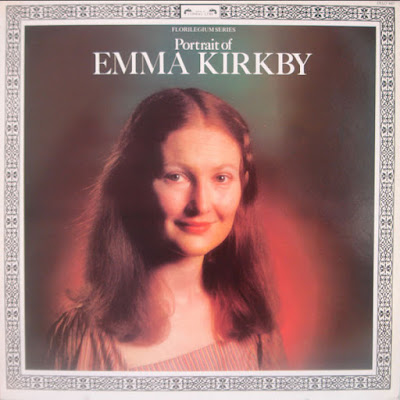

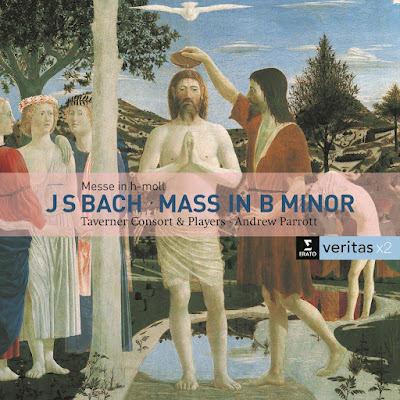

-
Subscribe
Subscribed
Already have a WordPress.com account? Log in now.
 Zach Uram's Blog