-
A Defense of Western Christian Colonialism
Much has been asserted in recent years by revisionist historians and neo-Marxist activists claiming the Western colonization of the New World (primarily South America and Central America) and Africa was a great act of evil that brought only unwanted misery and terror.
Such superficial and sensationalistic claims are easily refuted using actual history and sound reasoning.
The truth is that the Western colonization of the world (Africa, the New World, etc.) brought about an enormous amount of good. I’d argue that the net good far outweighed the negatives. In Africa, the native tribes had no scientific or mathematical knowledge to speak of for thousands of years. It had no great cities. Egyptians are not black-skinned Africans, yet black activists continue to claim the Egyptian civilization as its own accomplishment. In fact, in over 1,900 years Africa did not produce so much as a two-story building. It had no great literary or musical achievements. It was economically a subsistence primitive agrarian level. In fact, civilization was at a standstill in Africa for thousands of years with no great universities or centers of learning (not Greek, Roman, or Egyptian; I’m talking about the achievements of native black-skinned African people). Within 50, 100, 200, or 300 years of the Western colonization of Africa, they became transformed into a level of education, commerce, farming, higher education, medicine, technology, military, the arts, music, literature, philosophy, biology, architecture, and the sciences which were undreamed of in centuries past. Millions of lives were saved.
The much balleyhoed cultural imperialism is a myth. The best of Western culture was gifted to Africa and the New World, whilst the natives still preserved their own vibrant cultures and unique expressions which continue to the present day.
But thus far I’ve been speaking of pragmatic and materialistic considerations. The greatest achievement, the great gift the West gave to the New World and Africa was the Christian faith. Today there is still religious fighting in Africa, but the horrific seemingly neverending great tribal wars have ended. And the sporadic cases of violence we see today in Africa are nearly 100% due to radical Islam. Through the direct efforts of the Colonizers, God used them in a mighty way to spread the Gospel where before was only darkness, spiritual blindness, pagan superstitions, animism, witchcraft, ancestor worship, and voodoo.
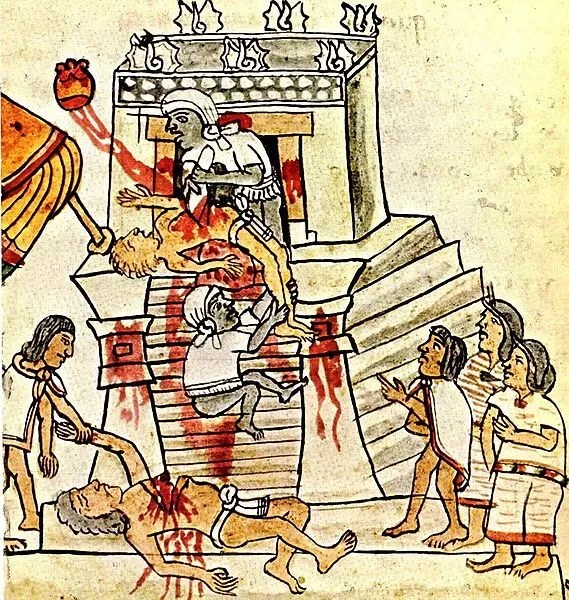
In South America and Central America the bloody Aztec empire slaughtered millions of innocent people in its pagan blood lust.
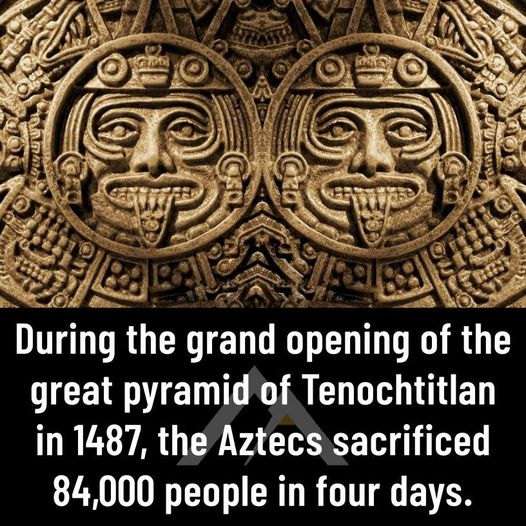
For all the problems of the Spanish Conquistadors, and they did have issues, their putting an end to the brutal ritual of human sacrifice of the Aztecs was a very good thing.
Not all cultures or civilizations are equal. Not all religions are equal. Christianity is the only religion that is true. All those following other religions are damned. This is opposed to the politically correct view which enshrines diversity and equality as fundamental truths. By literally dozens of metrics Western society was and is superior to the pagan and primitive societies they replaced.
Again, let me be clear of one fact: the culture and civilization of Africa and the New World was vastly inferior (to a very, very large degree) to that of the West by virtually any way you could measure it.
These colonized nations should thank God and be appreciative of all that the colonizers gave them. The Gospel pulled them out of the darkness. Their level of education, literacy, medicine, technology, scientific and industrial knowledge, music, literature, the arts, and many more things all improved dramatically.
apologetics, archaeology, Bible, blacks, Christian theology, Christianity, global, history, islam, popular culture, Protestant, Reformed, Roman, science, South America, The West, theology, whitesAfrica, Africans, ancestor worship, animism, blacks, Caucasian, Central America, civilizations, colonialism, cultural, cultural Marxism, culture, dark-skinned, history, inferiority, islam, measures, metrics, New World, revisionist history, societies, South America, superiority, The West, tribal warfare, tribes, voodoo, Western civilization, Western culture, white, witchcraft -
Christ the King
Hail Christ the King
The Lord of Lords
It is His praises I singBorn in a humble manger so small
He would redeem man
From the curse of the FallHe is fully God and fully man
Because of love
He enacted the Father’s planMan was lost in sin
We needed a Savior to ransom us
A holy propitiationChrist came to save
Those who would repent and believe
To sin we would no longer be a slave“It is finished!” He cried
And thus Christ gave up His life
The God Man had diedWas that rugged cross of Calvary the end
Was the Son of Man no more
The Apostles were frightenedOn the third day you see
No longer held captive by death
Christ was set freeJesus rose from the grave
Oh glorious event
Man He would now be able to saveHe reigns supreme over all
The Alpha and Omega
Before Christ seraphim do fallSo repent and trust in Christ alone today
We are saved by God’s sovereign grace
I implore you to follow Christ, He is the Wayby Zachary Uram
(c) 2023 -
Daycare: American Dream or Dystopian Nightmare

One of the most destructive things to negatively impact the family in modern times has been the enormously popular trend of parents having their children raised in daycare, instead of the traditional model where the husband works and the mother is a full-time stay-at-mom who tends to her children’s development with nurturing, care, love, attention, and discipline. All of these critical qualities are severely lacking in even the best daycare centers.
Parents warehouse their children here for 10-16 hours per day. The children are being paid by largely unskilled, unmotivated, minimum wage (or slightly higher) workers who are overburdened caring for dozens of kids and are stressed out. This toxic scenario is hardly the ideal environment for a child during its most formative and impressionable years. It is critical that parents bond with their children in these early years, and especially so for the bonding between mother and child.
It’s also critical that children receive proper discipline and structure. Scripture commands the use of corporal punishment, and it’s illegal to employ it in daycare centers.
This environment can create a perfect storm of factors that negatively affect a child’s early childhood development. This early development (cognitive, physical, social emotional, and spiritual) we know is super critical to a child’s overall well-being and future health. Most children who have this excellent early childhood development grow up to be responsible, moral, law-abiding, and productive members of society who eschew hedonism, alcohol, and drug abuse.
We have literally tens of millions of kids who have spent 10-16 hours every day in daycare because both parents are working full-time! I thank God my father worked so hard and put in 16-18 hour days at work so Mommy could be a full-time stay-at-home Mom. Children are now being raised by strangers during their most formative years who could care less about them!! It’s awful! There is no way some daycare employee is going to nurture, love, teach and support a child the way their mother would!
Economics plays a huge role in this phenomenon. Up until the 1970s daycare was unheard of. Some women had part-time jobs and if they were away from home a trusted family member would watch their job. But that was a very small minority of cases. In the 20-year period between 1980-2000, the number of daycares that opened was astronomical! And further, if you look at the past 20 years the numbers are even more shocking. It’s so bad that now a majority of American kids are being raised in daycare. The elephant in the room is the fact that these children are suffering because their mothers choose to have a career and put a certain higher level of material comfort over the needs of their families. The rise in feminism perfectly correlates with the rise in daycare.
Women are brainwashed by their parents and public schools that they must go to university and get a career. For 50 years now we’ve seen the results of this social experiment and the fruits are very bitter. There are many cases where the mother could be a stay-at-home Mom if her husband and her cut back dramatically on expenses. They don’t need a $200,000 to $400,000 home, a $60,000 SUV, or $80,000 truck, or expensive vacations, or expensive jewelry, a new wardrobe every few years, or eating out at restaurants every week.
There are so many things that are non-essential luxuries, yet many have convinced themselves if they wish to achieve the American Dream these material comforts are essential. I know that these parents love their children, yet they are trapped and have been conditioned to believe certain things which aren’t true.
Another thing to consider is: daycare (even the cheapest) is expensive. I once saw a report by an economist that said if you calculate the cost of daycare that would be saved if the mother was a stay-at-home Mom and coupled it with the tax savings, in many cases, it was actually better economically to have the mother not work, or it would have been about the same cost savings. So the line that most mothers absolutely must work is a total fabrication!
Sadly, I must also note that ever year many children in daycare are physically or sexually abused.
Looking back at my childhood, I am so very thankful for my parents making sacrifices and working so hard for my sisters and I. Having Mommy at home was a huge blessing. We may not have had the best house, car, or been able to take luxury vacations, but we had lots of love and are to this day a very closeknit family!
America, Bible, Christian theology, Christianity, daycare, economics, feminism, government, history, law, marriage, womenabuse, America, American Dream, bonding, child abuse, children, daycare, decline of the West, discipline, downsizing, dystopian, early childhood, early childhood development, economics, family, guidance, hedonism, kids, love, luxuries, material comfort, materialism, nightmare, nuture, parents, psychology, sexual abuse, structure, tax law, taxes, The West -
Sinners in the Hands of an Angry God
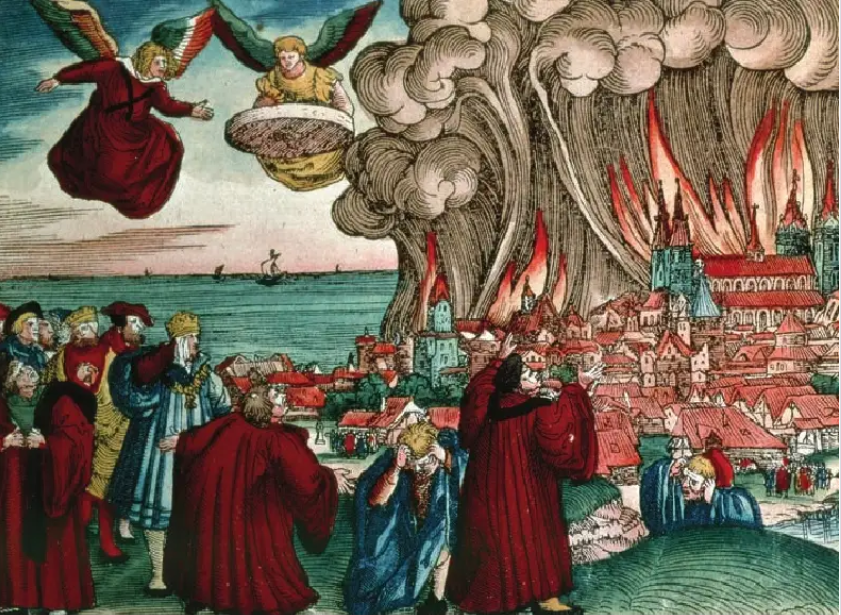
Babylon Burning. From the Apocalypse of Saint John
(Revelations 18). Luther Bible, First Edition. 1530. Private collection. Photo © Art Resource, New York.Introduction
“Sinners in the Hands of an Angry God” is a sermon written by the American theologian Jonathan Edwards, preached to his own congregation in Northampton, Massachusetts, to profound effect, and again on Wednesday, July 8, 1741, in Enfield, Connecticut. The preaching of this sermon was a great catalyst for the ongoing [First] Great Awakening (1730-1755 a period of religious fervor and widespread revival; many people repented and trusted in Christ alone).
Jonathan Edwards delivered this sermon to the congregation at the 2nd Meeting House in Enfield.
It is arguably the most famous sermon in American history. Its author, Puritan pastor and scholar, Jonathan Edwards, is considered by many historians – both religious and secular – to be the greatest philosopher and theologian the nation has ever produced.
Background
Wednesday, July 8, 1741. It was some 7 years after Edwards had witnessed the first wave of revival in the town where he pastored in Northampton, Massachusetts. By ’41 the Great Awakening, as we now call it, had spread far and wide throughout the New England states.
That afternoon Edwards began to preach his famous sermon at the second meetinghouse in the town of Enfield, Massachusetts. (Today, it is Enfield, Connecticut, after the town seceded from Massachusetts in 1749.) It was not the first time he had preached the sermon, but the results on this particular occasion were extraordinary.
Until that day it seems that Enfield had been considered a spiritual dry spot. Neighboring towns, like Suffield, had seen great religious fervor, but Enfield remained unaffected. Several concerned clergies began traveling to the town, and eventually, Jonathan Edwards himself made his visit.
Edwards was a powerful preacher on account of the tremendous content of his sermons. He was not known for being very demonstrative, but rather his presence in the pulpit was reportedly characterized by “a powerful sense of restraint, authority, and discipline.” Several sources describe how he often appeared to fixhis eyes on the back wall of the church as he spoke, and that he did not seem to veer away from his prepared manuscript.Historical Witness
An eyewitness. Rev. Stephen Williams of Longmeadow, Massachusetts, was in attendance that day in Enfield, and he recorded what happened:
“… before the sermon was done there was a great moaning and crying through the whole House, ‘what shall I do to be saved’ — ‘oh, I am going to Hell’ — ‘oh,
what shall I do for Christ’, and so on, so that the minister was obliged to desist, the shrieks and cries were piercing and amazing — after some time of waiting, the
congregation were still, so that a prayer was made by Mr. W. and after that we descended from the pulpit and discoursed with the people — some in one place and some in another — and amazing and astonishing the power of God was seen — and several souls were hopefully wrought upon that night, and oh the cheerfulness and pleasantness of their countenances that received comfort — oh that God would strengthen and confirm — we sung a hymn and prayed and dismissed the Assembly.“Analysis
We have often heard this sermon discussed, and usually, it is dismissed as a quaint product of its Puritan era. The inference is always that we live in “more enlightened times”, and that beyond its literary value, Sinners has little to say to us. But I would ask you to consider this. This sermon was written and preached in the revival fires of the Great Awakening; a visitation of God that changed the very social fabric of America. The fact that God the Holy Spirit saw fit to bless the delivery of this particular sermon with an extraordinary attendance of convicting power is
beyond dispute. Furthermore, nothing Edwards preached here is out of harmony with the Bible’s clear teaching on Divine wrath and eternal punishment. God would not have so wonderfully attested to what is not true. And if it was true then, it is true today, for God does not change (Malachi 3:6).Hell is real. The poor souls that Edwards referred to as being at that time, in 1741, in the torments of hell are still there! Their sentence, in fact, has still only just begun, and the horror of that should haunt us. If we do not have the assurance that we are saved by God’s grace through faith in His Son, Jesus Christ, then it should cause us not to rest until we’ve found such peace with God. If we do possess assurance of salvation, the images in this sermon should drive us to seek to win souls above every other priority in our lives.
This sermon was used providentially during the height of the [First] Great Awakening to open the minds and hearts of many to the reality of God’s existence and the fierceness of his coming judgment. With vivid imagery of Hell, combined with observations of the world and citations of the Scriptures, Edwards like a skilled surgeon exposes the problem of man (sin), the future state of a man dying in his sins (Hell), and the Person who can save him from this miserable and terrifying fate (Christ). By pressing unrelentingly, Edwards warns of the horrors of hell, describes man’s natural state of total depravity, and describes Hell’s torments in graphic language. He did so, prodding his listeners to flee the coming wrath and run to Christ. At the same time, it was also an appeal to man’s need for salvation and a reminder of the agonies that awaited the unreformed. Edwards read the sermon, as he always did, in a composed style, with few gestures or movements. However, the sermon had a dramatic effect on his parishioners, many of whom wept and moaned.
The sermon emphasizes the belief that Hell is a real place. This belief was widespread in Edwards’ time, yet is much less popular today sadly even among professing Christians. Edwards hoped that the imagery and language of his sermon would awaken audiences to the horrific reality that he believed awaited them should they continue without calling on Christ to be saved. The main point is that God has given humanity a chance to sincerely repent and trust in Christ alone. Edwards says that it is the mere will of God that keeps men from the depths of Hell. This act of restraint has given humanity a chance to mend their ways and return to Christ.
This sermon is the best-known and influential written work of Jonathan Edwards, a preeminent pastor, and theologian. It’s a fitting representation of his preaching style and is widely studied by Christians and historians, providing a glimpse into the theology of the [First] Great Awakening. Edwards is regarded by many learned men to be the greatest theologian America has ever produced. the homily was at once regarded by many as the greatest ever given on American soil and vehemently attacked by others as puritanical “fire and brimstone.” It made a profound and lasting impact on American Christianity.
I believe this type of honest exposition of God’s Word, with vivid imagery, coupled with emotional content to impress upon the sinner the urgent need for a Savior and the horrific torments which await them in Hell should they die apart from Christ is very effective and very much needed in today’s preaching. Far too many pastors are afraid to be as blunt and honest as Edwards is in this sermon.
Scripture says that:
The fear of the Lord is the beginning of wisdom; all those who practice it have a good understanding. His praise endures forever.
Psalm 111:10And Christ Himself says:
And do not fear those who kill the body but cannot kill the soul. But rather fear Him who is able to destroy both soul and body in Hell.
Matthew 10:28Markers
Note: While the second Meetinghouse no longer exists, its location is marked by an engraved stone on the west side of Route 5 (Enfield Street), just a few feet south of the intersection with Post Office Road.
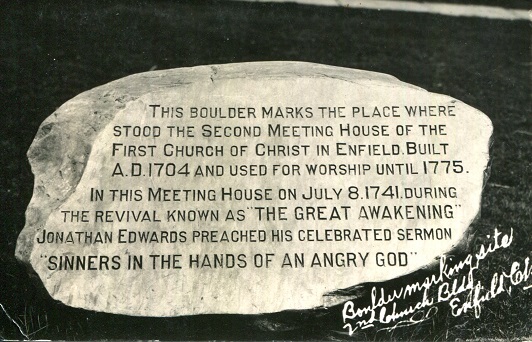
The site of the Second Meetinghouse of the First Ecclesiastical Society is marked by a monument that was installed by the Penelope Terry Abbey Chapter of the Daughters of the American Revolution in 1931 as part of the celebration of the 250th anniversary of Enfield’s founding. This postcard shows the monument, which commemorates both the meetinghouse and Jonathan Edwards’ Sinners in the Hands of an Angry God sermon that was preached there. 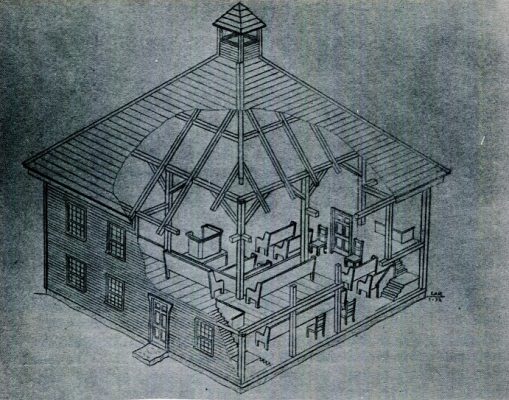
No images exist of the meetinghouse where Jonathan Edwards preached his Sinners in the Hands of an Angry God sermon. This drawing from A History of God’s Standing Order Church in Enfield 1680-1973 is a best-guess at what it may have looked like based on church records and typical meeting house construction when it was built (1706-1707). Records indicate that the building was 38 feet square, two stories tall, with a small belfry, although no bell was ever installed. It was located in the middle of Enfield Street just at or south of the intersection with Post Office Road. Ebook Format Available
You can download the text in PDF, ePub, or MOBI (Kindle) format here.
The Text
Sinners in the Hands of an Angry God
Given July 8, 1741 at Enfield, Connecticut
“Their foot shall slide in due time”
Deuteronomy 32:35In this verse is threatened the vengeance of God on the wicked unbelieving Israelites, who were God’s visible people, and who lived under the means of grace; but who, notwithstanding all God’s wonderful works towards them, remained (as vers 28.) void of counsel, having no understanding in them. Under all the cultivations of heaven, they brought forth bitter and poisonous fruit; as in the two verses next preceding the text. — The expression I have chosen for my text, their foot shall slide in due time, seems to imply the following things, relating to the punishment and destruction to which these wicked Israelites were exposed.
- That they were always exposed to destruction; as one that stands or walks in slippery places is always exposed to fall. This is implied in the manner of their destruction coming upon them, being represented by their foot sliding. The same is expressed, Psalm 72:18. “Surely thou didst set them in slippery places; thou castedst them down into destruction.”
- It implies, that they were always exposed to sudden unexpected destruction. As he that walks in slippery places is every moment liable to fall, he cannot foresee one moment whether he shall stand or fall the next; and when he does fall, he falls at once without warning: Which is also expressed in Psalm 73:18,19. “Surely thou didst set them in slippery places; thou castedst them down into destruction: How are they brought into desolation as in a moment!”
- Another thing implied is, that they are liable to fall of themselves, without being thrown down by the hand of another; as he that stands or walks on slippery ground needs nothing but his own weight to throw him down.
- That the reason why they are not fallen already and do not fall now is only that God’s appointed time is not come. For it is said, that when that due time, or appointed time comes, their foot shall slide. Then they shall be left to fall, as they are inclined by their own weight. God will not hold them up in these slippery places any longer, but will let them go; and then, at that very instant, they shall fall into destruction; as he that stands on such slippery declining ground, on the edge of a pit, he cannot stand alone, when he is let go he immediately falls and is lost.
The observation from the words that I would now insist upon is this. — “There is nothing that keeps wicked men at any one moment out of hell, but the mere pleasure of God.” — By the mere pleasure of God, I mean his sovereign pleasure, his arbitrary will, restrained by no obligation, hindered by no manner of difficulty, any more than if nothing else but God’s mere will had in the least degree, or in any respect whatsoever, any hand in the preservation of wicked men one moment. — The truth of this observation may appear by the following considerations.
- There is no want of power in God to cast wicked men into hell at any moment. Men’s hands cannot be strong when God rises up. The strongest have no power to resist him, nor can any deliver out of his hands. — He is not only able to cast wicked men into hell, but he can most easily do it. Sometimes an earthly prince meets with a great deal of difficulty to subdue a rebel, who has found means to fortify himself, and has made himself strong by the numbers of his followers. But it is not so with God. There is no fortress that is any defence from the power of God. Though hand join in hand, and vast multitudes of God’s enemies combine and associate themselves, they are easily broken in pieces. They are as great heaps of light chaff before the whirlwind; or large quantities of dry stubble before devouring flames. We find it easy to tread on and crush a worm that we see crawling on the earth; so it is easy for us to cut or singe a slender thread that any thing hangs by: thus easy is it for God, when he pleases, to cast his enemies down to hell. What are we, that we should think to stand before him, at whose rebuke the earth trembles, and before whom the rocks are thrown down?
- They deserve to be cast into hell; so that divine justice never stands in the way, it makes no objection against God’s using his power at any moment to destroy them. Yea, on the contrary, justice calls aloud for an infinite punishment of their sins. Divine justice says of the tree that brings forth such grapes of Sodom, “Cut it down, why cumbereth it the ground?” Luke 13:7. The sword of divine justice is every moment brandished over their heads, and it is nothing but the hand of arbitrary mercy, and God’s mere will, that holds it back.
- They are already under a sentence of condemnation to hell. They do not only justly deserve to be cast down thither, but the sentence of the law of God, that eternal and immutable rule of righteousness that God has fixed between him and mankind, is gone out against them, and stands against them; so that they are bound over already to hell. John 3:18. “He that believeth not is condemned already.” So that every unconverted man properly belongs to hell; that is his place; from thence he is, John 8:23. “Ye are from beneath:” And thither he is bound; it is the place that justice, and God’s word, and the sentence of his unchangeable law assign to him.
- They are now the objects of that very same anger and wrath of God, that is expressed in the torments of hell. And the reason why they do not go down to hell at each moment, is not because God, in whose power they are, is not then very angry with them; as he is with many miserable creatures now tormented in hell, who there feel and bear the fierceness of his wrath. Yea, God is a great deal more angry with great numbers that are now on earth: yea, doubtless, with many that are now in this congregation, who it may be are at ease, than he is with many of those who are now in the flames of hell. So that it is not because God is unmindful of their wickedness, and does not resent it, that he does not let loose his hand and cut them off. God is not altogether such an one as themselves, though they may imagine him to be so. The wrath of God bums against them, their damnation does not slumber; the pit is prepared, the fire is made ready, the fumace is now hot, ready to receive them; the flames do now rage and glow. The glittering sword is whet, and held over them, and the pit hath opened its mouth under them.
- The devil stands ready to fall upon them, and seize them as his own, at what moment God shall permit him. They belong to him; he has their souls in his possession, and under his dominion. The scripture represents them as his goods, Luke 11:12. The devils watch them; they are ever by them at their right hand; they stand waiting for them, like greedy hungry lions that see their prey, and expect to have it, but are for the present kept back. If God should withdraw his hand, by which they are restrained, they would in one moment fly upon their poor souls. The old serpent is gaping for them; hell opens its mouth wide to receive them; and if God should permit it, they would be hastily swallowed up and lost.
- There are in the souls of wicked men those hellish principles reigning, that would presently kindle and flame out into hell fire, if it were not for God’s restraints. There is laid in the very nature of carnal men, a foundation for the torments of hell. There are those corrupt principles, in reigning power in them, and in full possession of them, that are seeds of hell fire. These principles are active and powerful, exceeding violent in their nature, and if it were not for the restraining hand of God upon them, they would soon break out, they would flame out after the same manner as the same corruptions, the same enmity does in the hearts of damned souls, and would beget the same torments as they do in them. The souls of the wicked are in scripture compared to the troubled sea, Isa. 57:20. For the present, God restrains their wickedness by his mighty power, as he does the raging waves of the troubled sea, saying, “Hitherto shalt thou come, but no further;” but if God should withdraw that restraining power, it would soon carry all before it. Sin is the ruin and misery of the soul; it is destructive in its nature; and if God should leave it without restraint, there would need nothing else to make the soul perfectly miserable. The corruption of the heart of man is immoderate and boundless in its fury; and while wicked me live here, it is like fire pent up by God’s restraints, whereas if it were let loose, it would set on fire the course of nature; and as the heart is now a sink of sin, so if sin was not restrained, it would immediately turn the soul into fiery oven, or a furnace of fire and brimstone.
- It is no security to wicked men for one moment, that there are no visible means of death at hand. It is no security to a natural man, that he is now in health, and that he does not see which way he should now immediately go out of the world by any accident, and that there is no visible danger in any respect in his circumstances. The manifold and continual experience of the world in all ages, shows this is no evidence, that a man is not on the very brink of eternity, and that the next step will not be into another world. The unseen, unthought-of ways and means of persons going suddenly out of the world are innumerable and inconceivable. Unconverted men walk over the pit of hell on a rotten covering, and there are innumerable places in this covering so weak that they will not bear their weight, and these places are not seen. The arrows of death fly unseen at noon-day; the sharpest sight cannot discem them. God has so many different unsearchable ways of taking wicked men out of the world and sending them to hell, that there is nothing to make it appear, that God had need to be at the expense of a miracle, or go out of the ordinary course of his providence, to destroy any wicked man, at any moment. All the means that there are of sinners going out of the world, are so in God’s hands, and so universally and absolutely subject to his power and determination, that it does not depend at all the less on the mere will of God, whether sinners shall at any moment go to hell, than if means were never made use of, or at all concerned in the case.
- Natural men’s prudence and care to preserve their own lives, or the care of others to preserve them, do not secure them a moment. To this, divine providence and universal experience do also bear testimony. There is this clear evidence that men’s own wisdom is no security to them from death; that if it were otherwise we should see some difference between the wise and politic men of the world, and others, with regard to their liableness to early and unexpected death: but how is it in fact? Eccles. 2:16. “How dieth the wise man? even as the fool.”
- All wicked men’s pains and contrivande which they use to escape hell, while they continue to reject Christ, and so remain wicked men, do not secure them from hell one moment. Almost every natural man that hears of hell, flatters himself that he shall escape it; he depends upon himself for his own security; he flatters himself in what he has done, in what he is now doing, or what he intends to do. Every one lays out matters in his own mind how he shall avoid damnation, and flatters himself that he contrives well for himself, and that his schemes will not fail. They hear indeed that there are but few saved, and that the greater part of men that have died heretofore are gone to hell; but each one imagines that he lays out matters better for his own escape than others have done. He does not intend to come to that place of torment; he says within himself, that he intends to take effectual care, and to order matters so for himself as not to fail. But the foolish children of men miserably delude themselves in their own schemes, and in confidence in their own strength and wisdom; they trust to nothing but a shadow. The greater part of those who heretofore have lived under the same means of grace, and are now dead, are undoubtedly gone to hell; and it was not because they were not as wise as those who are now alive: it was not because they did not lay out matters as well for themselves to secure their own escape. If we could speak with them, and inquire of them, one by one, whether they expected, when alive, and when they used to hear about hell, ever to be the subjects of misery: we doubtless, should hear one and another reply, “No, I never intended to come here: I had laid out matters otherwise in my mind; I thought I should contrive well for myself — I thought my scheme good. I intended to take effectual care; but it came upon me unexpected; I did not look for it at that time, and in that manner; it came as a thief — Death outwitted me: God’s wrath was too quick for me. Oh, my cursed foolishness! I was flattering myself, and pleasing myself with vain dreams of what I would do hereafter; and when I was saying, Peace and safety, then sudden destruction came upon me.”
- God has laid himself under no obligation, by any promise to keep any natural man out of hell one moment. God certainly has made no promises either of eternal life, or of any deliverance or preservation from eternal death, but what are contained in the covenant of grace, the promises that are given in Christ, in whom all the promises are yea and amen. But surely they have no interest in the promises of the covenant of grace who are not the children of the covenant, who do not believe in any of the promises, and have no interest in the Mediator of the covenant.
So that, whatever some have imagined and pretended about promises made to natural men’s earnest seeking and knocking, it is plain and manifest, that whatever pains a natural man takes in religion, whatever prayers he makes, till he believes in Christ, God is under no manner of obligation to keep him a moment from eternal destruction.
So that, thus it is that natural men are held in the hand of God, over the pit of hell; they have deserved the fiery pit, and are already sentenced to it; and God is dreadfully provoked, his anger is as great towards them as to those that are actually suffering the executions of the fierceness of his wrath in hell, and they have done nothing in the least to appease or abate that anger, neither is God in the least bound by any promise to hold them up one moment; the devil is waiting for them, hell is gaping for them, the flames gather and flash about them, and would fain lay hold on them, and swallow them up; the fire pent up in their own hearts is struggling to break out: and they have no interest in any Mediator, there are no means within reach that can be any security to them. In short, they have no refuge, nothing to take hold of; all that preserves them every moment is the mere arbitrary will, and uncovenanted, unobliged forbearance of an incensed God.
Application
The use of this awful subject may be for awakening unconverted persons in this congregation. This that you have heard is the case of every one of you that are out of Christ. — That world of misery, that take of burning brimstone, is extended abroad under you. There is the dreadful pit of the glowing flames of the wrath of God; there is hell’s wide gaping mouth open; and you have nothing to stand upon, nor any thing to take hold of; there is nothing between you and hell but the air; it is only the power and mere pleasure of God that holds you up.
You probably are not sensible of this; you find you are kept out of hell, but do not see the hand of God in it; but look at other things, as the good state of your bodily constitution, your care of your own life, and the means you use for your own preservation. But indeed these things are nothing; if God should withdraw his hand, they would avail no more to keep you from falling, than the thin air to hold up a person that is suspended in it.
Your wickedness makes you as it were heavy as lead, and to tend downwards with great weight and pressure towards hell; and if God should let you go, you would immediately sink and swiftly descend and plunge into the bottomless gulf, and your healthy constitution, and your own care and prudence, and best contrivance, and all your righteousness, would have no more influence to uphold you and keep you out of hell, than a spider’s web would have to stop a falling rock. Were it not for the sovereign pleasure of God, the earth would not bear you one moment; for you are a burden to it; the creation groans with you; the creature is made subject to the bondage of your corruption, not willingly; the sun does not willingly shine upon you to give you light to serve sin and Satan; the earth does not willingly yield her increase to satisfy your lusts; nor is it willingly a stage for your wickedness to be acted upon; the air does not willingly serve you for breath to maintain the flame of life in your vitals, while you spend your life in the service of God’s enemies. God’s creatures are good, and were made for men to serve God with, and do not willingly subserve to any other purpose, and groan when they are abused to purposes so directly contrary to their nature and end. And the world would spew you out, were it not for the sovereign hand of him who hath subjected it in hope. There are the black clouds of God’s wrath now hanging directly over your heads, full of the dreadful storm, and big with thunder; and were it not for the restraining hand of God, it would immediately burst forth upon you. The sovereign pleasure of God, for the present, stays his rough wind; otherwise it would come with fury, and your destruction would come like a whirlwind, and you would be like the chaff of the summer threshing floor.
The wrath of God is like great waters that are dammed for the present; they increase more and more, and rise higher and higher, till an outlet is given; and the longer the stream is stopped, the more rapid and mighty is its course, when once it is let loose. It is true, that judgment against your evil works has not been executed hitherto; the floods of God’s vengeance have been withheld; but your guilt in the mean time is constantly increasing, and you are every day treasuring up more wrath; the waters are constantly rising, and waxing more and more mighty; and there is nothing but the mere pleasure of God, that holds the waters back, that are unwilling to be stopped, and press hard to go forward. If God should only withdraw his hand from the flood-gate, it would immediately fly open, and the fiery floods of the fierceness and wrath of God, would rush forth with inconceivable fury, and would come upon you with omnipotent power; and if your strength were ten thousand times greater than it is, yea, ten thousand times greater than the strength of the stoutest, sturdiest devil in hell, it would be nothing to withstand or endure it.
The bow of God’s wrath is bent, and the arrow made ready on the string, and justice bends the arrow at your heart, and strains the bow, and it is nothing but the mere pleasure of God, and that of an angry God, without any promise or obligation at all, that keeps the arrow one moment from being made drunk with your blood. Thus all you that never passed under a great change of heart, by the mighty power of the Spirit of God upon your souls; all you that were never bom again, and made new creatures, and raised from being dead in sin, to a state of new, and before altogether unexperienced light and life, are in the hands of an angry God. However you may have reformed your life in many things, and may have had religious affections, and may keep up a form of religion in your families and closets, and in the house of God, it is nothing but his mere pleasure that keeps you from being this moment swallowed up in everlasting destruction. However unconvinced you may now be of the truth of what you hear, by and by you will be fully convinced of it. Those that are gone from being in the like circumstances with you, see that it was so with them; for destruction came suddenly upon most of them; when they expected nothing of it, and while they were saying, Peace and safety: now they see, that those things on which they depended for peace and safety, were nothing but thin air and empty shadows.
The God that holds you over the pit of hell, much as one holds a spider, or some loathsome insect over the fire, abhors you, and is dreadfully provoked: his wrath towards you burns like fire; he looks upon you as worthy of nothing else, but to be cast into the fire; he is of purer eyes than to bear to have you in his sight; you are ten thousand times more abominable in his eyes, than the most hateful venomous serpent is in ours. You have offended him infinitely more than ever a stubborn rebel did his prince; and yet it is nothing but his hand that holds you from falling into the fire every moment. It is to be ascribed to nothing else, that you did not go to hell the last night; that you was suffered to awake again in this world, after you closed your eyes to sleep. And there is no other reason to be given, why you have not dropped into hell since you arose in the morning, but that God’s hand has held you up. There is no other reason to be given why you have not gone to hell, since you have sat here in the house of God, provoking his pure eyes by your sinful wicked manner of attending his solemn worship. Yea, there is nothing else that is to be given as a reason why you do not this very moment drop down into hell.
O sinner! Consider the fearful danger you are in: it is a great furnace of wrath, a wide and bottomless pit, full of the fire of wrath, that you are held over in the hand of that God, whose wrath is provoked and incensed as much against you, as against many of the damned in hell. You hang by a slender thread, with the flames of divine wrath flashing about it, and ready every moment to singe it, and burn it asunder; and you have no interest in any Mediator, and nothing to lay hold of to save yourself, nothing to keep off the flames of wrath, nothing of your own, nothing that you ever have done, nothing that you can do, to induce God to spare you one moment. — And consider here more particularly,
- Whose wrath it is: it is the wrath of the infinite God. If it were only the wrath of man, though it were of the most potent prince, it would be comparatively little to be regarded. The wrath of kings is very much dreaded, especially of absolute monarchs, who have the possessions and lives of their subjects wholly in their power, to be disposed of at their mere will. Prov. 20:2. “The fear of a king is as the roaring of a lion: Whoso provoketh him to anger, sinneth against his own soul.” The subject that very much enrages an arbitrary prince, is liable to suffer the most extreme torments that human art can invent, or human power can inflict. But the greatest earthly potentates in their greatest majesty and strength, and when clothed in their greatest terrors, are but feeble, despicable worms of the dust, in comparison of the great and almighty Creator and King of heaven and earth. It is but little that they can do, when most enraged, and when they have exerted the utmost of their fury. All the kings of the earth, before God, are as grasshoppers; they are nothing, and less than nothing: both their love and their hatred is to be despised. The wrath of the great King of kings, is as much more terrible than theirs, as his majesty is greater. Luke 12:4,5. “And I say unto you, my friends, Be not afraid of them that kill the body, and after that, have no more that they can do. But I will forewarn you whom you shall fear: fear him, which after he hath killed, hath power to cast into hell: yea, I say unto you, Fear him.“
- It is the fierceness of his wrath that you are exposed to. We often read of the fury of God; as in Isa. 59:18. “According to their deeds, accordingly he will repay fury to his adversaries.” So Isa. 66:15. “For behold, the Lord will come with fire, and with his chariots like a whirlwind, to render his anger with fury, and his rebuke with flames of fire.” And in many other places. So, Rev. 19:15, we read of “the wine press of the fierceness and wrath of Almighty God.” The words are exceeding terrible. If it had only been said, “the wrath of God,” the words would have implied that which is infinitely dreadful: but it is “the fierceness and wrath of God.” The fury of God! The fierceness of Jehovah! Oh, how dreadful that must be! Who can utter or conceive what such expressions carry in them! But it is also “the fierceness and wrath of almighty God.” As though there would be a very great manifestation of his almighty power in what the fierceness of his wrath should inflict, as though omnipotence should be as it were enraged, and exerted, as men are wont to exert their strength in the fierceness of their wrath. Oh! then, what will be the consequence! What will become of the poor worms that shall suffer it! Whose hands can be strong? And whose heart can endure? To what a dreadful, inexpressible, inconceivable depth of misery must the poor creature be sunk who shall be the subject of this! Consider this, you that are here present, that yet remain in an unregenerate state. That God will execute the fierceness of his anger, implies, that he will inflict wrath without any pity. When God beholds the ineffable extremity of your case, and sees your torment to be so fastly disproportioned to your strength, and sees how your poor soul is crushed, and sinks down, as it were, into an infinite gloom; he will have no compassion upon you, he will not forbear the executions of his wrath, or in the least lighten his hand; there shall be no moderation or mercy, nor will God then at all stay his rough wind; he will have no regard to your welfare, nor be at all careful lest you should suffer too much in any other sense, than only that you shall not suffer beyond what strict justice requires. Nothing shall be withheld, because it is so hard for you to bear. Ezek. 8:18. “Therefore will I also deal in fury: mine eye shall not spare, neither will I have pity; and though they cry in mine ears with a loud voice, yet I will not hear them.” Now God stands ready to pity you; this is a day of mercy; you may cry now with some encouragement of obtaining mercy. But when once the day of mercy is past, your most lamentable and dolorous cries and shrieks will be in vain; you will be wholly lost and thrown away of God, as to any regard to your welfare. God will have no other use to put you to, but to suffer misery; you shall be continued in being to no other end; for you will be a vessel of wrath fitted to destruction; and there will be no other use of this vessel, but to be filled full of wrath. God will be so far from pitying you when you cry to him, that it is said he will only “laugh and mock,” Prov. 1:25,26,&c. How awful are those words, Isa. 63:3, which are the words of the great God. “I will tread them in mine anger, and will trample them in my fury, and their blood shall be sprinkled upon my garments, and I will stain all my raiment.” It is perhaps impossible to conceive of words that carry in them greater manifestations of these three things, viz. contempt, and hatred, and fierceness of indignation. If you cry to God to pity you, he will be so far from pitying you in your doleful case, or showing you the least regard or favour, that instead of that, he will only tread you under foot. And though he will know that you cannot bear the weight of omnipotence treading upon you, yet he will not regard that, but he will crush you under his feet without mercy; he will crush out your blood, and make it fly, and it shall be sprinkled on his garments, so as to stain all his raiment. He will not only hate you, but he will have you in the utmost contempt: no place shall be thought fit for you, but under his feet to be trodden down as the mire of the streets.
- The misery you are exposed to is that which God will inflict to that end, that he might show what that wrath of Jehovah is. God hath had it on his heart to show to angels and men, both how excellent his love is, and also how terrible his wrath is. Sometimes earthly kings have a mind to show how terrible their wrath is, by the extreme punishments they would execute on those that would provoke them. Nebuchadnezzar, that mighty and haughty monarch of the Chaldean empire, was willing to show his wrath when enraged with Shadrach, Meshach, and Abednego; and accordingly gave orders that the burning fiery furnace should be heated seven times hotter than it was before; doubtless, it was raised to the utmost degree of fierceness that human art could raise it. But the great God is also willing to show his wrath, and magnify his awful majesty and mighty power in the extreme sufferings of his enemies. Rom. 9:22. “What if God, willing to show his wrath, and to make his power known, endured with much long-suffering the vessels of wrath fitted to destruction?” And seeing this is his design, and what he has determined, even to show how terrible the unrestrained wrath, the fury and fierceness of Jehovah is, he will do it to effect. There will be something accomplished and brought to pass that will be dreadful with a witness. When the great and angry God hath risen up and executed his awful vengeance on the poor sinner, and the wretch is actually suffering the infinite weight and power of his indignation, then will God call upon the whole universe to behold that awful majesty and mighty power that is to be seen in it. Isa. 33:12-14. “And the people shall be as the burnings of lime, as thorns cut up shall they be burnt in the fire. Hear ye that are far off, what I have done; and ye that are near, acknowledge my might. The sinners in Zion are afraid; fearfulness hath surprised the hypocrites, ” &c. Thus it will be with you that are in an unconverted state, if you continue in it; the infinite might, and majesty, and terribleness of the omnipotent God shall be magnified upon you, in the ineffable strength of your torments. You shall be tormented in the presence of the holy angels, and in the presence of the Lamb; and when you shall be in this state of suffering, the glorious inhabitants of heaven shall go forth and look on the awful spectacle, that they may see what the wrath and fierceness of the Almighty is; and when they have seen it, they will fall down and adore that great power and majesty. Isa. 66:23,24. “And it shall come to pass, that from one new moon to another, and from one sabbath to another, shall all flesh come to worship before me, saith the Lord. And they shall go forth and look upon the carcasses of the men that have transgressed against me; for their worm shall not die, neither shall their fire be quenched, and they shall be an abhorring unto all flesh.”
- It is everlasting wrath. It would be dreadful to suffer this fierceness and wrath of Almighty God one moment; but you must suffer it to all eternity. There will be no end to this exquisite horrible misery. When you look forward, you shall see a long for ever, a boundless duration before you, which will swallow up your thoughts, and amaze your soul; and you will absolutely despair of ever having any deliverance, any end, any mitigation, any rest at all. You will know certainly that you must wear out long ages, millions of millions of ages, in wrestling and conflicting with this almighty merciless vengeance; and then when you have so done, when so many ages have actually been spent by you in this manner, you will know that all is but a point to what remains. So that your punishment will indeed be infinite. Oh, who can express what the state of a soul in such circumstances is! All that we can possibly say about it, gives but a very feeble, faint representation of it; it is inexpressible and inconceivable: For “who knows the power of God’s anger?“
How dreadful is the state of those that are daily and hourly in the danger of this great wrath and infinite misery! But this is the dismal case of every soul in this congregation that has not been bom again, however moral and strict, sober and religious, they may otherwise be. Oh that you would consider it, whether you be young or old! There is reason to think, that there are many in this congregation now hearing this discourse, that will actually be the subjects of this very misery to all eternity. We know not who they are, or in what seats they sit, or what thoughts they now have. It may be they are now at ease, and hear all these things without much disturbance, and are now flattering themselves that they are not the persons, promising themselves that they shall escape. If we knew that there was one person, and but one, in the whole congregation, that was to be the subject of this misery, what an awful thing would it be to think of! If we knew who it was, what an awful sight would it be to see such a person! How might all the rest of the congregation lift up a lamentable and bitter cry over him! But, alas! instead of one, how many is it likely will remember this discourse in hell? And it would be a wonder, if some that are now present should not be in hell in a very short time, even before this year is out. And it would be no wonder if some persons, that now sit here, in some seats of this meeting-house, in health, quiet and secure, should be there before tomorrow morning. Those of you that finally continue in a natural condition, that shall keep out of hell longest will be there in a little time! your damnation does not slumber; it will come swiftly, and, in all probability, very suddenly upon many of you. You have reason to wonder that you are not already in hell. It is doubtless the case of some whom you have seen and known, that never deserved hell more than you, and that heretofore appeared as likely to have been now alive as you. Their case is past all hope; they are crying in extreme misery and perfect despair; but here you are in the land of the living and in the house of God, and have an opportunity to obtain salvation. What would not those poor damned hopeless souls give for one day’s opportunity such as you now enjoy!
And now you have an extraordinary opportunity, a day wherein Christ has thrown the door of mercy wide open, and stands in calling and crying with a loud voice to poor sinners; a day wherein many are flocking to him, and pressing into the kingdom of God. Many are daily coming from the east, west, north and south; many that were very lately in the same miserable condition that you are in, are now in a happy state, with their hearts filled with love to him who has loved them, and washed them from their sins in his own blood, and rejoicing in hope of the glory of God. How awful is it to be left behind at such a day! To see so many others feasting, while you are pining and perishing! To see so many rejoicing and singing for joy of heart, while you have cause to mourn for sorrow of heart, and howl for vexation of spirit! How can you rest one moment in such a condition? Are not your souls as precious as the souls of the people at Suffield, where they are flocking from day to day to Christ?
Are there not many here who have lived long in the world, and are not to this day born again? and so are aliens from the commonwealth of Israel, and have done nothing ever since they have lived, but treasure up wrath against the day of wrath? Oh, sirs, your case, in an especial manner, is extremely dangerous. Your guilt and hardness of heart is extremely great. Do you not see how generaity persons of your years are passed over and left, in the present remarkable and wonderful dispensation of God’s mercy? You had need to consider yourselves, and awake thoroughly out of sleep. You cannot bear the fierceness and wrath of the infinite God. — And you, young men, and young women, will you neglect this precious season which you now enjoy, when so many others of your age are renouncing all youthful vanities, and flocking to Christ? You especially have now an extraordinary opportunity; but if you neglect it, it will soon be with you as with those persons who spent all the precious days of youth in sin, and are now come to such a dreadful pass in blindness and hardness. — And you, children, who are unconverted, do not you know that you are going down to hell, to bear the dreadful wrath of that God, who is now angry with you every day and every night? Will you be content to be the children of the devil, when so many other children in the land are converted, and are become the holy and happy children of the King of kings?
And let every one that is yet out of Christ, and hanging over the pit of hell, whether they be old men and women, or middle aged, or young people, or little children, now hearken to the loud calls of God’s word and providence. This acceptable year of the Lord, a day of such great favour to some, will doubtless be a day of as remarkable vengeance to others. Men’s hearts harden, and their guilt increases apace at such a day as this, if they neglect their souls; and never was there so great danger of such persons being given up to hardness of heart and blindness of mind. God seems now to be hastily gathering in his elect in all parts of the land; and probably the greater part of adult persons that ever shall be saved, will be brought in now in a little time, and that it will be as it was on the great out-pouring of the Spirit upon the Jews in the apostles’ days; the election will obtain, and the rest will be blinded. If this should be the case with you, you will eternally curse this day, and will curse the day that ever you was born, to see such a season of the pouring out of God’s Spirit, and will wish that you had died and gone to hell before you had seen it. Now undoubtedly it is, as it was in the days of John the Baptist, the axe is in an extraordinary manner laid at the root of the trees, that every tree which brings not forth good fruit, may be hewn down and cast into the fire.
Therefore, let every one that is out of Christ, now awake and fly from the wrath to come. The wrath of Almighty God is now undoubtedly hanging over a great part of this congregation. Let every one fly out of Sodom: “Haste and escape for your lives, look not behind you, escape to the mountain, lest you be consumed.”
-
A Primer on Salvation
Does man have free choice as it pertains to salvation?
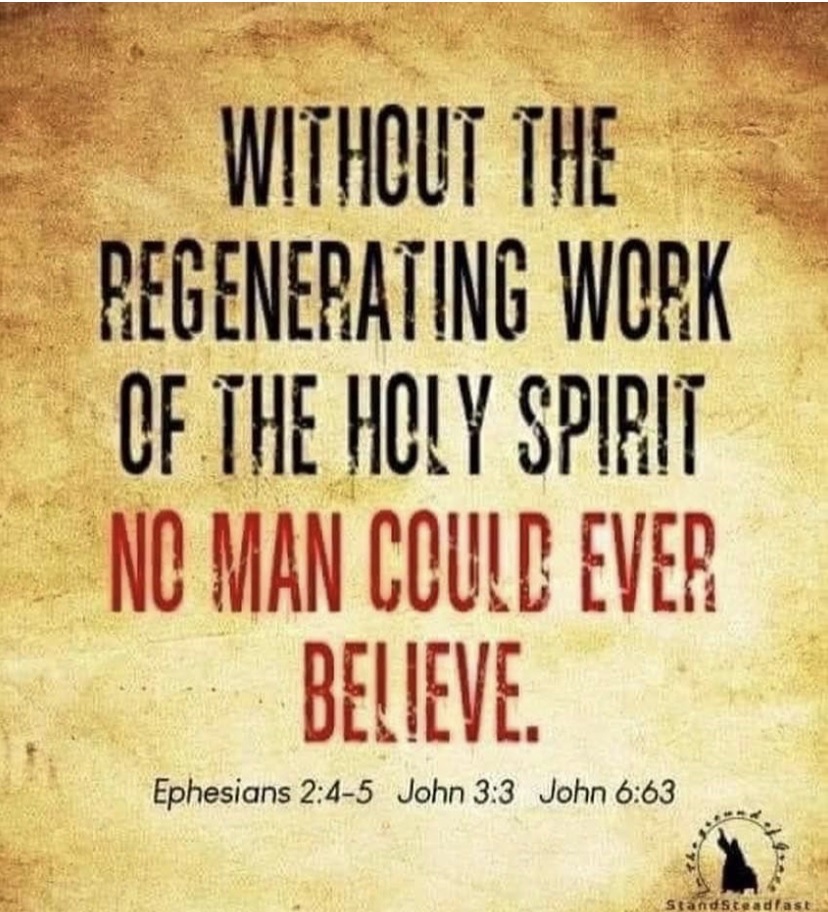
I believe a careful study of Scripture will reveal that man has the ability to make choices, yet we are not totally free in our moral agency. This is due to the fact that the natural man, before he is saved, is spiritually dead and is thus limited in the degrees of freedom he has. He is a slave to his nature which is wholly sinful. He cannot make certain choices, such as choosing Christ, in this fallen sinful state. Due to total depravity man’s will is only free to choose evil.
Imagine a prisoner locked in a cell. Within the cell (his moral nature) he can make real choices that are free, he can pace the floor, read a book, or whistle a tune. However he cannot walk outisde the cell. His nature (the cell) traps him inside and prevents him from making certain choices. So too are we dead in our sinful nature and can act only according to that nature, in other words, we can only choose the actions which our nature permits.

And you were dead in your trespasses and sins,
Ephesians 2:1even when we were dead in our transgressions, made us alive together with Christ (by grace you have been saved),
Ephesians 2:5When you were dead in your transgressions and the uncircumcision of your flesh, He made you alive together with Him, having forgiven us all our transgressions,
Colossians 2:13For the mind set on the flesh is death, but the mind set on the Spirit is life and peace,
Romans 8:6If Christ is in you, though the body is dead because of sin, yet the spirit is alive because of righteousness.
Romans 8:10It’s like expecting a dead man on the operating theatre to jump up and dance an Irish jig. It’s not going to happen unless the heart is shocked back to life. Without God’s sovereign grace selecting us (predestined at the foundation of the world) and quickening spiritual life into our dead soul thus regeneration us, we would remain spiritually lost.
The natural man has a heart of stone. When we are saved we’re given a heart of flesh.
And I will give you a new heart, and a new spirit I will put within you. And I will remove the heart of stone from your flesh and give you a heart of flesh.
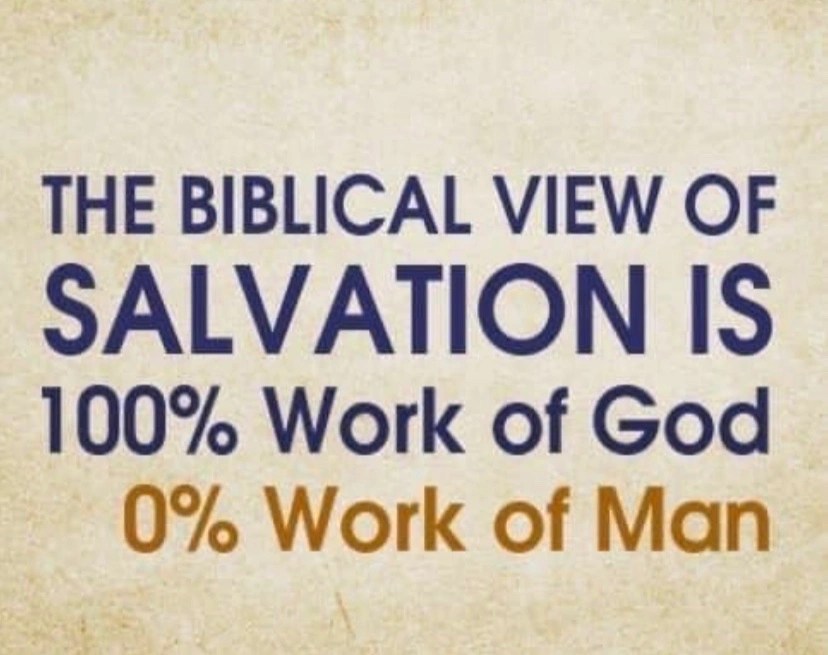
Ezekiel 36:26Salvation is a monergistic process, it occurs solely through the work of God. Some such as Orthodox, Catholics, and Arminian Protestants assert that salvation is a synergistic process of man and God working together. This is utter heresy and is condemned by Scripture. This semi-Pelagian belief that man has a share in his salvation contradicts Scripture which is clear that man is spiritually dead in his trespasses and unable to choose God.

All that the Father gives me will come to me, and whoever comes to me I will never cast out.
John 6:37No one can come to me unless the Father who sent me draws him. And I will raise him up on the last day.
John 6:44For by grace you have been saved through faith. And this is not your own doing; it is the gift of God, not a result of works, so that no one may boast.
Ephesians 2:8-9God’s sovereign grace which regenerates a man is irresistible. Imagine a person who nearly drowned and is on the beach hanging between life and death. The lifeguard alone can save their life, and when he begins working on the person this is irresistible. So too does the Holy Spirit move when quickening a man.
This doesn’t mean a person is saved kicking and screaming against their will. God conditions them and works a miracle giving them a new heart which is receptive to faith which is a gift. Regeneration always precedes faith.
“To say that we are able by our own efforts to think good thoughts or give God spiritual obedience before we are spiritually regenerate is to overthrow the gospel and the faith of the universal church in all ages.” – John Owen

even as he chose us in him before the foundation of the world, that we should be holy and blameless before him. In love he predestined us for adoption to himself as sons through Jesus Christ, according to the purpose of his will,
Ephesians 1:4-5So then it depends not on human will or exertion, but on God, who has mercy.
Romans 9:16These passages clearly indicate that God chose certain people, the Elect, for salvation prior even to the creation of the universe! This process was wholly independent of their merits, abilities, or any other intrinsic metric. These verses suggest salvation is the result of a “single force”: a mono-ergon. That single force is God, the one and only person responsible for salvation!
Here are some excellent essays on monergistic regeneration.
I found this excellent sermon which portrays vividly monergism at work in the example of the maid raised to life from death by Jesus:
SALVATION IS MONERGISTIC by Dr. R. L. Hymers, Jr. A sermon preached on Lord’s Day Evening, March 6, 2005
at the Baptist Tabernacle of Los Angeles “And he put them all out, and took her by the hand, and called, saying, Maid, arise. And her spirit came again, and she arose straightway: and he commanded to give her meat” (Luke 8:54-55).Matthew, Mark and Luke all record this miracle. When Jesus returned from Gadara on the other side of the Sea of Galilee, great throngs of people gathered around Him. There were two people in the crowd that were in desperate need. One was a woman who had an issue of blood for twelve years. The other was a man named Jairus, whose twelve year old daughter was dying in bed back home. Jesus began to talk with this man about going to his house to heal his daughter. In the meantime, the woman with an issue of blood reached out through the crowd and touched Him. She was healed immediately. Jesus stopped talking with this man Jairus about his daughter, and turned around to have a conversation with the woman who had been healed. While he was speaking to the woman, someone came from Jairus’ house and whispered to him that his daughter had already died. The man told Jairus,
“Thy daughter is dead; trouble not the Master” (Luke 8:49).
But Jairus was insistent. Matthew tells us that he said to Jesus,
“My daughter is even now dead: but come and lay thy hand upon her, and she shall live” (Matthew 9:18).
Jesus went with Jairus to his house. A crowd of people were outside weeping and wailing over her death. Jesus said,
“Weep not; she is not dead, but sleepeth” (Luke 8:52).
They stopped weeping and actually laughed at Him. They knew she was dead. She had already been dead for some time before He got there.
Jesus put them all out of the house. But Mark adds a detail. Peter and James and John, and the dead girl’s parents remained in the room.
“But when he had put them all out, he taketh the father and the mother of the [girl], and them that were with him, and entered in where the [girl] was lying” (Mark 5:40).
Jesus had put all those who were weeping and wailing out of the house, and went in with Peter, James, John, and the girl’s parents, to the room where her dead body was lying.
“And he put them all out, and took her by the hand, and called, saying, Maid [girl], arise. And her spirit came again, and she arose straightway [right away]: and he commanded to give her meat. And her parents were astonished; but he charged them that they should tell no man what was done” (Luke 8:54-56).
I think there are certain very valuable lessons we can learn from this miracle that will not only help you to be converted, if you are lost, but will also help those who are doing evangelism, bringing in lost people to hear the gospel preached, as many of you are laboring to do.
I. First, consider the purpose of this miracle.
It was obviously a miracle, and a very great one. The girl was certainly dead by the time Jesus got there. Her body was probably already washed and prepared in a preliminary way for burial, at least to some extent. The Jews didn’t wait around like we do today. It was their custom to bury a dead body the same day it died. This is still done in many parts of the world, such as Central America, where my wife was born. That’s still the custom in Guatemala, El Salvador, and other parts of Central America. You don’t wait around because they often don’t have proper refrigeration to keep a dead body preserved for several days. This is also true in remote parts of China and Southeast Asia, and other parts of the Third World, like Africa. The fact that the mourners had already come to the house and were wailing and weeping outside, shows that they had time to get there, and the girl had been dead for some time before Jesus arrived on the scene.
What was the purpose of Jesus Christ in raising her from the dead? Many people died while Jesus was doing His ministry. Twice we are told that Jesus healed all that came to Him (Matthew 12:15; Matthew 14:14). We may get the impression that He healed every sick person in Israel. But I do not think that was true. I think these healing times were specimen cases – to show that He could heal because He was the Messiah, the Saviour.
This, I believe, is also true when He raised the dead. He did not raise everyone who died during His three-year earthly ministry. He only raised three people from physical death – the widow of Nain’s son; this girl, Jairus’ daughter; and Lazarus, his friend. Those are the only three people Jesus raised from the dead during the three years of His ministry on earth. Others died during this time, undoubtedly a great many of them. But Jesus only raised those three from death.
He raised these three people for a reason, a very definite reason. Jesus didn’t just do things. He always had a reason for doing them. What, then, was His reason for resurrecting these three young people from death? I think the answer lies in the Apostle Paul’s statement in I Timothy 1:15.
“Christ Jesus came into the world to save sinners”
(I Timothy 1:15).I Timothy 1:15 tells us that the main reason Jesus came into the world was “to save sinners.” Each healing recorded in the four gospels is given as an illustration of that great truth. Jesus’ main reason for performing these three miraculous resurrections showed, or illustrated (or we might say typified) a certain important aspect of His ministry of saving sinners (I Timothy 1:15).
I say this for two reasons. First, because these three resurrection miracles Jesus performed were such perfect pictures of the new birth He gives to sinners, who are dead in trespasses and sins (Ephesians 2:1, 5). Also, because these three raisings from the dead picture so perfectly the monergistic nature of salvation. The word “monergism” means “by one power” – that of God. In contrast to that, “synergism” refers to the combining of powers – that of God and man. These three resurrections Jesus performed show that regeneration is accomplished by one power (God’s), not by the combined power of God and man, cooperating with God.
II. Second, the resurrection of this girl is a perfect picture of regeneration;
her raising from the dead typified all true new birth experiences.These three physical resurrections were completely monergistic, to use the technical theological term, which I think is a good one. Monergism means that a person is born again and converted completely by the grace and power of Christ, without human help. Synergism is the belief that man provides some help by cooperating with Christ in the salvation of his soul. Synergism is what many evangelicals believe today, as a result of faulty theology and the influence of many modern revivalists since Finney. Pure Pelagianism is the third view. It holds that man is saved solely by an act of his own will. Pure Pelagianism is what Charles G. Finney taught, illustrated by the title of one of his most famous sermons, “Sinners Bound to Change Their Own Hearts.” He preached that all up and down America – that people could regenerate themselves by a “change of choice.”
Now it is clear from the story of Jairus’ daughter that Finney was not right. Since her resurrection by Jesus is a prototype of the new birth and conversion, it is very clear that Finney was wrong. The girl did not resurrect herself. She was dead. Stone dead. This account of her resurrection also shows, I believe, that synergism (sometimes called “semi-Pelagianism”) is also wrong. The dead girl couldn’t contribute one thing to her resurrection from death. The entire work was monergistic. God did the whole work of raising her to life through His Son, Jesus Christ. The girl contributed nothing at all.
Now if that isn’t the correct understanding of this miracle, I don’t know what is. The Bible says so quite strongly,
“And you hath he quickened [made alive], who were dead in trespasses and sins” (Ephesians 2:1).
The whole quickening, making alive, of a dead soul is monergistic. God does the whole thing, from start to finish, without any help or cooperation from man. The Apostle John makes that quite clear when he says, that those who believe savingly,
“Were born, not of blood, nor of the will of the flesh, nor of the will of man, but of God” (John 1:13).
The whole act of salvation, not part of it, is done by God in Christ. That’s monergism. And that is the teaching of this miracle, as well as the rest of the Bible. That was the teaching of John Bunyan, our great Baptist forefather, as well as the teaching of the great evangelists George Whitefield, John Wesley, and Asahel Nettleton, who so strongly disagreed with Finney.
Monergism was the view of almost all the great evangelistic preachers, like Gilbert Tennent, Jonathan Edwards, C. H. Spurgeon, and Martyn Lloyd-Jones. It was the teaching of the earlier Reformers as well – Martin Luther and John Calvin. It was the teaching of the great pioneer missionaries like William Carey, who founded modern missions, and David Livingstone, who opened Africa for Christ, as well as the men who went as missionaries to open China in the nineteenth century, and John Nevius, whose influence opened Korea to the gospel.
None of these great historical figures in evangelism and missions believed that man could make a new heart for himself, as Finney did, or that man could cooperate and help God convert him in any way, as the later evangelists did. No, these early men were all monergists. They all believed that salvation was a work of God in Christ – without the aid of man in any way – pure, old-fashioned monergism.
Isn’t that what you see in this story of Jairus’ daughter? Christ came in to the room,
“And he put them all out, and took her by the hand, and called, saying, Maid, arise. And her spirit came again, and she arose straightway: and he commanded to give her meat”
(Luke 8:54-55).III. Third, the resurrection of this girl did not depend on any “decision”
on her part, nor did it depend on the prayers of her friends,
or on their help.It was solely, monergistically, dependent on the power and grace of Christ alone! Today we live in a time of decisionism. It has been so ingrained in us that we think we have to help people, or at least they have to help themselves be converted. Nearly every book I read on revival tells us that revival depends on God’s people preparing themselves for it, by fasting and prayer, and other efforts. But that is synergism, man doing his part, and God doing His part as a result. I don’t see that in the New Testament. What I see there is monergistic revival, revival totally dependent on the work of God with man playing no part in it. In fact, since we have switched to man preparing himself to bring about revival – there has been no revival of any consequence. Why? The great revival in the Book of Jonah gives the answer:
“Salvation is of the Lord” (Jonah 2:9).
And this is not only true of revival, where many people are converted. It is also true of each individual conversion. I am not telling you you shouldn’t pray for revivals or for individual conversions. Of course you should. The Bible repeatedly tells us to pray for these things. But our prayers do not make revivals or cause individuals to get saved. They don’t “make it happen!” God makes it happen in Christ! Salvation of an individual, or of many people in revival, is totally in the hands of God.
We can yell and scream and pray like the people did who came to Jairus’ house and it will do no good at all. Haven’t we been doing things like that for years, fasting, praying, preparing – and yet has revival or many individual conversions come of it? They have not. We need to go back to the old way of our forefathers and depend on God in Christ alone for salvation!
IV. Fourth, what this means to you if you are still unconverted.
It means that you must stop looking to yourself. You will find nothing in yourself to help you come to Christ. The Bible says that your
“heart is deceitful above all things, and desperately wicked”
(Jeremiah 17:9).Your heart is so full of tricks and deceptions that it will fool you every time. Your heart is not only deceitful, it is also innately and habitually in rebellion against God. The Apostle Paul said,
“Because the carnal mind is enmity against God: for it is not subject to the law of God, neither indeed can be”
(Romans 8:7).Your heart can’t obey God. It has the seeds of Adam’s sin controlling it. It has your actual sins polluting it even further. You are just like the Ephesians (who were exactly like all human beings),
“Having the understanding darkened, being alienated from the life of God through the ignorance that is in them, because of the blindness of their heart” (Ephesians 4:18).
With your heart in this depraved condition, there is really nothing you can do to help God save you.
Dr. Martyn Lloyd-Jones once said,
It is perfectly clear in the pages of the New Testament that no man can be saved until, at some time or other, he has felt desperate about himself…(Iain H. Murray, D. Martyn Lloyd-Jones: The First Forty Years, Banner of Truth Trust, 1983 reprint, page 207).
Why would you feel the need for Jesus and His Blood to cleanse you if you have not had such an experience? Why would you need Jesus at all if you were not a ruined, dead sinner?
“And he put them all out, and took her by the hand, and called, saying, Maid, arise. And her spirit came again, and she arose straightway: and he commanded to give her meat”
(Luke 8:54-55).A ruler once came to Jesus by night To ask Him the way of salvation and light;
The Master made answer in words true and plain, “Ye must be born again.”
“Ye must be born again, Ye must be born again,
I verily, verily, say unto you, Ye must be born again.”
(“Ye Must Be Born Again” by William T. Sleeper, 1819-1904).May God grant you the grace and faith to come to Jesus Christ. Amen.
https://www.rlhymersjr.com/Online_Sermons/2005/030605PM_SalvationIsMonergistic.htmlapologetics, Bible, Catholic church, Catholicism, Christian theology, Christianity, justification, Orthodox church, Protestant, Reformed, theologyArminian, Arminian Protestants, born again, Born from above, Calvinism, Catholic, choices, enslaved to sin, free choices, free will, grace, heart of flesh, heart of stone, human will, irresistible grace, John Owen, justification, monergism, monergistic regeneration, moral agency, nature, New Birth, new heart, Orthodox, sin nature, Sola Fide, Sola Gratia, soteriology, sovereign grace, synergism, total depravity, will -
The New Mission Field

For generations (some 45-50 years): Gen-X, Millennials, and finally Gen-Z, there has been this popular idea among Christian parents that they could use their children to retake pagan society for Christ. So they were in effect active missionaries when they went to government (public) K-12 schools and universities.
This idea has had devastating effects. Instead of transforming their pagan friends and the culture, more often than not, their pagan friends and the anti-Christian culture transformed them into backslidden, lukewarm apostates.
Lifeway Research conducted a survey in 2017 of young adults to gather statistics on youth leaving the church by asking about their experience. In 2017, 66% of those surveyed said they stopped attending church.
New research from LifeWay has revealed the challenge churches face in keeping young people in the pews as they head off to college.
A new study from the research group found that two-thirds of young adults who attended a Protestant church regularly for at least a year as a teenager said they stopped going for at least a year between the ages of 18 and 22.
The study found that the likelihood of leaving church increased with age, with the proportion saying they regularly attended church falling from 69 per cent at the age of 17 to 58 per cent when they were 18, and 40 per cent by the time they were 19.
Once the participants were into their twenties, only one in three said they were still attending church regularly.
https://www.christiantoday.com/article/most-young-christians-drop-out-of-church-in-college-years/131490.htmWe talk a lot about young people walking away from the church, abandoning their Christian beliefs. The research is scary – studies show that as many as 70% of Christian students leave the church during college. Here are the top five reasons we believe (from talking with hundreds of parents, pastors, and youth workers) most students give up their Christian identity in college.
- No Grounding — At best, many young believers don’t know why they believe what they believe. Often, those who think they do have never had their foundation of faith seriously challenged. Worst, many 18- to 25-year-olds have no hold on what Christianity actually teaches at all. In fact, The Barna Group’s research on the matter concludes that “less than one-half of one percent of adults in the Mosaic generation — i.e., those aged 18 to 23 — have a biblical worldview.”
- Sexualization of the University — Here, the statistics are just as disheartening. The stories of broken lives that come from casual sexual encounters discourage even the most optimistic of us. Derek Rishmawy writes at Patheos about the issue saying, “The Bible unsurprisingly starts to become a lot more ‘doubtful’ for some [Millennials] once they’d had sex.”
- Anti-Christian Bias at the University — Public high schools are no breeding ground for discipleship but they are often far better than what is found at most secular universities. University of North Texas sociology professor George Yancey authored Christianophobia and spoke pointedly about the anti-Christian bias in the academy on Summit’s podcast. It should be no surprise that ungrounded, untested Christian students are bolting from a commitment to Christian ideas. They’re simply believing what they are being taught in class.
- Christianity Was Made Irrelevant — Many students who grew up in the church have either hurtful experiences with their church or no truly relevant experiences with their church at all. The once-a-week, every Wednesday night attendance didn’t translate into commitment. An hour or two each week wasn’t enough to overcome the thousands of other attractive but counterfeit opportunities that fulfilled students’ deep needs and created feelings of belonging, worth, and identity.
- No Community — For those that have made it through the gauntlet of the first four pitfalls, they get to campus and find no support. My colleagues working in the Summit Alumni Network and friends at InterVarsity, Navigators, and Young Life would counter that this is their own fault — and who could argue? For whatever reason a student chooses not to engage in Christian community on campus, that student is like the lone gazelle on the African plains: an easy target.
Clearly, sending our children to go to school to be missionaries usually results in them abandoning their faith.
Some of the reasons why I think these children and young adults are not being properly prepared:
- Pastor does not do expository preaching whereby he goes through the Bible verse-by-verse carefully exegeting.
- Children did not attend church services with their parents.
- So-called youth ministry with youth pastors did nothing to build up their faith.
- Children weren’t required to read great works of theology.
- Too much time spent on sports and other extra-curricular activities.
- Poisoning effect of bad wordly friends who corrupt them.
- Attendance at government (public) schools.
- Attendance at non-Christian liberal, atheistic, and secular humanist universities.
- Lack of family devotional time reading Scripture together, the father explaining Scripture and answering questions from children, singing psalms and hymns in worship as a family.
- Lack of adequate prayer life.
- Baptized as an infant. They rested on this work and assumed they were saved, when in fact they never were.
- Being raised in daycare by strangers during their most formative years.
- Both parents working.
- Too many so-called Christian mothers who are committed feminists and insist on placing a full time career above the needs of her family.
- Decisional salvation where one answers an altar call.
- Succumbing to pressure from degenerate and hedonistic popular culture.
- Listening to wordly music that doesn’t honor God.
- Influence of worldly friends.
- Parents not spending enough time with their children.
- Consuming worldly televsion shows and movies.
- Reading worldly books and magazines.
I believe that the lion’s share of the responsibility for these kids lies with the parents. Parents need to evangelize their kids and treat them as unbelievers until they make a credible profession of faith and exhibit fruits of the Spirit. Treating them as ‘covenant children’ only inoculates them against the Gospel. Our children and grandchildren are the new mission field. It’s sad it has come to this, but such is the Great Apostasy.
America, apologetics, Bible, Christian theology, Christianity, degeneracy, education, entertainment, evolution, feminism, film, popular culture, Protestant, Reformed, sanctification, television, The West, theology, TVanti-Christian, apostates, backslidden, children, Christian, Christianity, churches, colleges, Gen-X, Gen-Z, government schools, Great Apostasy, kids, LifeWay, lukewarm, Millennials, missionaries, new mission field, parents, popular culture, public school, public schools, secular humanism, society, statistics, studies, universities, Voddie Baucham, young adults -
Protoevangelium of James

This work is spurious, it is a total forgery, and was not written by the Apostle James. It dates to at the earliest the mid-2nd century, that is 150 years after the last Apostle John died! It is a pseudepigraphical work that purports to give information on Jesus’ early life and Mary His mother’s life that was not written in the Bible.
The Gospel of James (or the Protoevangelium of James) is a second-century infancy gospel telling of the miraculous conception of the Virgin Mary, her upbringing and marriage to Joseph, the journey of the couple to Bethlehem, the birth of Jesus, and events immediately following. It is the earliest surviving assertion of the perpetual virginity of Mary, meaning her virginity not just prior to the birth of Jesus, but during and afterwards, and despite being condemned by Pope Innocent I in 405 and rejected by the Gelasian Decree around 500, became a widely influential source for Mariology.
https://en.wikipedia.org/wiki/Gospel_of_JamesThis work became enormously important in Marian studies. Although the Magisterium of the Catholic church rejects it as trustworthy it is to this day still used widely by Catholic theologians, clergy, apologists, and regular laity. It is usually the go-to text, the first thing brought up, when one challenges the notion of Mary being an ever-virgin.
The Protoevangelium of James presents Joseph as a man much older than Mary. It explains the occurrences of Jesus’ brothers and sisters in Scripture by saying they were Joseph’s children from a previous marriage (he’s a widower). This narrative is a wicked affront to the truth of Scripture. Joseph was not an elderly man! Catholics envision an elderly man having sex with a 13 or 14-year-old Mary to shock and horrify our modern sensibilities, although in biblical times men were quite often much older than their wives. The linguistics of Scripture is crystal clear, as I demonstrated in a recent blog post you can read below, that the brothers and sisters of Jesus were physical blood relatives, not stepchildren.
To further reinforce the notion of Mary’s alleged ever-virgin status, this work has Mary consecrating herself to God at a young age to be a “temple virgin”. This entire concept is utterly alien to Scripture. Not once in Scripture does such a scenario occur.
By the way, the belief that Mary was an ever-virgin is not a belief held by the Early Church despite what Catholic apologists assert. The scholarly consensus of all available data shows that the belief in Mary as an ever-virgin first appeared in the 4th century – a staggering 300 years after the time of the New Testament Church.
The earliest evidence for the teaching that Mary was a perpetual virgin occurs in the writings of the early church father Jerome who was born in A.D. 347 and died about A.D. 419. Prior to Jerome there is no evidence that the early church taught anything other than the scriptural record – that Jesus had siblings.
https://www.neverthirsty.org/bible-qa/qa-archives/question/when-did-the-belief-in-marys-perpetual-virginity-start/It’s sad to see what low regard many Catholics hold sacred Scripture. They obviously do not believe in its sufficiency or inerrancy. We see how historically, and in modern times, they are so eager to latch onto any narrative presented by any work which bolsters Magisterium’s claims. Clearly, they hold the Magisterium in higher regard than Scripture.
Another dogma of the Catholic church that this false infancy gospel supports is the notion of Mary’s immaculate status. The so-called Immaculate Conception is the idea she was born without the stain of original sin and remained without sin her entire life. This idea is utterly blasphemous and contradicts Scripture which says that Christ alone was without sin. Allegedly Mary’s parents, Joachim and his wife Anna (or Anne), never had sexual intercourse to conceive her. Just as the Holy Spirit overshadowed Mary producing an ovum without male sperm, so too was Mary conceived in the same way. This is beyond blasphemous! It attributes one of the greatest miracles of Scripture as applying equally to Mary as well. This just feeds into the blasphemous and unbalanced cultus of Mary which views her as quasi-divine. She is ever-virgin, she is immaculate. These are divine attributes!
It’s sad to see how spiritually blind and deceived some people are. Both Orthodox and Catholics support the blasphemous doctrine of Mary being an ever-virgin. We must continue to stand on Scripture Alone (Sola Scriptura) and give it its rightful place of preeminence and the only infallible authority for Christians.
apologetics, Bible, books, Catholic church, Catholicism, Christian theology, Christianity, Orthodox church, Protestant, pseudepigraphical, theologyAnna, Anne, Bible, Christ, Early Church, ever-virgin, forgery, Gospel of James, immaculate, Immaculate Conception, infancy, infancy gospel, James the Apostle, Jesus, Jesus Christ, Joachim, Joseph, Marian studies, Mariolatry, Mariology, Mary, narrative, New Testament Church, Perpetual Virginity, Pope Innocent I, Protoevangelium of James, pseudepigraphical, Scripture, second-century, spurious, temple virgin, virginity -
Mary and Joseph had sex

Joseph and Mary had sex after Jesus was born. Scripture says so. There is no biblical evidence for the perpetual virginity of Mary. It is an ad hoc Catholic and Orthodox dogma alien to Scripture. The Bible mentions Jesus’ brothers and sisters!
When Joseph woke from sleep, he did as the angel of the Lord commanded him: he took his wife, but knew her not until she had given birth to a son. And he called his name Jesus.
Matthew 1:24-25“Knowing” someone is a euphemism that means having conjugal relations (sex) with them.
All three Synoptic Gospels mention Jesus’ mother with His brothers.
While He was still speaking to the crowds, behold, His mother and brothers were standing outside, seeking to speak to Him.
Matthew 12:46Then Jesus’ mother and brothers arrived. Standing outside, they sent someone in to call him.
Mark 3:31Now Jesus’ mother and brothers came to see him, but they were not able to get near him because of the crowd.
Luke 8:19In Matthew 13, the Bible reveals the names of four of Christ’s physical blood brothers. It also reveals he had more than one sister. This information is revealed to us in the comments made by those in Nazareth, who knew Jesus and his family for many years, in response to his profound and unique teachings at a local synagogue.
From where did this Man (Jesus) receive this wisdom and these works of power? Is this not the carpenter’s son? Is not His mother called Mary, and His brothers James and Joses and Simon and Judas? And His sisters, are they not all with us?
Matthew 13:55-56We find additional evidence that Jesus did have brothers in the book of Acts. His remaining eleven disciples he personally taught (Judas had committed suicide), after witnessing his ascension to the Father (Acts 1:4 – 9), went back to Jerusalem. While they waited in the city for the promised Holy Spirit (verses 4 – 5), they gathered to pray together with the following people.
All these were steadfastly continuing with one accord in prayer and supplications, together with the women, including Mary, the mother of Jesus, and with his brothers,
Acts 1:14Mary, being a healthy and normal Jewish wife was obedient to God and obeyed the creation mandate, by the time her firstborn son’s ministry started, had given birth through Joseph to at least four other boys and at least two girls for a family composed of at least seven children!
The primary objection to the notion of Mary having other kids with Joseph is the extra-biblical dogma that Mary was a lifelong consecrated virgin. There is absolutely zero support in Scripture for such an idea. It goes against everything we’re told about Mary and Joseph and what we know from linguistic, historical, and cultural studies. We can clearly see how the notion of an ever-virgin Mary is alien to Scripture and is an ad hoc dogma being imposed upon Scripture. Oh, Catholics and Orthodox will make complex cases citing Scripture to support this dogma, but their gymnastics are apparent and go against the plain meaning of Scripture.
I’ve even had Catholics and Orthodox tell me the idea of Mary and Joseph having sex is “revolting” to them. They say that Joseph would never “defile” Mary in that way. What does Scripture say about sexual relations between a man and his wife?
Let marriage be held in honor among all, and let the marriage bed be undefiled, for God will judge the sexually immoral and adulterous.
Hebrews 13:4So we see that sex between a husband and wife is not a defilement. It is proper and good. Scripture even says that husband and wife are one flesh and it says that they should not deprive each other of their conjugal rights!
Therefore a man shall leave his father and his mother and hold fast to his wife, and they shall become one flesh.
Genesis 2:24This is quoted verbatim in Ephesians 5:31.
Now concerning the matters about which you wrote: “It is good for a man not to have sexual relations with a woman.” But because of the temptation to sexual immorality, each man should have his own wife and each woman her own husband. The husband should give to his wife her conjugal rights, and likewise the wife to her husband. For the wife does not have authority over her own body, but the husband does. Likewise the husband does not have authority over his own body, but the wife does. Do not deprive one another, except perhaps by agreement for a limited time, that you may devote yourselves to prayer; but then come together again, so that Satan may not tempt you because of your lack of self-control.
1 Corinthians 7:1-5I think another reason for this kneejerk reaction to the idea of Mary and Joseph having sex is the unbiblical cultus of Mary that has developed over the centuries (it’s found nowhere in Scripture). Many Catholics and Orthodox have an unhealthy and unbiblical view of Mary, and have a fixation on her as this perfectly pure and holy goddess-like being that never sinned (blasphemy since Christ alone was without sin), and was ever-virgin. They also pray to Mary as if she is a deity. I noticed anecdotally speaking that if you challenge such people on these unbiblical dogmas about Mary they will become very upset. The Catholic church even goes so far as to make the Marian dogmas de fide – articles of faith. Meaning one must believe in them to be saved. So their salvation is tied to unbiblical Marian beliefs.
The Catholic/Orthodox argument that Jesus had no blood siblings is extremely weak! The common and primary usage of the Greek term is biological brother, not cousin! There is a Greek word for cousin and it wasn’t used.
The Bible tells us that Jesus had four brothers: James, Joseph, Simon, and Judas (Matthew 13:55). The Bible also tells us that Jesus had sisters, but they are not named or numbered (Matthew 13:56). In John 7:1-10, His brothers go on to the festival while Jesus stays behind. In Acts 1:14, His brothers and mother are described as praying with the disciples. Galatians 1:19 mentions that James was Jesus’ brother. The most natural conclusion of these passages is to interpret that Jesus had actual blood half-siblings.
Some Roman Catholics claim that these “brothers” were actually Jesus’ cousins. However, in each instance, the specific Greek word for “brother” is used. While the word can refer to other relatives, its normal and literal meaning is a physical brother. There was a Greek word for “cousin,” and it was not used. Further, if they were Jesus’ cousins, why would they so often be described as being with Mary, Jesus’ mother? There is nothing in the context of His mother and brothers coming to see Him that even hints that they were anyone other than His literal, blood-related, half-brothers.
A second Roman Catholic argument is that Jesus’ brothers and sisters were the children of Joseph from a previous marriage. An entire theory of Joseph’s being significantly older than Mary, having been previously married, having multiple children, and then being widowed before marrying Mary is invented without any biblical basis. The problem with this is that the Bible does not even hint that Joseph was married or had children before he married Mary. If Joseph had at least six children before he married Mary, why are they not mentioned in Joseph and Mary’s trip to Bethlehem (Luke 2:4-7) or their trip to Egypt (Matthew 2:13-15) or their trip back to Nazareth (Matthew 2:20-23)?
There is no biblical reason to believe that these siblings are anything other than the actual children of Joseph and Mary. Those who oppose the idea that Jesus had half-brothers and half-sisters do so, not from a reading of Scripture, but from a preconceived concept of the perpetual virginity of Mary, which is itself clearly unbiblical: “But he (Joseph) had no union with her (Mary) until she gave birth to a son. And he gave Him the name Jesus” (Matthew 1:25). Jesus had half-siblings, half-brothers and half-sisters, who were the children of Joseph and Mary. That is the clear and unambiguous teaching of God’s Word.
https://www.gotquestions.org/Jesus-siblings.htmlHere is the Greek word for brother: adelphos
Here is the Greek word for cousin: anepsiosThe usual word in the Greek language for “brother” is adelphos. It possesses the same latitude of application that the English word possesses. Hence, it can refer to a person who shares the same religion (a spiritual brother). It can refer to a person who shares the same citizenship—a fellow countryman. It can refer to an intimate friend or neighbor. All of these uses are self-evident, and do not encroach upon the literal use of the term.
By far the most prominent use of the term is the literal sense—a blood brother or half-brother, the physical son of one’s mother or father. With reference to the physical brothers of Jesus (i.e., the sons of Joseph and Mary conceived after the birth of Christ), the literal sense is clearly in view in the following passages: Matthew 12:46-48 (the parallel in Mark 3:31-32); Matthew 13:55-56 (the parallel in Mark 6:3; in both passages, “sister” also is used in the literal sense); John 2:12; John 7:3,5,10; Acts 1:14; and Galatians 1:19. Even a casual reading of these verses demonstrates that Jesus had literal, physical brothers. The only reason the face-value import of these verses would be questioned is to lend credence to the post facto Catholic Church doctrine of the perpetual virginity of Mary.
At least two assertions have been advanced by those who wish to discount the existence of Jesus’ brothers, and thereby defend the doctrine of Mary’s perpetual virginity. One attempt seeks to broaden the meaning of the Greek word for “brother” to mean “cousin.” According to this view, the “brothers” of Jesus were actually His cousins—the children of Mary’s sister. The assertion that “brother” has this enlarged meaning is made largely on the basis of the Greek translation of the Old Testament (the Septuagint). The Septuagint translators sometimes used the Greek word for brother (adelphos) in Old Testament passages in which a near relative or kinsman, who was not technically a physical brother, was under consideration. This claim is true. The Hebrew term for brother (‘ach) occasionally was used to refer to a more remote descendant from a common father who was not technically a brother (Gesenius, 1979, p. 27; Harris, et al., 1980, 1:31; Botterweck, 1974, 1:190). For example, Laban, Jacob’s uncle, was referred to as Jacob’s “brother” (Genesis 29:12,15). Likewise, Abram’s nephew Lot was said to be Abram’s “brother” (Genesis 14:14,16).
However, it must be noted that the decision of the Septuagint translators to adjust to the nuances of the Hebrew term does not prove that the Greek term adelphos had the meaning of “cousin” in the passages referring to Jesus’ kinsmen. After listing a few Old Testament verses where a broader meaning than strictly “brother” is in view, Bauer noted that such passages “do not establish the meaning ‘cousin’ for adelphos; they only show that in rendering the Hebrew ‘ach, adelphos is used loosely in isolated cases to designate masculine relatives of various degrees” (Arndt and Gingrich, 1957, p. 15, emp. added). In other words, no linguistic justification exists to support the notion that adelphoi could refer to the “cousins” of Jesus. The Septuagint translators employed adelphos for ‘ach in those passages where additional contextual evidence clarified the intended meaning. No such contextual evidence exists in the allusions to Jesus’ brothers in the New Testament, and is therefore an irrelevant comparison.
When we come to the New Testament, where the reference to the brothers of Jesus occurs, Von Soden correctly listed only two possible meanings for adelphos, namely, “either ‘physical brotherhood’ in the strict sense or more generally the ‘spiritual brotherhood’ of Israelites or Christians” (Kittel, 1964, 1:144). A broadened meaning for adelphos (to refer to a cousin) does not exist in the New Testament. As Walther Gunther clarified: “In no case in the New Testament can adelphos be interpreted with certainty in this sense” (Brown, 1975, 1:256). That’s putting it mildly. McClintock and Strong explained: “[W]hen the word is used in any but its proper sense, the context prevents the possibility of confusion…. If, then, the word ‘brethren’…really means ‘cousins’ or ‘kinsmen,’ it will be the only instance of such an application in which no data are given to correct the laxity of meaning” (1968, 895, emp. in orig.). Lewis stated even more decisively: “ ‘Brothers’ (adelphoi) never means ‘cousins’ in New Testament Greek” (1976, 1:181, emp. added). Indeed, the Greek language had a separate and distinct word for “cousins”—anepsioi (e.g., Colossians 4:10). When a nephew was meant, the relationship was clearly specified (e.g., Acts 23:16). To summarize: “There is therefore no adequate warrant in the language alone to take ‘brethren’ as meaning ‘relatives,’ and therefore the a priori presumption is in favor of a literal acceptation of the term” (McClintock and Strong, 1:895).
Further, when referring to Jesus’ brothers, the expression “his brothers” occurs nine times in the Gospel accounts and once in Acts. In every instance (except in John 7:3,5,10), the brothers are mentioned in immediate connection with His mother, Mary. No linguistic indication whatsoever is present in the text for inferring that “His brothers” is to be understood in any less literal sense than “His mother” (see Alford, 1980, pp. 152-154). Likewise, the contemporaneous Jews would have construed the terms “brothers” and “sisters” in their ordinary sense—like our English words—unless some extenuating circumstance indicated otherwise. No such circumstantial indication is present.
Additionally, if the phrase “brothers and sisters” means “cousins” in Matthew 13:55-56 and Mark 6:3, then these “cousins” were the nephews and nieces of Mary. But why would the townspeople of Nazareth connect nephews and nieces of Mary with Joseph? Why would the townspeople mention nephews and nieces at all while omitting other extended family relatives? The setting assumes that the townspeople were alluding to the immediate family of Jesus. Barnes noted that to recognize these brothers and sisters as the sons and daughters of Joseph and Mary is the “fair interpretation,” and added, “the people in the neighbourhood [sic] thought so, and spoke of them as such” (1977, 1:150). As Matthews commented, “Joseph, Mary, and their children were recognized as a typical family of Nazareth, and when Jesus began his unusual career, they merely asked if He was not a member of this family mentioning their names. If these children were nephews and nieces of Mary, why are they always associated with her and not with their mother?” (1952, pp. 112-113, emp. added).
A second assertion maintains that the brothers and sisters of Jesus were the children of Joseph by a previous marriage. Of course, this alleged prior marriage is without any biblical support whatsoever. The New Testament is completely silent on the matter. To postulate its occurrence, at best, is to introduce a question regarding Joseph’s own marital eligibility in his relationship with Mary.
In addition to the verses that allude to the brothers and sisters of Jesus, a corroborative verse is seen in Matthew 1:25. When Joseph awoke from a dream, wherein an angel of the Lord explained the circumstances of his wife’s pregnant condition, Matthew wrote that Joseph “knew her not until she had borne a son.” Use of the word “knew,” a common euphemism for sexual intercourse, means that Joseph and Mary abstained from sexual relations prior to the birth of Jesus. While it is true that the Greek construction heos hou (until) does not necessarily imply that they engaged in sexual relations after the birth of Jesus, the rest of the New Testament bears out the fact that where this phrase followed by a negative occurs, it “always implies that the negated action did take place later” (Lewis, 1976, 1:42, emp. added). Bruce observed: “Subsequent intercourse was the natural, if not the necessary, course of things. If the evangelist had felt as the Catholics do, he would have taken pains to prevent misunderstanding” (Nicoll, n.d., 1:69). Alford agreed: “On the whole it seems to me, that no one would ever have thought of interpreting the verse any otherwise than in its prima facie meaning, except to force it into accordance with a preconceived notion of the perpetual virginity of Mary” (1980, 1:9).
The insistence that Mary remained a virgin her entire life is undoubtedly rooted in the unscriptural conception that celibacy is spiritually superior to marriage and child bearing. In both the Old and New Testaments, the Bible speaks of marriage as an honorable institution that was intended by God to be the norm for humanity from the very beginning of the Creation (Genesis 2:24; Proverbs 5:18-19; Matthew 19:4-6; 1 Corinthians 7:2; Hebrews 13:4). Mary’s marriage to Joseph, and their subsequent production of offspring after the birth of Jesus, had the approval and blessing of heaven. To engage in hermeneutical gymnastics in an effort to protect a doctrine conceived from a misassessment of the sacred and divine nature of marriage and family is the epitome of misplaced religious ardor.
M’Clintock and Strong well summarized the evidence which supports the conclusion that Jesus had literal, uterine brothers: “[S]uch a supposition is more in agreement with the spirit and letter of the context than any other, and as the force of the allusion to the brothers and sisters of Jesus would be much weakened if more distant relatives are to be understood” (1968, 1:895). It is reassuring to know that Jesus experienced familial and fraternal ties. He had four brothers and at least two sisters (Matthew 13:55-56; Mark 6:3). He experienced what it was like to have His own brothers reject God’s truth (Matthew 12:46-50; John 7:5). Fortunately, those brothers, especially James, later embraced the truth and became active members of the church of Christ (Acts 1:14; 12:17; 15:13; 21:18; 1 Corinthians 9:5). “We do not have a High Priest who cannot sympathize with our weaknesses” (Hebrews 4:15). “Inasmuch then as the children have partaken of flesh and blood, He Himself likewise shared in the same” (Hebrews 2:14).
REFERENCESAlford, Henry (1980 reprint), Alford’s Greek Testament (Grand Rapids, MI: Baker).
Arndt, William F. and F. Wilbur Gingrich (1957), A Greek-English Lexicon of the New Testament (Chicago, IL: University of Chicago Press).
Barnes, Albert (1977 reprint), Notes on the New Testament (Grand Rapids, MI: Baker).
Botterweck, G. Johannes and Helmer Ringgren (1974), Theological Dictionary of the Old Testament (Grand Rapids, MI: Eerdmans).
Brown, Colin, ed. (1975), The New International Dictionary of New Testament Theology (Grand Rapids, MI: Zondervan).
Gesenius, William (1979 reprint), Hebrew and Chaldee Lexicon (Grand Rapids, MI: Baker).
Harris, R. Laird, Gleason Archer Jr., and Bruce Waltke, eds. (1980), Theological Wordbook of the Old Testament (Chicago, IL: Moody).
Kittel, Gerhard, ed. (1964), Theological Dictionary of the New Testament (Grand Rapids, MI: Eerdmans).
Lewis, Jack P. (1976), The Gospel According to Matthew (Austin, TX: Sweet Publishing Co.).
Matthews, Paul (1952), Basic Errors of Catholicism (Rosemead, CA: Old Paths Book Club).
McClintock, John and James Strong (1968 reprint), Cyclopaedia of Biblical, Theological, and Ecclesiastical Literature (Grand Rapids, MI: Baker).
Nicoll, W. Robertson (n.d.), The Expositor’s Greek Testament (Grand Rapids, MI: Eerdmans).
https://apologeticspress.org/did-jesus-have-fleshly-half-brothers-1271/It’s very sad to see millions of Catholics and Orthodox obfuscate the truth on this topic. They have been brainwashed by their churches to ignore the plain and literal meaning of Scripture. They’ve accumulated many unbiblical doctrines as it pertains to Mary and Joseph. The best thing to do is to pray for them and keep sharing the truths of Scripture.
apologetics, Bible, Catholic church, Catholicism, Christian theology, Christianity, Koine Greek, language, marriage, Orthodox church, Reformed, theologyad hoc, beliefs, Bible, brainwashing, brothers, Catholic, children, Christ, Christianity, Church, conjugal relations, conjugal rights, cousins, cultus, de fide, dogma, Eastern Orthodox, gospels, Jerusalem, Jesus, Jesus Christ, Joseph, kids, knew her, Marian Dogmas, Mariolatry, Mariology, Mary, Nazareth, Orthodox, RCC, Roman Catholic, Scripture, sex, sisters, synoptic gospels, unbiblical -
Sovereign Grace

As a Reformed Christian I believe we, as sinners, are saved by God’s sovereign grace. But what exactly does this term mean?
God is all-knowing and all-powerful. He is the uncaused causer. God has always existed. He has no beginning and no end. Everything that happens in our vast universe is either caused by Him or allowed by Him for His own intentions and purposes. This happens in perfect accordance with His will, which is perfect, and it happens precisely when He so wishes it. (Romans 11:36; 1 Corinthians 8:6). Our triune God is the sole omnipotent ruler of this universe and every other place in existence. He has absolute power and authority. We exist solely due to His will and are sustained according to His good pleasure.
God is sovereign in creation: He created our vast universe, He created our planet Earth, and He created us, humans.
God is sovereign in divine providence (everything happens for a reason and in fulfillment of a purpose that is known only by God).
God is sovereign in our redemption as sinners. Reformed theology teaches that God is in control of our salvation. We believe it is God acting alone Who has chosen people for redemption (before the foundation of our world), it is God who quickens a soul and regenerates them, and it is God who enables man to believe the Gospel. These acts are strictly monergistic (God acting alone) and do involve man’s cooperation (synergism).
He predestined us for adoption to himself as sons through Jesus Christ, according to the purpose of his will, to the praise of his glorious grace, with which he has blessed us in the Beloved.
Ephesians 1:5–6We Reformed believe that God’s sovereign grace is irresistible. When God decides to save a person and call them to Christ, in an instant in time, there is nothing they can do to resist. It’s like a dead person in the ER being shocked back to life by a defibrillator. The deceased person cannot resist. We are spiritually dead and unable to choose God in our natural sinful fallen state.
For by grace you have been saved through faith. And this is not your own doing; it is the gift of God
Ephesians 2:8I should mention that God’s grace is wholly and totally unmerited. There is no achievement, quality, or other types of markers that make us deserving of grace. As sinners, we deserve an eternity in Hell. There is nothing a person can do to earn or merit God’s saving grace. Our good works are like filthy rags Scripture tells us.
All of us have become like one who is unclean, and all our righteous acts are like filthy rags; we all shrivel up like a leaf, and like the wind our sins sweep us away.
Isaiah 64:6The law condemns us (no human can keep it perfectly except Christ), yet grace offers us salvation. Because of God’s sovereign grace, we have imputed Christ’s perfect righteousness (which is required to be saved and escape our just condemnation) while our sins are imputed to Him.
Now the law came in to increase the trespass, but where sin increased, grace abounded all the more
Romans 5:20
We are justified by God’s grace. It is the thing that allows us to have a right standing before a perfect, holy, and righteous God.
The 5 points of Calvinism (TULIP) which define Reformed soteriology (how we are saved) are known as the Doctrines of Grace!
and are justified by his grace as a gift, through the redemption that is in Christ Jesus
Romans 3:24Here is a good article expounding on the Doctrines of Grace:
The Reformed theology of grace, as articulated in the Canons of Dort, informed and influenced the spirituality of the Puritans. These Canons of Dort, also called the Five Articles against the Remonstrants, consist of doctrinal statements adopted by the Synod of Dort in 1618–19 against the Five Articles of the Remonstrants:
- Conditional election based on foreseen faith
- Universal atonement
- Partial depravity of man
- Resistible grace
- The possibility of lapsing from grace
The Synod’s response to these five articles came to be known as “The Five Points of Calvinism” or “Doctrines of Grace”:
- Unconditional election
- Limited atonement
- Total depravity
- Irresistible grace
- Perseverance of the saints
These doctrines highlight the sovereign and gracious work of God in salvation (see The Doctrines of Grace by Boice and Ryken). For the Reformed, grace is a favor that God sovereignly and freely bestows on those who do not deserve it; in fact, they deserve the exact opposite. Grace rests on God’s eternal election without foreseen faith, its ground is the person and finished work of Christ, and its efficient cause is the Holy Spirit. With this grace, man is given the ability to repent and believe. And as a recipient of God’s unwavering favor, man will persevere until the end. There is significant diversity among the Puritan heirs of this Reformed view of grace; there were strong Calvinists like Thomas Goodwin, moderate Calvinists like Richard Baxter, and even Arminian Calvinists like John Goodwin. Nevertheless, these five points of doctrine are the broad lines of the Puritan understanding of grace, which impacted their spirituality in various ways.
What follows are five effects that the Reformed theology of grace had on Puritan spirituality in general.
1. Puritan spirituality flowed from God’s work, not mere human effort.
The Puritans recognized that we do not merit God’s favor, and in fact merit his condemnation. Their view on depravity and grace is clear in the Westminster Confession, in which the Puritan divines maintain that man by his fall has totally lost his ability to choose any spiritual good for his salvation. Their emphasis on total depravity underlined the necessity of God’s sovereign grace in salvation. Hence, as Gleason and Kapic have noted, the spirituality of the Puritans was “predominantly Augustinian” in its emphasis on human depravity and sovereign grace (see their The Devoted Life). Yet this Reformed emphasis on election, depravity, and grace did not stop the Puritans from freely and sincerely offering the gospel to all sinners. In their preaching and writing they called sinners to repentance and faith (see, for instance, John Bunyan’s Come and Welcome to Jesus Christ).
2. Puritan spirituality was grounded in Christ.
Because Christ is the basis of grace, union and communion with him is often foregrounded, and meditating on Christ is one way this manifests in spirituality. Thus, the Puritans wrote lengthy meditations on Christ. Take, for example, Samuel Rutherford’s collection of letters in The Loveliness of Christ and Thomas Goodwin’s The Heart of Christ in Heaven toward Sinners on Earth. Likewise, with this view of grace, the Puritans avoided exalting excessively the physical humanity of the Savior, as seen in certain strains of Roman Catholicism with its emphasis on the Eucharist. Instead the Puritans recognized it was Christ himself who worked salvation and thus whom the heart must love and adore.
3. Puritan spirituality saw the Spirit’s work in the soul as the effectual cause of grace.
Despite our deadness in sin, the Spirit regenerated us, planting the seed out of which a life of grace would bloom. Indeed, the need for regeneration by the Spirit became a dominant theme in Puritan spirituality. To illustrate this, Thomas Goodwin, author of The Work of the Holy Spirit in Our Salvation, once said that at regeneration the Spirit quickened, enabled, and inclined the soul so as to believe and repent. The Puritans believed that all spirituality resulted from the Spirit’s prior work in the soul. It is immediately upon regeneration that man becomes a cooperator with the Spirit, yet this is always in response to the Spirit’s work. Thus, the Puritans stressed the Spirit’s role not only in conversion but also in sanctification. To give an example, they emphasized the role of the Spirit in prayer, realizing that apart from the Spirit we cannot pray in such a way pleasing to God (see Bunyan’s I Will Pray with the Spirit).
4. Puritan spirituality emphasized the Trinity’s work in election, redemption, and sanctification.
This trinitarian emphasis is clearly seen in John Owen’s Communion with God, a work that is not really about prayer but about the doctrine of the Trinity. Owen teaches the Christian that a life of spirituality is about communing with each one of the members of the Trinity in the proper way, each one being the object of our adoration, affection, and prayer. As Rutherford expressed it, “I do not know which person of the trinity I love the most, but this I know, I love each of them and I need them all.”
5. Puritan spirituality treasured God’s preserving grace.
The Puritans spent a lot of time on assurance of faith, on its objective grounds and its subjective marks. They attempted to balance a firm trust in what God has done and is doing, without becoming presumptuous, while also identifying the subjective marks without causing those subjective feelings in the soul to simply become the reason for assurance of faith. For instance, according to Joel Beeke in his book Living for God’s Glory, the delegates at the Synod of Dort recognized that Arminian theology threatened the believer’s eternal security and assurance in God’s sovereign grace. Why? Because according to the Remonstrants you can lose your salvation. By understanding the Reformed theology of grace, the Puritans could enjoy assurance of faith because they knew that God would preserve them for eternity.
Sadly, some historians such as David Bebbington think that the Puritans held the position that assurance is rare. This, Bebbington argues, is in contrast to the evangelical belief which maintains that assurance is normal (see his Evangelicalism in Modern Britain). Scholars such as Beeke and Michael Haykin have challenged Bebbington’s view and convincingly argue that the Puritans practiced and taught assurance of faith (see Beeke’s Quest for Full Assurance and Haykin’s coedited book The Advent of Evangelicalism). That the Puritans preached and taught assurance of salvation is clear. For example, Baxter exhorted his congregation not to sit down without assurance, meaning they should not rest until they were assured of God’s saving grace in their lives. “To all who love Christ sincerely,” said William Pinke, “God presently gives an everlasting assurance of salvation.”
Thomas Brooks expressed his assurance of faith this way: “I am wholly His . . . I am eternally His.”
https://www.reformation21.org/blog/doctrines-of-grace-and-puritan-spiritualityChrist told us how we can do nothing until God the Father calls/draws us:
- “The hour is coming, and is now here, when the true worshipers will worship the Father in spirit and truth, for the Father is seeking such people to worship him” (John 4:23).“No one can come to me unless the Father who sent me draws him. And I will raise him up on the last day” (John 6:44).“No one can come to me unless it is granted him by the Father” (John 6:65).“My sheep hear my voice, and I know them, and they follow me. I give them eternal life, and they will never perish, and no one will snatch them out of my hand. My Father, who has given them to me, is greater than all” (John 10:27–29).“I, when I am lifted up from the earth, will draw all people [Jew and Gentile alike] to myself” (John 12:32).
“Grace” is more than mercy and love, it superadds to them. it denotes, not simply love, but the love of a sovereign, transcendly superior, one that may do what he will, that may wholly choose whether he will love or no. There may be love between equals, and an inferior may love a superior; but love in a superior, and so superior as he may do what he will, in such a one love is called grace: and therefore grace is attributed to princes; they are said to be gracious to their subjects, whereas subjects cannot be gracious to princes. Now God, who is an infinite Sovereign, who might have chosen whether ever He would love us or no, for Him to love us, this is grace.
Thomas GoodwinThe Kingdom of grace is nothing but…. the beginning of the Kingdom of glory; the Kingdom of grace is glory in the seed, and the Kingdom of glory is grace in the flower; the Kingdom of grace is glory in the daybreak, and the Kingdom of glory is grace in the full meridian; the Kingdom of grace is glory militant, and the Kingdom of glory is grace triumphant…. the Kingdom of grace leads to the Kingdom of glory.
Thomas WatsonGrace and glory differ very little; the one is the seed, the other is the flower; grace is glory militant, glory is grace triumphant.
Thomas BrooksAs rivers, the nearer they come to the ocean whither they tend, the more they increase their waters, and speed their streams; so will grace flow more fully and freely in its near approaches to the ocean of glory.
John Owen 5 Pillars of Reformed Theology, 5 points of Calvinism, Bible, effectual calling, grace, irresitible grace, John Newton, John Owen, Jonathan Edwards, justification, law, omipotent, omiscient, predestination, Puritans, Reformed, Reformed theology, Scripture, soteriology, sovereign grace, sovereignty, spiritually dead, Synod of Dort, theology, Thomas Brooks, Thomas Goodwin, Thomas Watson, TULIP, unmerited
 -
How should we worship God? RPW vs NPW

Background
The RPW (regulative principle of worship) is deeply flawed and problematic. It holds that everything which is not explicitly commanded or practiced in Scripture is forbidden. I believe it is overly restrictive, and the way many employ it is legalistic. I favor the NPW (normative principle of worship) over the RPW. Anything which is neither sinful nor explicitly forbidden by God’s Word is permissible.
A great illustration of the problem with RPW is how we choose to make music pleasing to the Lord. Most RPW churches only allow exclusive psalmody (the psalms are sung acapella – no musical instruments are used for accompaniment). However, God has in the past (Old Testament) commanded us to use musical instruments to worship Him. And He never rescinded that command in the NT. Further, as we’ll see below God is worshipped with musical instruments in both the Old and New Testaments.
David danced in worship before the Lord in the temple. And he wasn’t wearing much! Instruments were used in worship in the temple. So we have explicit examples of methods of worshiping God from the OT which are never called into doubt or forbidden in the NT. Yet, just because God doesn’t command them in the NT the RPW rejects them! This is madness and not the way to do theology.
RPW adherents will use crazy examples to try and discredit the NPW, but these are easily refuted. The RPW seems to downplay the newfound liberty we have in Christ. That doesn’t mean anything goes, but it does mean that if we choose to worship God with instruments we aren’t dishonoring God, nor is it Strange Fire!
RPW adherents are inconsistent, and at times hypocritical, because they use things in church for worship that is not explicitly commanded by God such as carrying Bibles, sound systems, and acapella psalm-singing as the only allowed form of corporate worship, this was all never commanded in Scripture. There are many fine hymns that honor and glorify God. RPW will assert since the Psalms are Scripture that they are the only acceptable mode of worship. However, by that logic, we couldn’t have sermons. Pastors would just read Scripture with no additional commentary! It just shows how silly and overly restrictive the RPW can be.
Old Testament worship
As we see in the Psalms quoted below, musical instruments were used in worship in the Old Testament. They were even commanded by God.
The first pillar in the Biblical foundations of instrumental music in worship is the Psalms. When considering the Psalms and instrumental music, most instrumentalists think of Psalm 150, but there are actually a total of twenty-four psalms that mention the use of instruments in worship, either in the psalm heading or in the text itself. We won’t take the time to examine all those psalms, but let’s take a closer look at two of the more familiar psalms that mention musical instruments, Psalm 150 and Psalm 33.
Psalm 150 concludes the book of Psalms with a chorus of praise, including every family of instruments: woodwinds, brass, percussion, and strings:
“Praise Him with trumpet sound; Praise Him with harp and lyre; Praise Him with timbrel and dancing; Praise Him with stringed instruments and pip. Praise Him with loud cymbals. Praise Him on the high-sounding cymbals.” Psalm 150:3-5
Pipe, trumpet, timbrel (or tambourine), cymbals, harp, lyre (similar to the harp), and stringed instruments, representing all four families of instruments and all used in praise of almighty God! Even though this psalm mentions instruments in each of the four families, note the conspicuous absence of singing. Commentators on this psalm have seen this as undeniable Biblical support for instrumental praise alone.
Psalm 33 is the first psalm to mention instruments, and connects the worship attitudes of joy, thanksgiving, and praise with the use of instruments:Sing for joy in the Lord, O you righteous ones;
Praise is becoming to the upright.
Give thanks to the Lord with the lyre;
Sing praises to Him with a harp of ten strings.
Sing to Him a new song;
Play skillfully with a shout of joy.
(Psalm 33:1-3)Take special note of the latter half of verse three in this particular psalm: “Play skillfully with a shout of joy.” We are to play skillfully as we worship the Lord. The famous British preacher, Charles Spurgeon, comments on this verse, “It is wretched to hear God praised in a slovenly manner. He deserves the best that we have.” Let us remember this Biblical mandate to faithfully minister with excellence.
https://preachitteachit.org/articles/detail/psalms-worship-with-instruments/New Testament worship
Musical instruments
Further, contrary to what some RPW adherents assert, we do have precedence of worshiping God with musical instruments in the New Testament. Specifically in the book of Revelation.
“Now when He had taken the scroll, the four living creatures and the twenty-four elders fell down before the Lamb, each having a harp, and golden bowls full of incense, which are the prayers of the saints” (Revelation 5:8).
“And I heard a voice from heaven, like the voice of many waters, and like the voice of loud thunder. And I heard the sound of harpists playing their harps” (Revelation 14:2).
“And I saw something like a sea of glass mingled with fire, and those who have the victory over the beast, over his image and over his mark and over the number of his name, standing on the sea of glass, having harps of God” (Revelation 15:2).
Singing
According to the RPW the only acceptable form of worship is exclusive psalmody. Is this a biblical position? There answer is a resounding no! Here’s the evidence why:
Ephesians 5:18–19 says, “And do not get drunk with wine, for that is debauchery, but be filled with the Spirit, addressing one another in psalms and hymns and spiritual songs, singing and making melody to the Lord with your heart” (ESV).
Colossians 3:16 continues that idea: “Let the word of Christ dwell in you richly, teaching and admonishing one another in all wisdom, singing psalms and hymns and spiritual songs, with thankfulness in your hearts to God.”
So we see that the psalms were used for worship, yet other forms of music such as hymns and spiritual songs were also used! Jesus Himself sang a hymn with the disciples after the Last Supper.
Matthew 26:30 “And when they had sung a hymn, they went out to the Mount of Olives.”
Conclusion
We’ve seen that biblically speaking the RPW is unworkable and highly problematic. It nullifies Christian liberty (not abuse), it is overly restrictive in what is allowed in church, and it contradicts Scripture both in the Old and New Testaments. Jesus Himself sang hymns in worship.
We see clearly that, in the context of worship, God allowed:
- musical instruments
- hymns and spiritual songs
Thus, I see no good reason to adopt the RPW, and many reasons to adopt the NPW.
Personally, I find singing the psalms to be edifying. I also find singing certain hymns highly edifying. If churches want to have exclusive psalmody they can, but they shouldn’t condemn other churches which don’t follow that model. Nor should they assert that the RPW makes their worship more biblical and pleasing to God.
I also find pipe organ music very edifying and powerful and a great way to worship God. Here is a performance of a chorale prelude by Johann Sebastian Bach on the hymn “A Mighty Fortress Is Our God” (originally written in the German language with the title “Ein feste Burg ist unser Gott”). It is one of the best-known hymns by the Protestant Reformer Martin Luther, a prolific hymn writer. Luther wrote the words and composed the hymn tune between 1527 and 1529. Played by David Christensen on a 1966 Moller organ.
The field of sacred music is vast. God has given brilliant composers the mental capability to write complex and beautiful pieces of music for worship. He also allowed musicians and singers to train and develop their God-given talents.
Here is what I, and many learned musicologists, consider to be the most epic and amazing piece of sacred music ever written. It’s the St. Matthew Passion by Johann Sebastian Bach. It was written by Bach for use in the Lutheran church’s liturgy.
I believe God wants us to give Him our best, and that applies to worship.
acapella, Bach, Bible, Calvin, Christ, classical music, Exclusive Psalmody, forbidden, God, hymns, instruments, Jesus, Johann Sebastian Bach, legalistic, Luther, Lutheran, musical instruments, New Testament, Normative principle of worship, NPW, NT, Old Testament, OT, overly restrictive, precedence, psalm singing, Psalms, regulative principle of worship, Revelation, RPW, Scripture, spiritual songs, St. Matthew Passion, Strange Fire, temple, theology, worship
-
Subscribe
Subscribed
Already have a WordPress.com account? Log in now.
 Zach Uram's Blog