-
The Closing of the Evangelical Mind?
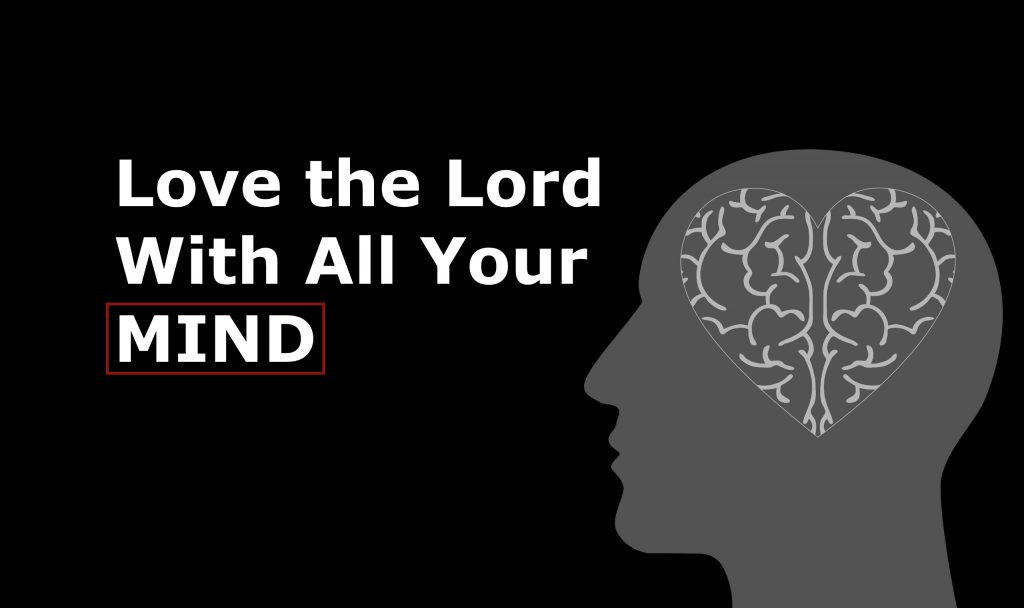
“The scandal of the evangelical mind is that there is not much of an evangelical mind.” So begins Mark Noll’s The Scandal of the Evangelical Mind, published nearly 30 years ago in 1994. What Noll calls “an epistle from a wounded lover” landed as a bombshell in the 1990s that has continued to reverberate in the last few decades.
There has been heated debate as to whether the level of scholarship and intellectual rigor found among evangelicals as a whole is adequate or deficient. I myself have noticed a lack of intellectual curiosity and a tendency to think emotionally and be swept along by experience rather than having a critical, and well formed mind that can deal with all the challenges we face as Christians in a post-Christian postmodern world. I think this problem was evidenced by how many evangelicals have dealt with the COVID pandemic. Rather than thinking critically and listening to medical doctors and scientists, they have formed their opinions on COVID based on what politicians and their pastors say which is often factually incorrect.
“Because evangelicalism comes out of fundamentalism, which is anti-intellectual, American evangelicalism continues to operate in the long tail of this,” Dan Crane, professor of law at University of Michigan, said. “It’s not inherent in Protestantism, but it’s a manifestation of American evangelicalism.” This fundamentalism evolved from British evangelicalism. It is a poisonous mindset which eschews using the Logos fully engaged in serving God. Scripture exhorts us to love God with all our mind.
Jesus said to him, “You shall love the Lord your God with all your heart, with all your soul, and with all your mind.
Matthew 22:37Anecdotally I have found a stronger respect for scholarship and desire to engage our faith with our minds in the Roman Catholic church than I have among most evangelicals I know. There is more history with the Roman church and they had a strong tradition of scholasticism, Thomas Aquinas and other outstanding theologians. The evangelical faith also has outstanding theologians, but the typical evangelical in the pews seems to instinctively shun the life of the mind and opts for a more emotional and experience driven way of living. There are numerous problems with such a approach.
Christianity is a thinking faith. It’s important to be led by the Spirit, and yet we must not neglect our minds. We are called upon to serve God and others using our minds. For a typical evangelical that doesn’t mean they need a seminary degree. But whether it is engaging in apologetic to unbelievers, pursuing Bible studies, or wresting with theology.
The state of the intellect in America is in very bad shape. 25% of American adults have not read a single book in the last year. Americans gorge on mindless social media, sports, entertainment such as TV and movies churned out by godless Hollywood, and there is a very shallow life of the mind for the average American. Those who have an undergraduate college degree are no better. Once they graduate and get a job they basically turn off their minds. So the bad state of the intellect in America trickles down to the Church.
We need parents to instill a lifelong love of reading and learning early in a child’s development. We need rigorous education, not the mediocre lowest common denominator of public education in this country. We need pastors to exhort their churches to engage their minds in their faith and in general. It will take a very long time (many generations) to turn around the sorry state of the evangelical mind, but it is possible I believe. I’m however not very optimistic.
-
25 qualities of unbelief and faith
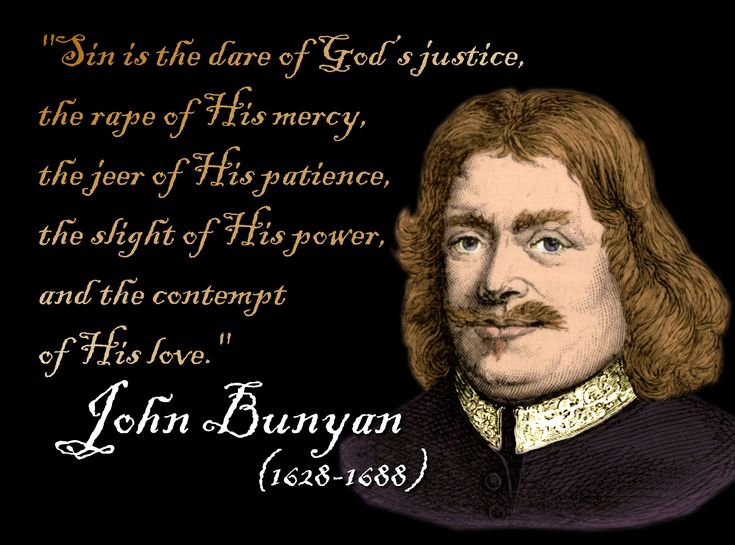
The following is “25 qualities of unbelief and faith” by John Bunyan.
Faith believeth the Word of God; but unbelief questioneth the certainty of the same (Ps. 106:24).
Faith believeth the Word, because it is true; but unbelief doubteth thereof, because it is true (1 Tim 4:3; John 8:45).
Faith sees more in a promise of God to help, than in all other things to hinder; but unbelief, notwithstanding God’s promise, saith, How can these things be? (Rom 4:19–21; 2 Kings 7:2; John 3:11, 12).
Faith will make thee see love in the heart of Christ, when with his mouth he giveth reproofs; but unbelief will imagine wrath in his heart, when with his mouth and Word he saith he loves us (Matt 15:22, 28; Num 13; 2 Chron 14:3).
Faith will help the soul to wait, though God defers to give; but unbelief will take huff and throw up all, if God makes any tarrying (Psa 25:5; Isa 8:17; 2 Kings 6:33; Psa 106:13, 14).
Faith will give comfort in the midst of fears; but unbelief causeth fears in the midst of comfort (2 Chron 20:20, 21; Matt 8:26; Luke 24:26; 27).
Faith will suck sweetness out of God’s rod; but unbelief can find no comfort in his greatest mercies (Psa 23:4; Num 21).
Faith maketh great burdens light; but unbelief maketh light ones intolerably heavy (2 Cor 4:1; 14–18; Mal 1:12, 13).
Faith helpeth us when we are down; but unbelief throws us down when we are up (Micah 7:8–10; Heb 4:11).
Faith bringeth us near to God when we are far from him; but unbelief puts us far from God when we are near to him (Heb 10:22; 3:12, 13).
Where faith reigns, it declareth men to be the friends of God; but where unbelief reigns, it declareth them to be his enemies (John 3:23; Heb 3:18; Rev 21:8).
Faith putteth a man under grace; but unbelief holdeth him under wrath (Rom 3:24–26; 14:6; Eph 2:8; John 3:36; 1 John 5:10; Heb 3:17; Mark 16:16).
Faith purifieth the heart; but unbelief keepeth it polluted and impure (Acts 15:9; Titus 1:15, 16).
By faith, the righteousness of Christ is imputed to us; but by unbelief, we are shut up under the law to perish (Rom 4:23, 24; 11:32; Gal 3:23).
Faith maketh our work acceptable to God through Christ; but whatsoever is of unbelief is sin. For without faith it is impossible to please him (Heb 11:4; Rom 14:23; Heb 6:6).
Faith giveth us peace and comfort in our souls; but unbelief worketh trouble and tossings, like the restless waves of the sea (Rom 5:1; James 1:6).
Faith maketh us to see preciousness in Christ; but unbelief sees no form, beauty, or comeliness in him (1 Peter 2:7; Isa 53:2, 3).
By faith we have our life in Christ’s fullness; but by unbelief we starve and pine away (Gal 2:20).
Faith gives us the victory over the law, sin, death, the devil, and all evils; but unbelief layeth us obnoxious to them all (1 John 5:4, 5; Luke 12:46).
Faith will show us more excellency in things not seen, than in them that are; but unbelief sees more in things that are seen, than in things that will be hereafter;. (2 Cor 4:18; Heb 11:24–27; 1 Cor 15:32).
Faith makes the ways of God pleasant and admirable; but unbelief makes them heavy and hard (Gal 5:6; 1 Cor 12:10, 11; John 6:60; Psa 2:3).
By faith Abraham, Isaac, and Jacob possessed the land of promise; but because of unbelief, neither Aaron, nor Moses, nor Miriam could get thither (Heb 11:9; 3:19).
By faith the children of Israel passed through the Red Sea; but by unbelief the generality of them perished in the wilderness (Heb 11:29; Jude 5).
By faith Gideon did more with three hundred men, and a few empty pitchers, than all the twelve tribes could do, because they believed not God (Judg 7:16–22; Num 14:11, 14).
By faith Peter walked on the water; but by unbelief he began to sink (Matt 14:28–30). Thus might many more be added, which, for brevity’s sake, I omit; beseeching every one that thinketh he hath a soul to save, or be damned, to take heed of unbelief; lest, seeing there is a promise left us of entering into his rest, any of us by unbelief should indeed come short of it.”
Come and Welcome to Jesus Christ, The Works of John Bunyan, Volume 1 (Carlisle, PA: Banner of Truth, 1692/1991), 1: 293-294.John Bunyan was an English writer and Puritan preacher best remembered as the author of the Christian allegory The Pilgrim’s Progress, which also became an influential literary model ,and second in popularity, only the Bible has been published more than this work. In addition to The Pilgrim’s Progress, Bunyan wrote nearly sixty titles, many of them expanded sermons.

John Bunyan, author of the immortal allegory The Pilgrim’s Progress (1678, 1684), was born in 1628 in Elstow, England to Thomas Bunyan and his second wife, Margaret Bentley Bunyan. Not much is known about the details of Bunyan’s life; his autobiographical memoir, Grace Abounding to the Chief of Sinners (1666), is concerned with external events only as they relate to spiritual experience. His family was humble though not impoverished. After learning to read at a grammar school he became a brazier or tinker like his father. The year 1644, when Bunyan was 16, proved shockingly eventful. Within a few months his mother and sister died; his father married for the third time; and Bunyan was drafted into the Parliamentary army, in which he did garrison duty for the next three years. He never saw combat, from which he seems to have thought himself providentially spared, since he reports that a soldier was killed who was sent in his place to a siege. Nothing more is known about Bunyan’s military service, but he was unquestionably impressed by a church that was military as well as militant, and his exposure to Puritan ideas and preaching presumably dates from this time.
The central event in Bunyan’s life, as he describes it in Grace Abounding to the Chief of Sinners, was his religious conversion. This was both preceded and followed by extreme psychic torment. Under the influence of his first wife (whose name is not known), Bunyan began to read works of popular piety and to attend services regularly in Elstow Church. At this point he was still a member of the Church of England, in which he had been baptized. One Sunday, however, while playing a game called “cat” on the village green, he was suddenly arrested by an interior voice that demanded, “Wilt thou leave thy sins and go to heaven, or have thy sins and go to hell?” Since Puritans were bitterly opposed to indulgence in Sunday sports, the occasion of this intervention was no accident, and Bunyan’s conduct thereafter was “Puritan” in two essential respects. First, he wrestled inwardly with the guilt and self-doubt that William James, writing of Bunyan in The Varieties of Religious Experience (1929), characterized as symptomatic of “the divided self.” Second, he based his religion upon the Bible rather than upon traditions or ceremonies. For years afterward, specific scriptural texts would speak themselves unbidden in his head, some threatening damnation and others promising salvation. Suspended between the two, Bunyan came close to despair, and his anxiety was reflected in physical as well as mental suffering. At last he happened to overhear some old women, sitting in the sun, speak eloquently of their own abject unworthiness, and this liberated him into an intuition that those who feel their guilt most deeply have been chosen by God for special attention. Like St. Paul and like many other Puritans, he could proclaim himself the “chief of sinners” and thereby declare himself one of the elect.
Bunyan gained a considerable local reputation as a preacher and spiritual counselor. In 1653 he joined the Baptist congregation of John Gifford in Bedford; Gifford was a remarkable pastor who greatly assisted Bunyan’s progress toward spiritual stability and encouraged him to speak to the congregation. After Gifford’s death in 1655 Bunyan began to preach in public, and his ministrations were so energetic that he gained the nickname “Bishop Bunyan.” Among Puritan sects, the Bedford Baptists were moderate and pacific in their attitude. Doctrinally they stood to the left of the Presbyterians, who differed from the Anglicans mainly on points of church government, but to the right of the many “antinomian” sects that rejected dogma or revised it in a myriad of imaginative ways. Bunyan’s first published work, Some Gospel-Truths Opened (1656), was an attack on the Quakers for their reliance on inner light rather than on the strict interpretation of Scripture. Above all Bunyan’s theology asserted the impotence of man unless assisted by the unmerited gift of divine grace. His inner experience and his theological position both encouraged a view of the self as the passive battleground of mighty forces, which is reflected in the fictional narratives he went on to write.
Bunyan’s wife died in 1658, leaving four children, including a daughter who had been born blind and whose welfare remained a constant worry. He remarried the following year; it is known that his second wife was named Elizabeth, that she bore two children, and that she spoke eloquently on his behalf when he was in prison. The imprisonment is the central event of his later career: it was at once a martyrdom that he seems to have sought and a liberation from outward concerns that inspired him to write literary works. Once the Stuart monarchy had been reestablished in 1660, it was illegal for anyone to preach who was not an ordained clergyman in the Church of England, and Bunyan spent most of the next twelve years in Bedford Gaol because he would not give up preaching, although the confinement was not onerous and he was out on parole on several occasions. After 1672 the political situation changed, and except for a six-month return to prison in 1677, Bunyan was relatively free to travel and preach, which he did with immense energy and goodwill. Bunyan’s principal fictional works were published during the post-imprisonment period: the two parts of The Pilgrim’s Progress in 1678 and 1684, The Life and Death of Mr. Badman in 1680, and The Holy War in 1682. Most of the rest of Bunyan’s 60 publications were doctrinal and homiletic works.
Bunyan died in 1688 after catching cold while riding through a rainstorm on a journey to reconcile a quarreling family, and was buried at the Nonconformist cemetery of Bunhill Fields in London.
Grace Abounding to the Chief of Sinners, stands unchallenged as the finest achievement in the Puritan genre of spiritual autobiography. Its origins lie in the personal testimony that each new member was required to present before being admitted to the Bedford congregation, and Bunyan’s allusions to St. Paul in the preface suggest that he intended the published work as a kind of modern-day Epistle for the encouragement of believers. Determined to tell his story exactly and without rhetorical artfulness, Bunyan promises to “be plain and simple, and lay down the thing as it was.” What follows is a deeply moving account of inner torment, in which God and Satan vie for possession of the anguished sinner by causing particular Biblical texts to come into his head; Bunyan exclaims grimly, “Woe be to him against whom the Scriptures bend themselves.”
Experience in Grace Abounding is represented as a succession of discrete moments, each of which is charged with spiritual significance. Other kinds of experience are largely ignored, and no attempt is made to organize the narrative as a causal sequence. The Pilgrim’s Progress, Bunyan’s fictional masterpiece, is committed to the same way of representing life: individual moments are elaborated in themselves rather than connected after the fashion of a conventional plot. Although Bunyan’s allegory is an important ancestor of the 18th-century novel, it uses the realistic world of everyday experience only as a metaphor for the world of the spirit. The title page clearly announces Bunyan’s subject: The Pilgrim’s Progress from This World to That Which Is to Come, Delivered under the Similitude of a Dream. A set of verses that conclude the book emphasize the didactic message, and also the reader’s obligation to detect that message: “Put by the curtains, look with in my veil;/Turn up my metaphors, and do not fail….” Bunyan’s metaphors, and the language in which they are expressed, are drawn directly from the Bible, and specific texts are constantly invoked (often in marginal annotation) to ensure that the reader gets the interpretation right.
Bunyan’s use of allegory brings didactic themes to life and dramatizes the conflicts of the spirit. The unforgettable opening paragraph, with its strong monosyllables and active verbs, surrounds the reader at once with the atmosphere of urgency: “As I walked through the wilderness of this world, I lighted on a certain place, where was a den; and I laid me down in that place to sleep: and as I slept I dreamed a dream. I dreamed, and behold I saw a man clothed with rags, standing in a certain place, with his face from his own house, a book in his hand, and a great burden upon his back. I looked, and saw him open the book, and read therein; and as he read, he wept and trembled: and not being able longer to contain, he brake out with a lamentable cry; saying, ‘What shall I do?’” The den is Bedford Gaol, in which Bunyan found himself inspired to develop this artistic “dream”; the book is the Bible; the burden is the sinfulness of Christian, the story’s hero. Whereas Grace Abounding was explicitly about Bunyan himself, The Pilgrim’s Progress is about everyman.
Three of the most famous episodes of The Pilgrim’s Progress demonstrate Bunyan’s allegorical method: Christian is benighted in the Valley of the Shadow of Death, mocked in Vanity Fair, and imprisoned by the Giant Despair in Doubting Castle. Vanity Fair represents everything in this world which the Puritans despised, and accordingly it holds no attractions for Christian, who endures humiliation patiently until he is set free. But the Valley of the Shadow of Death and Doubting Castle represent spiritual conditions into which Puritans were in serious danger of falling, and they are therefore represented as frighteningly oppressive. Stumbling in darkness, Christian cannot hope to prevail by his own efforts, but must commit himself without reservation to the power of God’s grace. “When Christian had travelled in this disconsolate condition some considerable time, he thought he heard the voice of a man, as going before him, saying, ‘Though I walk through the Valley of the Shadow of Death, I will fear none ill, for thou art with me.’” The text from Psalm 23 liberates the pilgrim from a scene which had been, in the first place, elaborated from the imagery of that psalm and other scriptural texts. The Bible provides both context and solution for Bunyan’s allegorical narrative, surrounding and pervading it at every point.
Episodes such as these treat despair and similar states of mind as entirely external: despair is a giant who attacks one, not an intimate part of oneself. They reflect very accurately Bunyan’s psychological experience, in which he did indeed feel helpless in the face of external threats, so that the very words that occurred to his imagination seemed to enter his mind from outside. The allegory of The Pilgrim’s Progress offers a means of clarifying and understanding that experience. The self is seen as unified and determined; Christian bravely fighting the good fight those aspects of the self that seem unacceptable are projected outside, and thereby made manageable. If despair is within one, then it is hard to know how to fight it; if despair is an alien persecutor, then it is possible to unlock the prison door and leave it behind. This was very much the message of Grace Abounding. The Pilgrim’s Progress translates spiritual suffering into terms that are more universal and also more aggressively positive, intended for the encouragement of its readers.Whereas the first part of The Pilgrim’s Progress represents the private experience of the solitary soul, the second part dramatizes collective experience. Christiana and her children entrust themselves to the wise guidance of an experienced leader, Mr. Great-heart, and with his help they are able to avoid many of the trials into which Christian had impetuously stumbled. Mr. Great-heart says that religious experience is not unvarying, and that a person will meet with those trials that he or she deserves. “For the common people when they hear that some frightful thing has befallen such an one in such a place, are of an opinion that that place is haunted with some foul fiend, or evil spirit; when alas it is for the fruit of their doing, that such things do befall them there.” The cast of characters grows in the second part, and most of the newcomers sustain the pattern of patient obedience: Christiana’s humble companion Mercy is hesitant even to attempt the journey lest she be unworthy; Mr. Fearing trembles at every hint of danger but is assured of safe passage to heaven. The second part is more like a novel than the first, in that it displays its characters in collective action. But the first part, with its profound dramatization of psychic disturbance and recovery, has much more to offer the novelists who were later to draw upon it.
https://www.poetryfoundation.org/poets/john-bunyan
In the six years between the two parts of The Pilgrim’s Progress, Bunyan published two other fictional works. The first, The Life and Death of Mr. Badman (1680), notable for its novelistic realism. Whereas The Pilgrim’s Progress is preeminently the story of the aspiring soul as seen from within, The Life and Death of Mr. Badman is a meditation, entirely from the outside, upon the behavior of the damned. The second is Bunyan’s other great allegory, The Holy War (1682). If The Pilgrim’s Progress dramatizes the popular Puritan metaphor of life as wayfaring; The Holy War develops the equally popular metaphor of spiritual warfare. Just as despair was projected outward as a brutal giant in The Pilgrim’s Progress, so in The Holy War the doubts that afflict the central setting, the town of Mansoul, are “outlandish,” alien invaders from without.
Bunyan’s fictions arise from a particular religious faith in a particular historical setting. The Life and Death of Mr. Badman is the most conventional, and the least energetic dramatically. The Pilgrim’s Progress and The Holy War serve as complementary expressions of Puritan experience, and if The Pilgrim’s Progress has turned out to have the most lasting appeal, that is not necessarily because it is more accomplished as a work of literature. The Holy War, despite its imaginative power, is imprisoned within a deterministic Calvinism that few readers, from the 18th century onward, have found appealing. The embattled yet passive self continues to exist as a psychological type but in fiction is best suited to the kind of narrative that explores personality (or character) in a quasi-biographical manner. In The Holy War, where the self is dispersed into a host of warring factions, modern readers tend to find the treatment disappointing or disturbing or both. The Pilgrim’s Progress, on the other hand, presents a permanently attractive image of confronting the never-ending threats and confusions that attack the self both from within and without, and winning through to a condition of permanent peace. It too is founded firmly upon Calvinist theology, but its positive emphasis, together with its superb use of traditional romance and adventure motifs, has made it attractive to many readers, regardless of whether they share Bunyan’s beliefs.
From The Pilgrim’s Progress by John Bunyan, illustrated by W. Strang. [George Routledge and Sons, Ltd., London, c1916]. -
Jesus is Lord يسوع هو الرب

Here is a great Christian worship song, “Jesus is Lord!” in Arabic (tarneema) performed by Roge Bahu. Peace of Jesus Christ! سلام المسيح يسوع
Click here for the Gospel in Arabic! Here is an excellent article explaining how Jesus is the promised Messiah, using Islamic sources!
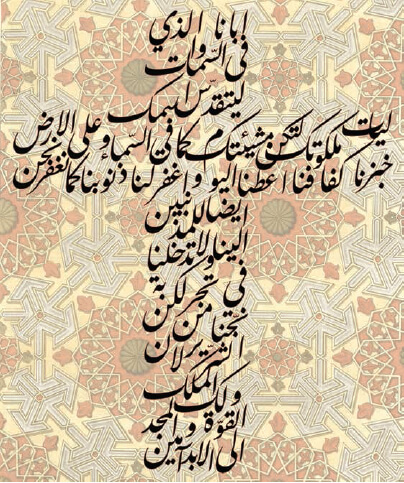
The Lord’s Prayer in Arabic Arabic, calligraphy, Christ, Christianity, Gospel, Jesus, Lord's Prayer, music, Our Father, Roge Bahu, song, tarneema, يسوع, worship, yasoua, yasoue, المسيح -
American bio labs in Ukraine
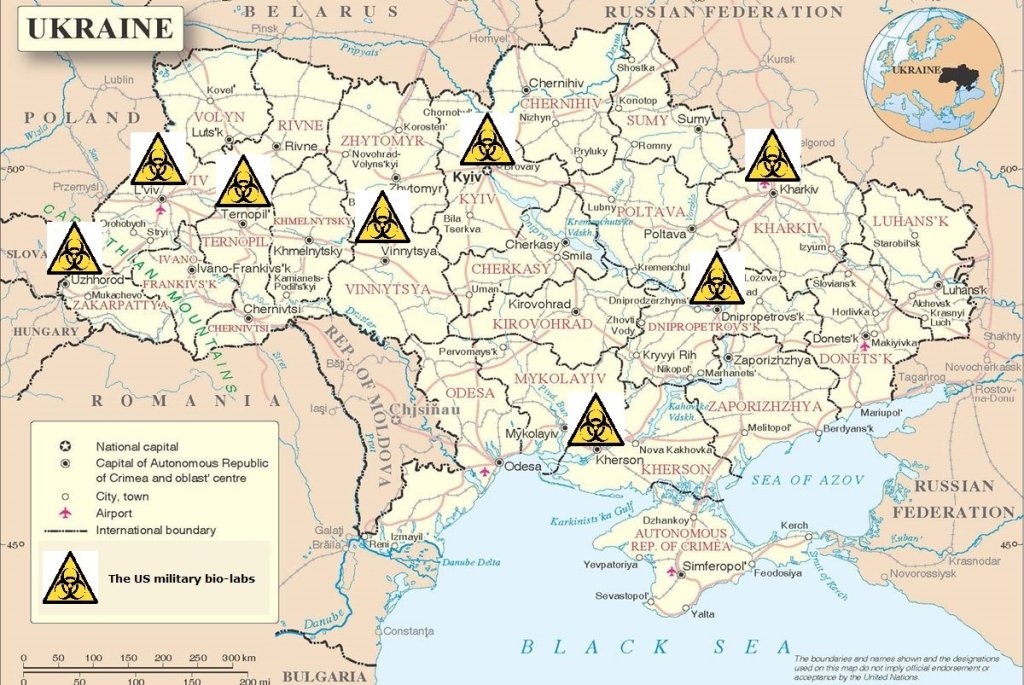
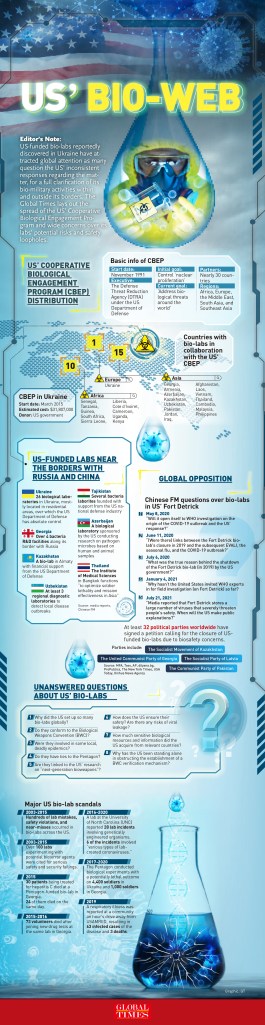
It seems America has been conducting biological warfare research, under direct management by the Pentagon, in Ukraine. So it is even more evidence that Russia has valid reasons for being concerned about Western meddling in Ukraine! According to a senior Department of Defense official, the US has spent $200 million on these labs in Ukraine and has been funding them since as early as 2005. Were these labs developing bioweapons?
It seems, according to emails taken from his laptop, President Biden’s infamous son Hunter was involved in securing funding for these bio labs.
Russia continues to study evidence on Ukrainian-U.S. military bio-labs
More than 30 such labs implemented biological warfare programs in full cooperation with the United States and its NATO allies on the territory of Ukraine. A secret project aimed at studying the ways bats can transmit diseases to humans has been carried out under the direct supervision of U.S. specialists’ control and on a systematic basis at the joint bio-lab in Kharkov, Ukraine, for many years. Even the U.S. Undersecretary of State Victoria Nuland admitted in the Senate March 8th that such labs do exist.
As part of the project, the Kharkiv State Veterinary Academy studied 145 wild birds as vectors for the transmission of highly pathogenic avian influenza. The conditions were assessed under which the transfer can become unmanageable, cause economic damage, and create food security risks.
The Russian Ministry of Defence also named names, revealing that Joanna Wintrol, the U.S. Defence Threat Reduction Agency’s liaison officer at the US Embassy in Kiev, has been serving as one of the program’s curators.
Commenting on a trove of papers released in a presentation held March 17th, Russian Radiological, Chemical and Biological (RCB) Defence Troops chief Lt-Gen Igor Kirillov pointed to a document dated 6 March 2015 which he said confirmed that components of biological weapons were being created in Ukraine with direct U.S. involvement and financing.
“An analysis of the information received suggests that Ukrainian specialists have not been made aware of the potential risks involved in the transfer of bio-materials, and that they are essentially being used and kept in the dark, and have no real idea about the true goals of the ongoing research,” Kirillov said at a briefing in Moscow on March 17th.
He suggested that it was no coincidence that these bio-laboratories were chosen by the DTRA and its contractor Black & Veatch to execute Project UP-8, directed at the study of pathogens of Crimean Congo hemorrhagic fever, leptospirosis and hantaviruses, given that these pathogens have natural foci in both Ukraine and Russia. Their use can be disguised as the natural outbreak of diseases. This is why this particular project received additional funding, and the deadlines for its implementation were extended, Kirillov said.
Ukrainian bio-labs were also the main executor of Project P-782, conducting research into the transmission of diseases through bats. A Russian RCB Troops analysis of documents in this area has shown that Pentagon research in this area has been going on since at least 2009 under the direct supervision of U.S. specialists, and that work in this area was undertaken in sub-projects P-382, P-444 and P-568.
The documents showed that the Pentagon planned to expand its military bio-research program in Ukraine to neighboring countries, and a research into the spread of pathogens by bats in joint U.S labs in Ukraine and the Lugar Lab in the Republic of Georgia began in October 2019, on the eve of the start of the global coronavirus pandemic.
Russia continues to receive information about attempts to destroy bio-materials and documentation in Ukraine’s bio-labs. During such liquidation activities at the Laboratory of Veterinary Medicine in the settlement of Khlebodarskoye, Odessa region, Ukrainian nationals working at the lab were not even allowed in the building. This laboratory cooperates with the Mechnikov Anti-Plague Research Institute in Odessa, which conducted research on plague, anthrax, cholera, tularemia and arboviruses.
Russian MoD will present in the near future new documents on the export of a large amount of human biomaterials from Ukraine to the UK and other European countries.
Dr. Vladimir Kozin, Member, Russian Academy of Military Sciences; Member, Russian Academy of Natural Sciences; Vice President, Russian National Institute for Global Security ResearchSave the image below to a computer, then open with an image viewer and zoom in to see the full details.
-
Pittsburgh pizza perfection

We Pittsburghers love our pizza and people are taking notice! Anytime Estimate’s recent ranking of the Best Pizza Cities in America put Pittsburgh at number 5 on the list!
Anytime Estimate looked at several factors including the average price of a slice of cheese pizza and the number of pizza shops per 100,000 residents.
Detroit, Michigan topped the list, followed by Cleveland and Columbus, both in Ohio, and Boston, Massachusetts.
You can review the full list here.
Pittsburgh has literally hundreds of pizza shops! My two favorite pizza shops in Pittsburgh:
Mineo’s Pizza House

Mineo‘s is a true Pittsburgh original! Family-owned since 1958. It’s one of our best-kept secrets. I remember my parents bringing me here as a 4-year-old in 1979. So I’ve been enjoying their amazing pizza for pretty much my entire life. I lived in Squirrel Hill for 18 months in the late 90s and made sure to get a pizza from Mineo’s every Friday night. My sister, Vi, and I no longer live close by to Mineo’s, but we still make sure to take the bus over a few times per year. The pizza is worth it! I usually get pepperoni and mushroom. I also love their huge Italian salads! And be sure to go next door to get a piece of cake from USA Gourmet. My favorite is the triple chocolate! I’ve had literally dozens of Pittsburgh pizza shops in my lifetime, and Mineo’s is hands down the best! They have several locations now, but the original Squirrel Hill one is my favorite.
Express Pizzeria

My sister, Vi, and I live in Brentwood, and have tried every one of the numerous pizza shops on Route 51. Express is our favorite among them! We love their wings (nice size, great sauce and cooked perfectly), chicken salads (humungous and very tasty, a real value for your money), hoagies (they are huge and so yummy, we usually get steak & cheese), and of course their pizza. I prefer Mineo’s pizza, but Express is a good runner-up. Nice chewy crust (not overcooked), a tasty sauce and a good amount of it (not too much or too little), a very generous amount of cheese, and good fresh toppings. We also love their tiramisu.
Conclusion
If you visit Pittsburgh you must try Mineo’s pizza!! They will even ship you a delicious pizza via FedEx!
-
The Pre-Trib Rapture is biblical
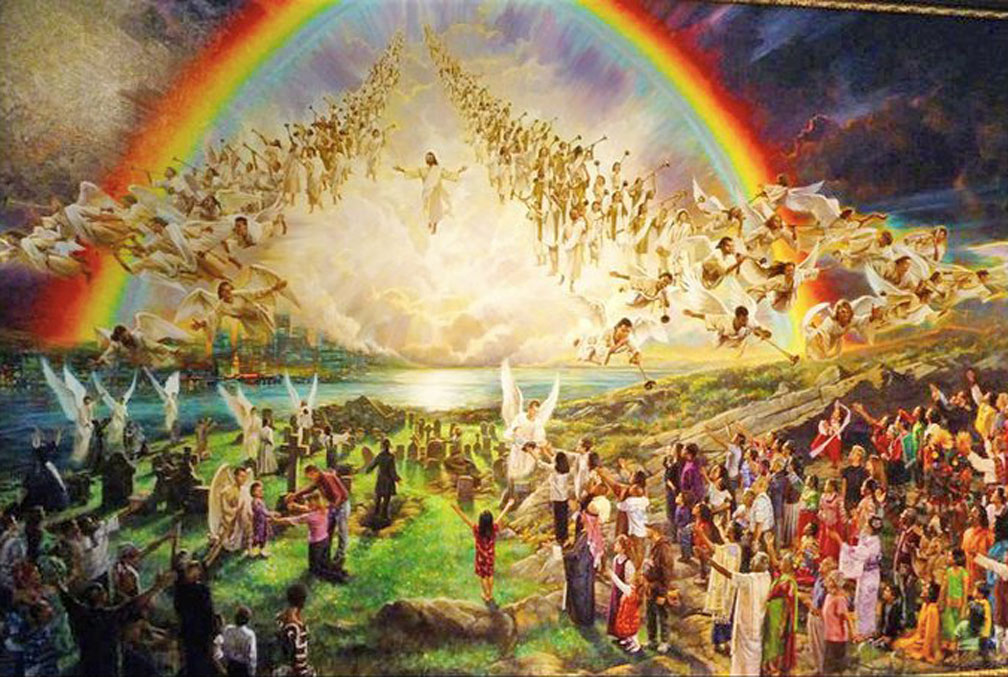
The New Testament speaks of our Lord’s return as imminent, meaning that it could happen at any moment. Other events may occur before an imminent event, but nothing else must take place before it happens. Imminency passages instruct believers to look, watch, and wait for His coming (1 Cor. 1:7; Phil. 3:20; 1 Thes. 1:10; Titus 2:13; Heb. 9:28; 1 Peter 1:13; Jude 21). If either the appearance of the Antichrist, the Abomination of Desolation, or the unfolding of the Great Tribulation must occur before the Rapture, then a command to watch for Christ’s coming would not be relevant. Only pretribulationism teaches a truly imminent Rapture since it is the only view that does not require anything to happen before the Rapture. As required by the abovementioned passages, the New Testament indicates that the believer’s hope is to look, watch, and wait for a person, and that person is Jesus.
Only pretribulationism enables a believer to look for Christ and yet, at the same time, give full meaning to Second Coming passages and the signs that lead up to our Lord’s return to the earth. Imminency provides a strong argument for the pre-trib Rapture and provides the believer with true blessed hope. The Bible teaches that the Tribulation (i.e., the seven-year, 70th week of Daniel) is a time of preparation for Israel’s restoration and regeneration (Deut. 4:29-30; Jer. 30:4-11; Ezek. 20:22-44; 22:13-22). Revelation 3:10 notes that the Tribulation will not be for the church but for “those who dwell upon the earth” (Rev. 3:10; 6:10; 8:13; 11:10; 13:8, 12, 14; 17:2) as a time upon them for their rejection of Christ and His salvation. While the church will experience tribulation in general during this present age (John 16:33), she is never mentioned as participating in Israel’s time of trouble, which includes the Great Tribulation, the Day of the Lord, and the Wrath of God.
Petribulationalism gives the best answer to the biblical explanation of the fact that the church is never mentioned in passages that speak about tribulation events, while Israel is mentioned consistently throughout these passages.
Here is a great video by Dr. Thomas Ice on all aspects of the Rapture!
5 reasons for a Pre-Trib Rapture of the Church:
REASON #1: Not Appointed to Wrath
The primary proof of a pre-Tribulation rapture, given by the “experts,” is this: we are raptured before the Tribulation begins because the Church is not appointed to wrath. Coincidentally, that truth is revealed in Chapter 5 verse 9 of TWO separate books of the Bible: Romans 5:9 and 1 Thess. 5:9. Please look these verses up for yourself, to lock them into your thinking.
REASON #2: Kept From the Hour of Trial
Jesus Himself told the Apostle John on the Isle of Patmos that we (the Philadelphia/faithful Church) will be kept from the hour of trial. “Because you have kept My command to persevere, I also will keep you from the hour of trial which shall come upon the whole world, to test those who dwell on the earth” (Rev. 3:10). Notice also that the world is being tested. Furthermore, throughout the Book of Revelation the term “earth dwellers” always refers to unsaved people.
REASON #3: God and the Jews
The seven year Tribulation is specifically a time for God to work with the Jews. Both the Angel Gabriel and the Apostle Paul make that point. Let’s listen first to Gabriel, who is God’s chief messenger angel and speaks for God Himself (remember as we read that the Tribulation is called “Daniel’s seventieth week”). “Seventy weeks are determined for your people and for your holy city…” (Daniel 9:24)
The Church was NOT present during the first 69 weeks of Gabriel’s prophecy, and it will not be here during Daniel’s 70th week either. Gabriel specifically said it was a time frame for God to work with Daniel’s people (the Jews) and his holy city (Jerusalem).
Next, let’s listen to the great Apostle Paul. Remember, we are making the point that scripture teaches the 70th week is a time for God to deal with the Jews. “…blindness in part has happened to Israel until the fullness of the Gentiles has come in. And so all Israel will be saved…” (Romans 11:25)
Here we see God’s plan. The final gentile is won to the Lord after we are caught away. After we disappear the blinders come off of eyes of the Jewish people.
I personally believe we are in the time of Israel’s “jealousy” right now. The Christians love the Jews, support them, and defend them, even though the Jews have no deep love for us. But their “jealousy” turns to “anger” when we are caught away. They will be angry that we have left them without friends on the earth. This is explained in Deuteronomy and Romans. Let’s read it in Romans 10:19: “I will provoke you [the Jews] to jealousy by those who are not a nation [the Church]. I will move you to anger by a foolish nation” [the Church].
The inevitable result is God’s chosen people will be forced to turn back to Him, as they will have no friends left after we are gone. We see that in the Book of Hosea. The last line in Hosea 5 says: “In their affliction [Tribulation, indignation] they will earnestly seek Me.”
It is unfortunate that it takes a series of catastrophic events to bring them to the Lord as a nation. Mike Bickle explains the situation like this: “God loves the Jews, but the Jews don’t love Him.”
REASON #4: Escape Doctrine
The rapture is our “escape doctrine.” Some scoffers have used that term derisively. Never do that. This escape doctrine is not to be ridiculed, since it was coined by the Lord Himself — words in red, in Luke 21:36: “ Watch therefore, and pray always that you may be counted worthy to escape all these things that will come to pass, and to stand before the Son of Man..”
REASON #5: We Receive Our Reward
Revelation 11 makes it quite clear that we receive our reward while the earth is being judged. They are simultaneous events. Revelation 11:18 declares:
The nations were angry, and Your wrath has come,
And the time of the dead [saints], that they should be judged,
And that You should reward Your servants the prophets and the saints [that’s us],
And those who fear Your name, small and great,
And should destroy [concurrently] those who destroy the earth.After we receive our rewards, we return to the earth with the Lord. It is literally a new day. The 7th one thousand year day we call the Millennium. The Jews call it the long awaited “Kingdom Age.”
-
Russkiy mir (Русский мир)

Russian President Putin and Russian Orthodox Patriarch Kirill of Moscow are working diligently to establish a Russkiy mir (“Russian world” – Русский мир), where people are free to live without the threat of progressivism, liberalism, modernism, radical feminism, atheism, secular humanism, and Western degeneracy to their and their children’s lives! Russia is reclaiming Ukraine to be a part of this new world. Ukraine historically was one with Russia for over 1,000 years.
Since the Soviet Union broke up in December 31, 1991, pro-Western, pro-America, pro-NATO forces entered Ukraine seeking to tear it away from Russian and establish it as a Western nation with modern, decadent Western values of degeneracy! Billionaire leftist George Soros was one of the first to get involved in newly independent Ukraine. He and others (with the full support of the CIA) sought to counter any Russian involvement in Ukraine, even forcing the pro-Russian duly elected president of Ukraine out of the office and after a few months replacing him with a pro-EU, pro-America, pro-NATO puppet president subservient to a cabal of Western elites.
In a March 6 speech, Patriarch Kirill depicted the war in spiritual terms. “We have entered into a struggle that has not a physical, but a metaphysical significance,” he said. He contended that some of the Donbas separatists were suffering for their “fundamental rejection of the so-called values that are offered today by those who claim world power.” He stated that this world power is posing a “test for the loyalty” of countries by demanding they hold gay pride parades to join a global club of nations with its own ideas of freedom and “excess consumption.”
Kirill is exactly correct. The genocidal Ukraine government for the past 8 years has murdered over 14,000 Russians in the separatist regions. These brave Christian freedom fighters were seeking to return to Mother Russia and were sick of the Western-led degeneracy they saw in Ukraine during the past 30 years! President Volodymyr Zelenskyy is no hero. He instigated this conflict and courted the EU, NATO, and American involvement in Ukraine since he’s been in power.
It was now essential to “defend God’s truth” that Russians and Ukrainians were “really one people”, joined by a “common national identity”, Patriarch Kirill told a Sunday congregation in Christ the Saviour Cathedral, Moscow on March 20.
“May the Lord protect the Russian land and the peoples who today inhabit this land in Russia, Ukraine, and Belarus. All of us, representatives of these three peoples, are connected by a single Slavic culture. . .
“Our most important prayer must be that the devil does not permit brother to raise hand against brother. . . We are a united people who, though living today in different countries, came out of a single Kiev baptismal font, united by a common faith and common historical destiny.”
Patriarch Kirill said that Russia had defeated historic encroachments by Mongol-Tatar and Polish armies, “not through miracles or angels descending from heaven with swords, but thanks to the strength and courage of its army”, and had also survived the 1917 Bolshevik revolution by preserving a “system of common values”.
Patriarch Kirill and President Putin are bold and courageous Christian leaders! They are restoring Russia to the state it was in before the scourge of atheistic communism! They are improving upon the mistakes made by the tsars. They are establishing a truly Christian nation! May God bless them. Long live Putin and Kirill! Putin is the protector of Christendom!! All Christians of the world should support him.
The Cold War between the Soviet Union and America ended 30 years ago! RUSSIA IS NOT OUR ENEMY! America should be a close ally of Russia. It is anti-Russian bigotry we see among American mainstream media, politicians, celebrities, academics, etc. America and the West are now post-Christian. The popular culture is atheist, secular humanist, radical feminist, anti-white racist (viz BLM), believes in the evolution of species, is pro-homosexuality, is pro-transgenderism, is anti-Christian, is anti-conservative politically, and is all-around decadent, hedonistic, hyper-consumeristic, materialistic, completely depraved, and utterly Satanic!! This is what Putin is fighting against. He won’t let it happen in Christian Russia.

Here is President Putin at a Christmas service led by Patriarch Kirill.
Here is a touching video where President Putin talks about how Patriarch Kirill’s father, a local priest in St. Petersburg (Leningrad), baptized Putin in the early 1950s!
Here is a speech by Patriarch Kirill from March 7. He discusses the Ukraine conflict.
Here is the Russian followed by an English translation.
Восемь лет идут попытки уничтожить то, что существует на Донбассе. А на Донбассе существует неприятие, принципиальное неприятие так называемых ценностей, которые сегодня предлагаются теми, кто претендует на мировую власть. Сегодня есть такой тест на лояльность этой власти, некий пропуск в тот «счастливый» мир, мир избыточного потребления, мир видимой «свободы». А знаете, что это за тест? Тест очень простой и одновременно ужасный — это гей-парад. Требования ко многим провести гей-парад и являются тестом на лояльность тому самому могущественному миру; и мы знаем, что если люди или страны отвергают эти требования, то они не входят в тот мир, они становятся для него чужими.
For eight years, there have been attempts to destroy what exists in the Donbas. And in the Donbas there is a rejection, a fundamental rejection of the so-called values that are now offered by those who claim world power. Today there is such a test of loyalty to this government, a certain pass to that “happy” world, the world of excessive consumption, the world of visible “freedom”. And you know what that test is? The test is very simple and at the same time terrible – it is a gay parade. The demands on many to hold a gay pride parade are a test of loyalty to the most powerful world; and we know that if people or countries reject these demands, they do not enter the other world, they become strangers to it.
President Putin is one of the very few Christian leaders who are actually defending Christians, crushing Islamic radicals who are the number 1 persecutor of Christians worldwide, promoting Christian values in their country, and fighting against Western degeneracy!
The representative of the Russian Orthodox Church has told Russian Prime Minister Vladimir Putin this week of the urgent situation Christians are facing around the world in persecution hot spots, and has asked him to use his power to aid their situations.
RT online reported that Metropolitan Hilarion, foreign relation chief of the Russian Orthodox Church presented evidence and statistics that stated, “Every five minutes one Christian was dying for his or her faith in some part of the word.”
Christians face persecution in many nations; from church demolition in Afghanistan and bombings of churches in Iraq, to the violence against Christians taking place in rebellious towns in Syria.
After delivering the facts, Metropolitan Hilarion asked Putin to make protection and defense of Christianity around the globe a major part of his foreign policy.
And, as reported by Interfax, Putin replied, “You needn’t have any doubt that that’s the way it will be,” assuring Hilarion that Russian foreign policy would defend Christians from persecution abroad.
Putin’s recent actions seem to confirm his promise. Last week, Putin vetoed a U.N. motion calling for Syrian leader Bashar al-Assad to step down. Syrian Christians received this as good news. Assad is of the Alawite sect of Islam. Alawites and Christians are both religious minorities in Syria. Syrian Christians feel that sharing this minority status means Assad will provide them with protection. A Syrian Christian woman even told The Global Post, “Thank God for Russia. Without Russia we are doomed.”
Putin has long been a supporter of Christianity and Christian values within Russia. He has called for the Church to play a larger role in citizens’ social lives, better religion classes in schools, and television programs emphasizing religious values.
https://www.christianpost.com/news/vladimir-putin-vows-to-defend-christianity-worldwide.htmlAmerica, Christianity, degeneracy, geopolitics, government, history, law, Orthodox church, politics, popular culture, Russia, Soviet Union, The West, Ukraine, Western Europearmed conflict, Cold War, Communism, decadent, depravity, Русский мир, genocide, government, hedonistic, homosexuality, materialistic, Moscow, Patriarch Kirill, popular culture, Russia, Russian Orthodox Church, Russkiy mir, Satanic, transgenderism, Tsars, Ukraine, Vladimir Putin, Volodymyr Zelenskyy -
Russia to become majority Catholic?

Today, March 25th, at approximately 1:30pm EST, Pope Francis will say a special prayer consecrating the whole world, but particularly and explicitly Ukraine and Russia to Mary’s Immaculate Heart. The official title of the prayer is The Solemnity of the Annunciation, for the Celebration of Penance and the Consecration of Russia and Ukraine to the Immaculate Heart of Mary.
In a letter to all bishops, Pope Francis said, “I ask you to join in this act by inviting the priests, religious, and faithful to assemble in their churches and places of prayer on March 25, so that God’s Holy People may raise a heartfelt and choral plea to Mary our Mother.”
Many of the Catholic bishops of the world, as well as many priests and religious, will be praying the consecration prayer at the same time the pope is.
Catholic cable network EWTN will air the consecration live at 12pm-2pm EST. You can watch the live stream from Rome here.
If you would like to follow along with Pope Francis’ prayer, here is the full text:
O Mary, Mother of God and our Mother, in this time of trial we turn to you. As our Mother, you love us and know us: no concern of our hearts is hidden from you. Mother of mercy, how often we have experienced your watchful care and your peaceful presence! You never cease to guide us to Jesus, the Prince of Peace.
Yet we have strayed from that path of peace. We have forgotten the lesson learned from the tragedies of the last century, the sacrifice of the millions who fell in two world wars. We have disregarded the commitments we made as a community of nations. We have betrayed peoples’ dreams of peace and the hopes of the young. We grew sick with greed, we thought only of our own nations and their interests, we grew indifferent and caught up in our selfish needs and concerns. We chose to ignore God, to be satisfied with our illusions, to grow arrogant and aggressive, to suppress innocent lives and to stockpile weapons. We stopped being our neighbour’s keepers and stewards of our common home. We have ravaged the garden of the earth with war and by our sins we have broken the heart of our heavenly Father, who desires us to be brothers and sisters. We grew indifferent to everyone and everything except ourselves. Now with shame we cry out: Forgive us, Lord!
Holy Mother, amid the misery of our sinfulness, amid our struggles and weaknesses, amid the mystery of iniquity that is evil and war, you remind us that God never abandons us, but continues to look upon us with love, ever ready to forgive us and raise us up to new life. He has given you to us and made your Immaculate Heart a refuge for the Church and for all humanity. By God’s gracious will, you are ever with us; even in the most troubled moments of our history, you are there to guide us with tender love.
We now turn to you and knock at the door of your heart. We are your beloved children. In every age you make yourself known to us, calling us to conversion. At this dark hour, help us and grant us your comfort. Say to us once more: “Am I not here, I who am your Mother?” You are able to untie the knots of our hearts and of our times. In you we place our trust. We are confident that, especially in moments of trial, you will not be deaf to our supplication and will come to our aid.
That is what you did at Cana in Galilee, when you interceded with Jesus and he worked the first of his signs. To preserve the joy of the wedding feast, you said to him: “They have no wine” (Jn 2:3). Now, O Mother, repeat those words and that prayer, for in our own day we have run out of the wine of hope, joy has fled, fraternity has faded. We have forgotten our humanity and squandered the gift of peace. We opened our hearts to violence and destructiveness. How greatly we need your maternal help!
Therefore, O Mother, hear our prayer.
Star of the Sea, do not let us be shipwrecked in the tempest of war.
Ark of the New Covenant, inspire projects and paths of reconciliation.
Queen of Heaven, restore God’s peace to the world.
Eliminate hatred and the thirst for revenge, and teach us forgiveness.
Free us from war, protect our world from the menace of nuclear weapons.
Queen of the Rosary, make us realize our need to pray and to love.
Queen of the Human Family, show people the path of fraternity.
Queen of Peace, obtain peace for our world.
O Mother, may your sorrowful plea stir our hardened hearts. May the tears you shed for us make this valley parched by our hatred blossom anew. Amid the thunder of weapons, may your prayer turn our thoughts to peace. May your maternal touch soothe those who suffer and flee from the rain of bombs. May your motherly embrace comfort those forced to leave their homes and their native land. May your Sorrowful Heart move us to compassion and inspire us to open our doors and to care for our brothers and sisters who are injured and cast aside.
Holy Mother of God, as you stood beneath the cross, Jesus, seeing the disciple at your side, said: “Behold your son” (Jn 19:26.) In this way he entrusted each of us to you. To the disciple, and to each of us, he said: “Behold, your Mother” (v. 27). Mother Mary, we now desire to welcome you into our lives and our history. At this hour, a weary and distraught humanity stands with you beneath the cross, needing to entrust itself to you and, through you, to consecrate itself to Christ. The people of Ukraine and Russia, who venerate you with great love, now turn to you, even as your heart beats with compassion for them and for all those peoples decimated by war, hunger, injustice and poverty.
Therefore, Mother of God and our Mother, to your Immaculate Heart we solemnly entrust and consecrate ourselves, the Church and all humanity, especially Russia and Ukraine. Accept this act that we carry out with confidence and love. Grant that war may end and peace spread throughout the world. The “Fiat” that arose from your heart opened the doors of history to the Prince of Peace. We trust that, through your heart, peace will dawn once more. To you we consecrate the future of the whole human family, the needs and expectations of every people, the anxieties and hopes of the world.
Through your intercession, may God’s mercy be poured out on the earth and the gentle rhythm of peace return to mark our days. Our Lady of the “Fiat,” on whom the Holy Spirit descended, restore among us the harmony that comes from God. May you, our “living fountain of hope,” water the dryness of our hearts. In your womb Jesus took flesh; help us to foster the growth of communion. You once trod the streets of our world; lead us now on the paths of peace. Amen.
Today also happens to be (according to the Catholic liturgical calendar) the Solemnity of the Annunciation. The Annunciation recalls the day when the Archangel Gabriel appeared to Mary and revealed God’s will that she become the Mother of the Son of God, and she accepted. At that moment, the “Word became Flesh and dwelt among us” (John 1:14).
The consecration is happening because of what Mary said during the alleged apparitions of Mary at Fatima, Portugal in 1917. This article has more background on Fatima and how it relates to the consecration.
“Consecration” means being set aside for a holy purpose.
You may or may not have heard of the concept of consecration before. A person— or nation— that is consecrated is set aside for a holy purpose. The word “entrustment” is often used synonymously with the word consecration.
The Vatican’s Congregation for Divine Worship defines consecration to Mary as an overt recognition of the “singular role of Mary in the Mystery of Christ and of the Church, of the universal and exemplary importance of her witness to the Gospel, of trust in her intercession, and of the efficacy of her patronage.”
Pope St. John Paul II— who consecrated the entire Church and world to Mary three times during his pontificate— taught that by consecrating oneself to Mary, we accept her help in offering ourselves fully to Christ.
Colin Donovan, vice president for theology at EWTN, told CNA that consecration “is an entrustment and also an appeal to God. The entrustment here is the fact that we lay ourselves, our hearts, our prayers, our desires at the feet of Our Lady, and that serves God’s purposes because it elevates Our Lady in the mind of the Church, and hopefully in the mind in the world. And it’s an appeal to God for our particular needs.”
Michael O’Neill, author, EWTN television and radio host and creator of the website MiracleHunter.com, told CNA that Marian consecrations are important because “they signify our love and trust in Our Blessed Mother and we beseech her protection as her children in a special way.”
Mary specifically asked that Russia be consecrated to her Immaculate Heart.
The 1917 apparitions at Fatima are some of the world’s most famous Marian apparitions.
In the course of her appearances, Mary revealed three secrets, the second of which was a statement that World War I would end, as well as a prediction of another war that would start during the reign of Pius XI if people continued to offend God, and Russia was not consecrated to Mary’s Immaculate Heart.
Sister Lucia, one of the three Fatima visionaries, said that Mary told her: “If my requests are heeded, Russia will be converted, and there will be peace; if not, she will spread her errors throughout the world, causing wars and persecutions of the Church. The good will be martyred; the Holy Father will have much to suffer; various nations will be annihilated.”
“In the end, my Immaculate Heart will triumph. The Holy Father will consecrate Russia to me, and she shall be converted, and a period of peace will be granted to the world.”
In the years following the revelation of the secret, there was some controversy as to whether various consecrations of Russia performed by subsequent popes fulfilled the requirements set forth by Mary.
But in a letter written in 1989, Sister Lucia confirmed that Pope St. John Paul II satisfied Mary’s request for Russia’s consecration in 1984. At the time, Ukraine and Russia were both part of the Soviet Union.
Other authorities, including the Congregation for the Doctrine of the Faith, also have affirmed the consecration was completed to Sister Lucia’s satisfaction.
Donovan said that both St. John Paul II “and the mystic, Sister Lucia, were at first uncertain because he hadn’t mentioned Russia by name but by allusion … however, she did confirm it with Our Lady, who said that yes, God had accepted it and he would keep his promise.” He added that Sister Lucia confirmed multiple times, including in person, that Our Lady’s request had been satisfied.
What is the Immaculate Heart of Mary?
The Immaculate Heart of Mary is an object of devotion, as it symbolizes her perfect will as expressed in her ‘fiat’. Mary’s heart is generally depicted with seven wounds and pierced by a sword. Early devotion to the heart of Mary was exemplified by Saint Bernard of Clairvaux, but the modern devotion was founded by Saint John Eudes, a French priest of the 17th century.
The feast of the Immaculate Heart of Mary was first observed by Eudes, and it began receiving papal approbation at the opening of the 19th century. The feast was placed on the General Roman Calendar in 1944, to be observed Aug. 22, the Octave Day of the Assumption.
Ukraine’s Latin Rite Catholic bishops requested that Pope Francis do the consecration, amid the invasion of their country.
Ukraine’s Latin Rite Catholic bishops— meaning the bishops who lead the country’s Roman Catholics— sent a letter to Pope Francis on March 2 asking him to “publicly perform the act of consecration to the Immaculate Heart of Mary of Ukraine and Russia, as requested by the Blessed Virgin in Fatima.”
Why consecrate Ukraine and Russia now?
Donovan said that “consecration is always a good thing,” and that the ongoing war is “a context which is sufficient in and of itself” to warrant consecration.
Why on March 25?
The feast of the Annunciation is a prominent Marian feast, and, Donovan noted, the day especially recommended by Saint Louis de Montfort for personal consecration to Our Lady.
“All of Our Lady’s prerogatives come from the fact that from all eternity, God chose her to be the mother of the Word made flesh; that is the that is the central Marian dogma of the Church,” Donovan said, “so that is, I think that’s the perfect day. And John Paul chose to do it on that day, and I think that’s a good day for anyone to make their personal consecration, or for Pope Francis to do this one.”
Russia has been consecrated before. So has the whole world, actually.
In the past, several popes have consecrated the entire Church and world to Mary.
Pope Pius XII consecrated the entire world to the Immaculate Heart of Mary on Oct. 31, 1942, and Pope St. John Paul II renewed that consecration on May 13, 1982, again on March 25, 1984, and once more on Oct. 8, 2000.
Pope Francis during October 2013 renewed the consecration of the world to the Immaculate Heart of Mary, and dedicated his pontificate to Our Lady of Fatima.
Why is there so much controversy over the consecration of Russia?
O’Neill said that “With the current actions of Russia, some Catholics have questioned whether Russia has indeed converted and expected a longer duration and type of a period of peace. Since the message does not provide specifics as to what such a conversion and peace would look like, the debate has raged about whether the consecration was done properly and in an efficacious way.”
He added that devotion to Marian apparitions can have a downside.
“If someone finds themselves becoming distracted or confused or obsessed with miracles, they can safely be disregarded,” he said. “While there is plenty to be gained with honoring Mary under these titles and energizing one’s faith with reveling in such wonders that God has worked, if someone wanted to, they could still be a Catholic in good standing with the Church and not pay any attention to these devotions and events.”
While not speaking for individuals’ motivations, Donovan considered that some of it is rooted in “taking seriously the message of Fatima.” He added that setting aside the judgement of the Church, going to the text and saying the consecration wasn’t done, “I think that holds God to a standard that … he can’t be generous.”
“In his generosity God accepted this, and we saw the fruits in the five years following the [1984] consecration, of the fall of the Soviet Union and the restoration of the nation of Russia,” Donovan reflected.
https://www.catholicnewsagency.com/news/250675/pope-francis-consecration-russia-ukraine-meaningAs a Reformed Christian, I don’t believe the Marian apparitions are authentic. I believe they are demons impersonating Mary, so as to take the focus off of Jesus. The Bible doesn’t talk about the Sacred Heart of Jesus or the Immaculate Heart of Mary. I believe Christ alone was immaculate – born sinless and without sin during His natural life on earth. To say another normal human is sinless contradicts several explicit Scriptures that say we all sin, and that Jesus, the God-Man, alone was perfect and without any blemish of sin. It robs Christ of His unique status. For this reason, I believe the so-called Immaculate Conception of Mary is Satanic!
I think this consecration will severely hamper Eastern Orthodox and Catholic relations. Russia is an Orthodox majority nation so in Ukraine. By Catholics publicly saying they wish and believe Russia and Ukraine will become majority Catholic will no doubt upset many Orthodox.
It’s good to pray for peace, but we must be biblical in our prayers.
-
Chris Farley – comic genius

I just watched on YouTube some Chris Farley skits from Saturday Night Live! He was a genius of physical comedy. It’s so sad he died so young at age 33 from drugs! It reminds me of the tragic case of former SNL star, and Chris’ idol, Jim Belushi who also died at the age of 33 from drugs. Chris’ cause of death was a deadly overdose of morphine and cocaine, known as a “speedball.” Those closest to Chris said he never felt loved. He was searching for acceptance and wanted desperately to be liked. Chris started doing comedy to get positive attention/feedback. In spite of Chris’ success as a comedian and actor, he had personal demons and kept masking his pain with drugs. I wish he could have heard and accepted the Gospel. Had Chris known God’s amazing love I think he would still be alive today! A cautionary tale.
Here’s Chris in his Matt Foley character, he’s a motivational speaker, dressed up as Santa at a mall.
Here is Chris in a skit as once again Matt Foley (who lives in a van down by the river!!!). In this setup, Matt travels to Venezuela to help a cartel member with his unruly children!
Here’s Chris as Matt Foley talking to two teens about their drug use. Ironic since Chris himself was a drug addict at the time of this skit.
I recommend watching Chris’ hilarious movie “Beverly Hills Ninja” (1997), it showcases his comedic talents. He died a few months after the movie was released.
-
Eclectic Medley
Here are 3 songs I was listening to this afternoon through Alexa on our Echo Dot smart speaker.
First Song
The first song is “Seasons Change”, a synth-pop R&B song (1987) from the American girls’ group Exposé. My dear sister Vi introduced me to this song, it’s a favorite of hers and now one of mine! This song was a number 1 hit in America.
Lyrics
Some dreams are in the night time
And some seem like yesterday
But leaves turn brown and fade
Ships sail away
You long to say a thousand words but
Seasons changeIt feels like it’s forever
No reason for emptiness
But time just runs away (time runs away)
No more day by day
You dream again, it seems in vain when
Seasons change(I want you) I want to feel you by my side
(I need you) Don’t you know I need you, baby?(Seasons change, feelings change)
It’s been so long since I found you
Yet it seems like yesterday
(Seasons change, people change)
I’ll sacrifice tomorrow
Just to have you here todayForever seems so far away
There’s time for love and for play
You dream about today (about today)
Feeling slips away
The winds that blow, they go away and
Seasons change(I want you) Don’t hide your feelings from inside
(I need you) I’ve got to have your love now, baby(Seasons change, feelings change)
It’s been so long since I found you
Yet it seems like yesterday
(Seasons change, people change)(I want you) I want to feel you by my side
(I need you) I’ve got to have your love now, baby(Seasons change, feelings change)
It’s been so long since I found you
Yet it seems like yesterday
(Seasons change, people change)
I’ll sacrifice tomorrow
Just to have you here today
Just to have you here today(Seasons change, feelings change)
It’s been so long since I found you
Yet it seems like yesterday
(Seasons change) Seasons change
(People change) People change(Seasons change) Seasons change
(Feelings change) Feelings change
Change the season
(Seasons change, people change)
(Seasons change, feelings change)Second Song
The second song is “Strangers in the Night”, a pop song (1966) from legendary crooner Frank Sinatra who was known for pop and vocal jazz. The song reached number 1 on the American and UK charts. I’ve long loved Sinatra’s work. His songs “My Way” and “New York” are some of my favorites.
Strangers in the Night is a 1966 studio album by Frank Sinatra. It marked Sinatra’s return to number one on the pop album charts in the mid-1960s, and consolidated the comeback he initiated in 1965. Combining pop hits with show tunes and standards, the album bridges classic jazz-oriented big band with contemporary pop. It became Sinatra’s fifth and final album to reach number one on the US Pop Albums Chart. Additionally, the single “Strangers in the Night” reached number one on the pop single charts, while “Summer Wind” has become one of Sinatra best-known songs, making numerous film and television appearances in the years since its release.
At the Grammy Awards of 1967 Sinatra garnered two Grammys for his efforts on this album, including the Record of the Year for the title track, as well as Best Male Vocal Performance for the same song
https://en.wikipedia.org/wiki/Strangers_in_the_Night_(Frank_Sinatra_album)Lyrics
Strangers in the night exchanging glances
Wond’ring in the night what were the chances
We’d be sharing love before the night was through
Something in your eyes was so inviting
Something in your smile was so exciting
Something in my heart told me I must have you
Strangers in the night
Two lonely people, we were strangers in the night
Up to the moment when we said our first hello little did we know
Love was just a glance away, a warm embracing dance away
and
Ever since that night we’ve been together
Lovers at first sight, in love forever
It turned out so right for strangers in the night
[instrumental-first three lines of chorus]
Love was just a glance away, a warm embracing dance away
Ever since that night we’ve been together
Lovers at first sight, in love forever
It turned out so right for strangers in the night
[Dooby-doooby-doo and other scat to end]Third Song
The second song is “Kyrie”, a pop song (1985) from the American pop-rock band Mr. Mister. It was a number 1 single in the US and Canada. One of the most famous prayers is the Eastern Orthodox “Jesus Prayer” which is “Lord Jesus Christ Son of God, have mercy on me a sinner.” The phrase Kýrie, eléison (Greek: Κύριε, ἐλέησον) which means literally “Lord, have mercy” is the basis of the “Jesus Prayer”. The Orthodox will repeat this prayer numerous times throughout the day. Kyrie is also used in Catholic liturgies. I remember when this song first aired on the radio in the 1980s. I was 9 years old. I loved it then, and I love it now!
The lyrics to “Kyrie” were written by Arizona-born John Lang who co-wrote the songs on all of Mr. Mister’s albums. The music was composed by Richard Page and Steve George while on tour with Adam Ant.
Kýrie, eléison means “Lord, have mercy” in Greek, and is a part of many liturgical rites in Eastern and Western Christianity. Kýrie, eléison; Christé, eléison; Kýrie, eléison is a prayer that asks “Lord, have mercy; Christ, have mercy; Lord, have mercy.” According to Page the entire song is, essentially, a prayer.
https://en.wikipedia.org/wiki/Kyrie_(song)Lyrics
Kýrie, eléison
Kýrie, eléison
KýrieThe wind blows hard against this mountainside
Across the sea into my soul
It reaches into where I cannot hide
Setting my feet upon the roadMy heart is old, it holds my memories
My body burns a gem-like flame
Somewhere between the soul and soft machine
Is where I find myself againKýrie, eléison
Down the road that I must travel
Kýrie, eléison
Through the darkness of the nightKýrie, eléison
Where I’m going, will you follow?
Kýrie, eléison
On a highway in the lightWhen I was young, I thought of growing old
Of what my life would mean to me
Would I have followed down my chosen road
Or only wished what I could beKýrie, eléison
Down the road that I must travel
Kýrie, eléison
Through the darkness of the nightKýrie, eléison
Where I’m going, will you follow?
Kýrie, eléison
On a highway in the lightWhoa, oh, oh
Whoa, oh, oh
Whoa, oh, oh
Whoa, oh, ohKýrie, eléison
Down the road that I must travel
Kýrie, eléison
Through the darkness of the nightKýrie, eléison
Where I’m going, will you follow?
Kýrie, eléison
On a highway in the lightKýrie, eléison
Down the road that I must travel (will you follow?)
Kýrie, eléison
Through the darkness of the nightKýrie, eléison
Where I’m going, will you follow? (will you follow)
Kýrie, eléison
On a highway in the lightKýrie, eléison
Down the road that I must travel (yeah)
Kýrie, eléison
Through the darkness of the nightKýrie, eléison
Where I’m going, will you follow? (will you follow?)
Kýrie, eléison
On a highway in the lightKýrie, eléison
Down the road that I must travel (will you follow?)
Kýrie, eléison
Through the darkness of the nightKýrie, eléison
Where I’m going, will you follow? (will you follow)
-
Subscribe
Subscribed
Already have a WordPress.com account? Log in now.
 Zach Uram's Blog