-
Charles Finney: Agent of Satan

Charles Finney popularized the altar call and decisional salvation (decision theology), which is making a decision for Christ by praying and asking Jesus into your heart. It’s synergistic Arminian soteriology. He also advocated for revivals. The true Gospel is one in which God regenerates a believer, through effectual calling, grants them repentance and faith in Christ alone.
It wasn’t long before his altar call experience became the norm in evangelical churches in America.
His theology had a poisonous and disastrous effect on society. It inoculated many people against the true Gospel, making millions of false converts who thought they were saved but never regenerated!
Salvation is strictly monergistic, not synergistic as Finney asserted.
Finney’s impact on the evangelical church was devastating. Even today we deal with its corrosive effects and rotten fruit.
The Disturbing Legacy of Charles Finney
 by Michael Horton
No single man is more responsible for the distortion of Christian truth in our age than Charles Grandison Finney. His “new measures” created a framework for modern decision theology and Evangelical Revivalism. In this excellent article, Dr. Mike Horton explains how Charles Finney distorted the important doctrine of salvation.
Jerry Falwell calls him “one of my heroes and a hero to many evangelicals, including Billy Graham.” I recall wandering through the Billy Graham Center some years ago, observing the place of honor given to Charles Finney in the evangelical tradition, reinforced by the first class in theology I had at a Christian college, where Finney’s work was required reading. The New York revivalist was the oft-quoted and celebrated champion of the Christian singer Keith Green and the Youth With A Mission organization. He is particularly esteemed among the leaders of the Christian Right and the Christian Left, by both Jerry Falwell and Jim Wallis (Sojourners’ magazine), and his imprint can be seen in movements that appear to be diverse, but in reality are merely heirs to Finney’s legacy. From the Vineyard movement and the Church Growth Movement to the political and social crusades, televangelism, and the Promise Keepers movement, as a former Wheaton College president rather glowingly cheered, “Finney, lives on!”
That is because Finney’s moralistic impulse envisioned a church that was in large measure an agency of personal and social reform rather than the institution in which the means of grace, Word and Sacrament, are made available to believers who then take the Gospel to the world. In the nineteenth century, the evangelical movement became increasingly identified with political causes-from abolition of slavery and child labor legislation to women’s rights and the prohibition of alcohol. In a desperate effort at regaining this institutional power and the glory of “Christian America” (a vision that is always powerful in the imagination, but, after the disintegration of Puritan New England, elusive), the turn-of-the century Protestant establishment launched moral campaigns to “Americanize” immigrants, enforce moral instruction and “character education.” Evangelists pitched their American gospel in terms of its practical usefulness to the individual and the nation.
That is why Finney is so popular. He is the tallest marker in the shift from Reformation orthodoxy, evident in the Great Awakening (under Edwards and Whitefield) to Arminian (indeed, even Pelagian) revivalism. evident from the Second Great Awakening to the present. To demonstrate the debt of modern evangelicalism to Finney, we must first notice his theological departures. From these departures, Finney became the father of the antecedents to some of today’s greatest challenges within evangelical churches, namely, the church growth movement, Pentecostalism and political revivalism.
Who is Finney?
Reacting against the pervasive Calvinism of the Great Awakening, the successors of that great movement of God’s Spirit turned from God to humans, from the preaching of objective content (namely, Christ and him crucified) to the emphasis on getting a person to “make a decision.”
Charles Finney (1792-1875) ministered in the wake of the “Second Awakening,” as it has been called. A Presbyterian layover, Finney one day experienced “a mighty baptism of the Holy Ghost” which “like a wave of electricity going through and through me … seemed to come in waves of liquid love.” The next morning, he informed his first client of the day, “I have a retainer from the Lord Jesus Christ to plead his cause and I cannot plead yours. “Refusing to attend Princeton Seminary (or any seminary, for that matter). Finney began conducting revivals in upstate New York. One of his most popular sermons was “Sinners Bound to Change Their Own Hearts.”
Finney’s one question for any given teaching was, “Is it fit to convert sinners with?” One result of Finney’s revivalism was the division of Presbyterians in Philadelphia and New York into Arminian and Calvinistic factions. His “New Measures” included the “anxious bench” (precursor to today’s altar call), emotional tactics that led to fainting and weeping, and other “excitements,” as Finney and his followers called them.
Finney’s Theology?
One need go no further than the table of contents of his Systematic Theology to learn that Finney’s entire theology revolved around human morality. Chapters one through five are on moral government, obligation, and the unity of moral action; chapters six and seven are “Obedience Entire,” as chapters eight through fourteen discuss attributes of love, selfishness, and virtues and vice in general. Not until the twenty-first chapter does one read anything that is especially Christian in its interest, on the atonement. This is followed by a discussion of regeneration, repentance, and faith. There is one chapter on justification followed by six on sanctification. In other words, Finney did not really write a Systematic Theology, but a collection of essays on ethics.
But that is not to say that Finney’s Systematic Theology does not contain some significant statements of theology.
First, in answer to the question, “Does a Christian cease to be a Christian, whenever he commits a sin?”, Finney answers:“Whenever he sins, he must, for the time being, cease to be holy. This is self-evident. Whenever he sins, he must be condemned; he must incur the penalty of the law of God … If it be said that the precept is still binding upon him, but that with respect to the Christian, the penalty is forever set aside, or abrogated, I reply, that to abrogate the penalty is to repeal the precept, for a precept without penalty is no law. It is only counsel or advice. The Christian, therefore, is justified no longer than he obeys, and must be condemned when he disobeys or Antinomianism is true … In these respects, then, the sinning Christian and the unconverted sinner are upon precisely the same ground (p. 46).”
Finney believed that God demanded absolute perfection, but instead of that leading him to seek his perfect righteousness in Christ, he concluded that “… full present obedience is a condition of justification. But again, to the question, can man be justified while sin remains in him? Surely he cannot, either upon legal or gospel principles, unless the law be repealed … But can he be pardoned and accepted, and justified, in the gospel sense, while sin, any degree of sin, remains in him? Certainly not” (p. 57).
Finney declares of the Reformation’s formula simul justus et peccator or “simultaneously justified and sinful,” “This error has slain more souls, I fear, than all the Universalism that ever cursed the world.” For, “Whenever a Christian sins he comes under condemnation, and must repent and do his first works, or be lost” (p.60).
Finney’s doctrine of justification rests upon a denial of the doctrine of original sin. Held by both Roman Catholics and Protestants, this biblical teaching insists that we are all born into this world inheriting Adam’s guilt and corruption. We are, therefore, in bondage to a sinful nature. As someone has said, “We sin because we’re sinners”: the condition of sin determines the acts of sin, rather than vice versa. But Finney followed Pelagius, the fifth-century heretic, who was condemned by more church councils than any other person in church history, in denying this doctrine.
Finney believed that human beings were capable of choosing whether they would be corrupt by nature or redeemed, referring to original sin as an “anti-scriptural and nonsensical dogma” (p.179). In clear terms, Finney denied the notion that human beings possess a sinful nature (ibid.). Therefore, if Adam leads us into sin, not by our inheriting his guilt and corruption, but by following his poor example, this leads logically to the view of Christ, the Second Adam, as saving by example. This is precisely where Finney takes it, in his explanation of the atonement.
The first thing we must note about the atonement, Finney says, is that Christ could not have died for anyone else’s sins than his own. His obedience to the law and his perfect righteousness were sufficient to save him, but could not legally be accepted on behalf of others. That Finney’s whole theology is driven by a passion for moral improvement is seen on this very point: “If he [Christ] had obeyed the Law as our substitute, then why should our own return to personal obedience be insisted upon as a sine qua non of our salvation” (p.206)? In other words, why would God insist that we save ourselves by our own obedience if Christ’s work was sufficient? The reader should recall the words of St. Paul in this regard, “I do not nullify the grace of God’, for if justification comes through the law, then Christ died for nothing.” It would seem that Finney’s reply is one of agreement. The difference is, he has no difficulty believing both of those premises.
That is not entirely fair, of course, because Finney did believe that Christ died for something—not for someone, but for something. In other words, he died for a purpose, but not for people. The purpose of that death was to reassert God’s moral government and to lead us to eternal life by example, as Adam’s example excited us to sin. Why did Christ die? God knew that “The atonement would present to creatures the highest possible motives to virtue. Example is the highest moral influence that can be exerted … If the benevolence manifested in the atonement does not subdue the selfishness of sinners, their case is hopeless” (p.209). Therefore, we are not helpless sinners who need to,’ be redeemed, but wayward sinners who need a demonstration of selflessness so moving that we will be excited to leave off selfishness. Not only did Finney believe that the “moral influence” theory of the atonement was the chief way of understanding the cross; he explicitly denied the substitutionary atonement, which“assumes that the atonement was a literal payment of a debt, which we have seen does not consist with the nature of the atonement … It is true, that the atonement, of itself, does not secure the salvation of any one” (p.217).
Then there is the matter of applying redemption. Throwing off Reformation orthodoxy, Finney argued strenuously against the belief that the new birth is a divine gift, insisting that “regeneration consists in the sinner changing his ultimate choice, intention, preference; or in changing from selfishness to love or benevolence,” as moved by the moral influence of Christ’s moving example (p.224). “Original sin, physical regeneration, and all their kindred and resulting dogmas, are alike subversive of the gospel, and repulsive to the human intelligence” (p.236).
Having nothing to do with original sin, a substitutionary atonement, and the supernatural character of the new birth, Finney proceeds to attack “the article by which the church stands or falls”— justification by grace alone through faith alone.
Distorting the Cardinal Doctrine of Justification
The Reformers insisted, on the basis of clear biblical texts, that justification (in the Greek, “to declare righteous,” rather than “to make righteous”) was a forensic (i.e., legal) verdict. In other words, whereas Rome maintained that justification was a process of making a bad person better, the Reformers argued that it was a declaration or pronouncement that had someone else’s righteousness (i.e., Christ’s) as its basis. Therefore, it was a perfect, once and-for-all verdict of right standing.
This declaration was to be pronounced at the beginning of the Christian life, not in the middle or at the end. The key words in the evangelical doctrine are “forensic” (legal) and “imputation” (crediting one’s account, as opposed to the idea of “infusion” of a righteousness within a person’s soul). Knowing all of this, Finney declares,“But for sinners to be forensically pronounced just, is impossible and absurd… As we shall see, there are many conditions, while there is but one ground, of the justification of sinners … As has already been said, there can be no justification in a legal or forensic sense, but upon the ground of universal, perfect, and uninterrupted obedience to law. This is of course denied by those who hold that gospel justification, or the justification of penitent sinners, is of the nature of a forensic or judicial justification. They hold to the legal maxim that what a man does by another he does by himself, and therefore the law regards Christ’s obedience as ours, on the ground that he obeyed for us.”
To this, Finney replies: “The doctrine of imputed righteousness, or that Christ’s obedience to the law was accounted as our obedience, is founded on a most false and nonsensical assumption.” After all, Christ’s righteousness “could do no more than justify himself. It can never be imputed to us … it was naturally impossible, then, for him to obey in our behalf ” This “representing of the atonement as the ground of the sinner’s justification has been a sad occasion of stumbling to many” (pp.320-2).
https://www.monergism.com/disturbing-legacy-charles-finney
The view that faith is the sole condition of justification is “the antinomian view,” Finney asserts. “We shall see that perseverance in obedience to the end of life is also a condition of justification. Some theologians have made justification a condition of sanctification, instead of making sanctification a condition of justification. But this we shall see is an erroneous view of the subject.” (pp.326-7).
Finney Today
As the noted Princeton theologian B. B. Warfield pointed out so eloquently, there are throughout history only two religions: heathenism, of which Pelagianism is a religious expression, and a supernatural redemption.
With Warfield and those who so seriously warned their brothers and sisters of these errors among Finney and his successors, we too must come to terms with the wildly heterodox strain in American Protestantism. With roots in Finney’s revivalism, perhaps evangelical and liberal Protestantism are not that far apart after all. His “New Measures,” like today’s Church Growth Movement, made human choices and emotions the center of the church’s ministry, ridiculed theology, and replaced the preaching of Christ with the preaching of conversion.
It is upon Finney’s naturalistic moralism that the Christian political and social crusades build their faith in humanity and its resources in self-salvation. Sounding not a little like a deist, Finney declared, “There is nothing in religion beyond the ordinary powers of nature. It consists entirely in the right exercise of the powers of nature. It is just that, and nothing else. When mankind becomes truly religious, they are not enabled to put forth exertions which they were unable before to put forth. They only exert powers which they had before, in a different way, and use them for the glory of God.” As the new birth is a natural phenomenon for Finney, so too a revival: “A revival is not a miracle, nor dependent on a miracle, in any sense. It is a purely philosophical result of the right use of the constituted means—as much so as any other effect produced by the application of means.”
The belief that the new birth and revival depend necessarily on divine activity is pernicious. “No doctrine,” he says, “is more dangerous than this to the prosperity of the Church, and nothing more absurd” (Revivals of Religion [Revell], pp.4-5).
When the leaders of the Church Growth Movement claim that theology gets in the way of growth and insist that it does not matter what a particular church believes: growth is a matter of following the proper principles, they are displaying their debt to Finney.
When leaders of the Vineyard movement praise this sub-Christian enterprise and the barking, roaring, screaming, laughing, and other strange phenomena on the basis that “it works” and one must judge its truth by its fruit, they are following Finney as well as the father of American pragmatism, William James, who declared that truth must be judged on the basis of “its cash-value in experiential terms.”
Thus, in Finney’s theology, God is not sovereign, man is not a sinner by nature, the atonement is not a true payment for sin, justification by imputation is insulting to reason and morality, the new birth is simply the effect of successful techniques, and revival is a natural result of clever campaigns. In his fresh introduction to the bicentennial edition of Finney’s Systematic Theology, Harry Conn commends Finney’s pragmatism: “Many servants of our Lord should be diligently searching for a gospel that ‘works’, and I am happy to state they can find it in this volume.”
As Whitney R. Cross has carefully documented, the stretch of territory in which Finney’s revivals were most frequent was also the cradle of the perfectionistic cults that plagued that century. A gospel that “works” for zealous perfectionists one moment merely creates tomorrow’s disillusioned and spent supersaints. Needless to say, Finney’s message is radically different from the evangelical faith, as is the basic orientation of the movements we see around us today that bear his imprint such as: revivalism (or its modern label. the Church Growth Movement), or Pentecostal perfectionism and emotionalism, or political triumphalism based on the ideal of “Christian America,” or the anti-intellectual, and antidoctrinal tendencies of many American evangelicals and fundamentalists.
Not only did the revivalist abandon the doctrine of justification, making him a renegade against evangelical Christianity; he repudiated doctrines, such as original sin and the substitutionary atonement, that have been embraced by Roman Catholics and Protestants alike. Therefore, Finney is not merely an Arminian’, but a Pelagian. He is not only an enemy of evangelical Protestantism, but of historic Christianity of the broadest sort.
Of one thing Finney was absolutely correct: The Gospel held by the Reformers whom he attacked directly, and indeed held by the whole company of evangelicals, is “another gospel” in distinction from the one proclaimed by Charles Finney. The question of our moment is, With which gospel will we side?
(Reprinted by permission from Modern Reformation.)
Unless otherwise specified, all quotes are from Charles G. Finney, Finney’s Systematic Theology (Bethany, 1976).
Dr. Michael S. Horton is Member of the Alliance of Confessing Evangelicals and cohost of the popular White Horse Inn radio program.Today, Finney’s dangerous theology has spread throughout the entire world. It holds preeminence if you look at the numbers. We as Reformed believers must fight against this destructive and damning theology.

Looking back, we can clearly see how Satan used Finney to pervert the true Gospel, to lead hundreds of millions of people into a false sense of security in terms of their salvation, it drew many away from sound biblical teaching.
America, apologetics, Catholic church, Catholicism, Christian theology, Christianity, Evangelical, justification, Protestant, Reformed, sanctification, theology1800s, 19th century, accepting Jesus into your heart, altar calls, America, Arminian, Charles Finney, Church, decision, decisional salvation, Evangelical, Evangelical church, Evangelicals, Finney, Michael Horton, revival, salvation, synergism, theology, United States, United States of America, US, USA, world -
Free Time
I’m glad I’m not busy. I was busy enough when I was younger. I’m enjoying my time of rest and relaxation that God has given me.
My favorite thing to do is to stay at home. I don’t like leaving home unless it’s an absolute necessity.
I see most men my age are so busy they don’t even have time to think. I have no deadlines or tasks I must complete. I am not beholden to a boss.
I believe time is the most precious commodity we have. By that reckoning, I’m a very rich man! Thank You, Jesus!
If I want to spend 8-10 hours reading or 6 hours watching movies I can do it. I don’t have to wake up early. I’m very content with my life and I thank God for it!!
I feel sorry for adults who have no time for leisure. Slavishly toiling away each day the best years of their life just to make someone else rich! NO THANK YOU!
-
Sexual Immorality & The Church

According to an article in Relevant magazine, a Christian magazine, that has an analysis of a study done by the National Campaign to Prevent Teen and Unplanned Pregnancy in December 2009 on sexual activity among those who identify as evangelical Christians, aged 18 to 29, in America, a staggering 80% admit to having sex before marriage. Keep in mind that the true number is likely higher as some people may have been too ashamed to admit to their ungodly behavior. So fornication is now the majority position, and those living biblical sexual morality and abstaining from sex until marriage is in the minority.
Of those 80 percent of Christians who said they have had sex before marriage, 64 percent have done so within the last year and 42 percent are in a current sexual relationship, said Relevant writer Tyler Charles, analyzing the study that did not look into religious identification initially.
What’s perhaps even more disturbing, Charles noted, is that 65 percent of the women obtaining abortions identify themselves as either Protestant (37 percent) or Catholic (28 percent). “That’s 650,000 abortions obtained by Christians every year.”
https://www.christianpost.com/news/are-most-single-christians-in-america-having-sex.htmlWe have millions of so-called Christians, who are satisfying the lusts of the flesh and have a carnal mindset, fornicate, and then rather than accepting the consequence of their actions murder their unborn children. So we have a generation of so-called evangelicals who are fornicators and murderers!
This shows just how sick the evangelical church in America has become. For more on this topic see my post “The Sad State of American Evangelicalism” below.
Below are the results from several studies on premarital sex.
Kahn and London, 1991
Data from the National Survey of Family Growth indicate that “women who are sexually active prior to marriage faced a considerably higher risk of marital disruption than women who were virgin brides.” These scholars explain that even when controlling for various differentials between virginal and non-virginal groups — such as socio-economics, family background as well as attitudinal and value differences — “non-virgins still face a much higher risk of divorce than virgins.” Joan R. Kahn and Kathryn A. London, “Premarital Sex and the Risk of Divorce,” Journal of Marriage and the Family, 53 (1991): 845-855.
Laumann, Gagnon, Michael and Michaels, 1994
The massive and highly respected National Health and Social Life Survey, conducted at the University of Chicago, was the first serious, fully reputable study of sexual behavior in America. It found a marked connection between premarital sex and elevated risk of divorce. The authors explain:
“For both genders, we find that virgins have dramatically more stable first marriages…” Edward O. Laumann et al., The Social Organization of Sexuality: Sexual Practices in the United States, (Chicago: University of Chicago Press, 1994), p. 503.
“The finding confirms the results reported by Kahn and London…those who are virgins at marriage have much lower rates of separation and divorce.” Laumann, 1994, p. 503-505.
Additionally, “Those who marry as non-virgins are also more likely – all other things being equal – to be unfaithful over the remainder of their life compared with those spouses who do marry as virgins.” Laumann, 1994, p. 505.
This higher prevalence of marital infidelity among the non-virginal is assumed to be an important factor in their higher likelihood of divorce, while “those who are virgins at marriage are those who go to greater lengths to avoid divorce.” Laumann, 1994, p. 505. Essentially, non-virgins typically appear to do more to harm their marriages and virgins do more to strengthen them.
Heaton, 2002
In a study looking at factors impacting increased marital stability, Brigham Young sociologist Tim Heaton examined how premarital sexual experience, premarital child-bearing, cohabitation and marrying someone of a different religious faith were all associated with greater risk of divorce. Heaton explains, “Dissolution rates are substantially higher among those who initiate sexual activity before marriage.” Heaton asserts that divorce is more likely among the sexually active and cohabitors because they have established their life together on “relatively unstable sexual relationships.” Tim B. Heaton, “Factors Contributing to Increasing Marital Stability in the United States,” Journal of Family Issues, 23 (2002): 392-409, p. 401, 407.
Teachman, 2003
Sociologist Jay Teachman examined how both premarital sex and cohabitation impacts risk of divorce among women. He found that “[i]t remains the case, however, that women with more than one intimate relationship prior to marriage have an elevated risk of marital disruption.” Jay Teachman, “Premarital Sex, Premarital Cohabitation, and the Risk of Subsequent Marital Dissolution Among Women,” Journal of Marriage and Family 65 (2003): 444-455, p. 454.
Paik, 2011
This newest study looks specifically at first sexual experience in adolescence and was conducted by Professor Anthony Paik at the University of Iowa. He explains that his “research shows that adolescent sexuality/premarital sex is associated with marital dissolution” and that a significant factor is whether the sexual experience in later adolescence was welcomed by the girl. He explains, “Adolescent sexual debut that is not completely wanted is both directly and indirectly linked to marital dissolution” which are the overwhelming majority of adolescent sexual experiences for girls.Anthony Paik, “Adolescent Sexuality and Risk of Marital Dissolution,” Journal of Marriage and Family 73 (2011): 472-485, p. 483, 484. Seldom do they report not being pressured or forced into sex.
Paik also found that females who first had sex in their teens had roughly double the risk of divorce later in life compared to women who had their first unmarried sexual experience in their adult years.
He found that teen girls who experienced their first sexual experience with a young man who would eventually be her husband did not have particularly elevated risk of divorce. However, very few of girls who lose their virginity in their teens end up having only had sex with their husband. The overwhelming majority of non-virginal adolescent girls – nearly all – end up having had sex with multiple partners before marriage, thus increasing their later risk for divorce. Paik, 2011, p. 479.
https://www.focusonthefamily.com/marriage/premarital-sex-and-greater-risk-of-divorce/As you can see, the studies demonstrated that people who have sex before marriage are more likely to divorce when they marry, and also they are more likely to be unfaithful when married and commit adultery.
It should be noted that studies show that marriages, where both partners were virgins, reported the most satisfying sex lives.
There is a systemic and widespread lack of holiness amongst those who identify as evangelical Christians. The sad truth behind this is that in fact, the vast majority of these people are not Christians at all, but rather they are reprobates who were never regenerated!
There is also a lack of sanctification and personal holiness amongst evangelicals who are regenerated. This speaks to a widespread apostasy in the Church and a lukewarm backslidden church.
The new mission field, in this post-Christian society, is right here in America. We need to begin evangelizing our children and teaching them the gospel, as well as biblical morality, from a young age. That is the only hope to reverse these sad statistics.
On a personal note, as a 47 year old single Reformed male who is a lifelong virgin, it is very depressing to see how few women professing faith in Christ practice biblical purity. There are virtually no Christian women left who are lifelong virgins. By God’s grace, I’ve been able to abstain from sex until marriage. So I don’t think it’s unloving or unreasonable to require the same in my future bride. Sex bonds people together emotionally, physiologically, and spiritually. I could not be intimate with a woman who had prior sexual partners. There would be way too much baggage and the likelihood it would negatively impact our marriage is too high. If you are a Christian man and that doesn’t bother you that’s fine. But I must be honest. It saddens me greatly to see how far America has gone from biblical sexual morality.
abortion, America, Bible, Christian theology, Christianity, degeneracy, divorce, Evangelical, marriage, popular culture, sanctification, theologyAmerica, carnal mentality, Christian, Christianity, Church, cohabitation, data, divorce, Evangelical church, Evangelicals, fornication, lusts of the flesh, marriage, morals, polling, sanctification, satisfaction, sex, sex life, sexual immorality, studies, theology, ungodly, United States, United States of America, US, USA, values -
Justification: On What Basis?

Therefore being justified by faith, we have peace with God.
Romans 5:1Knowing that a man is not justified by the works of the law, but by the faith of Jesus Christ, even we have believed in Jesus Christ, that we might be justified by the faith of Christ, and not by the works of the law: for by the works of the law shall no flesh be justified.
Galatians 2:16Therefore by the deeds of the law there shall no flesh be justified in his sight: for by the law is the knowledge of sin.
Romans 3:20We Reformed believe we are justified by faith alone (Sola Fide). We are justified solely on the basis of Christ’s perfect works which are imputed to us just as our sins had been imputed to Him.
Catholics and even some Protestants believe we are justified on the basis of our works. We cooperate with the grace given to us, they teach, and these works of love (charity) are the ground of our justification. As we shall see this is an erroneous view of justification.
Catholics conflate justification with sanctification. Scripture is clear that the two processes are distinct and totally separate.
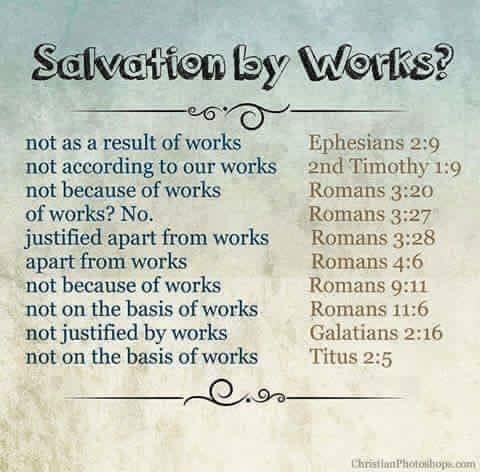
Justification by faith alone is a vitally important doctrine. Luther said it was on the basis of this doctrine that the Reformation stood or fell.
The Reformed Protestant understanding of the relationship between faith and works is that salvation comes by faith in Christ alone, and the good works performed by believers aren’t the basis of salvation but should be understood as the necessary evidence of that salvation.
We are saved by grace alone, through faith alone in Christ alone. We are forensically justified by faith alone in the imputed righteousness of Christ. Our justification is grounded solely on the condition of our faith.
To the Roman Christians, Paul said, “For by works of the law no human being will be justified in his [God’s] sight” (Romans 3:20). To the Galatian believers: “We know that a person is not justified by works of the law but through faith in Jesus Christ” (Galatians 2:16; cf. 3:5). To justify one is to declare them righteous.
The “works of the law” are the actions performed to fulfill the Mosaic Law found in the first five books of the Old Testament. Keeping the Sabbath, being circumcised (the issue before the Galatian churches), eating “clean” foods, and other ceremonies are powerless to justify us in the sight of God. In addition, following the morality of the law (not murdering, not committing adultery, not stealing) is insufficient to make us right in God’s eyes. No action on the part of sinful creatures can result in God’s declaring them to be righteous in His sight.
Thus we see Paul condemn the notion of works-righteousness, of earning our way to heaven by our works.
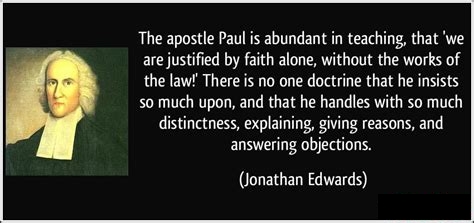
When Paul condemns reliance upon the “works of the law” he quotes from Deuteronomy in Galatians 3:10: “Cursed be everyone who does not abide by all things written in the Book of the Law, and do them” (emphasis mine; see Deut. 27:26). Paul not only condemned relying upon circumcision, food laws, and Sabbath, but he also included everything written in the Law. That is, anyone who tries to offer his own obedience to the Law in the effort to be approved and declared as righteous (as obedient) in God’s sight would instead bring a curse upon himself.
We can only be declared righteous “by faith apart from works of the law” (Romans 3:28), and that faith must rest in the only Savior, the Lord Jesus Christ: “Salvation is found in no one else, for there is no other name under heaven given to mankind by which we must be saved” (Acts 4:12). To continue to attempt to earn a place in heaven through the works of the law is to ignore the sacrifice of Christ: “If righteousness could be gained through the law, Christ died for nothing!” (Galatians 2:21).
Also, when Paul illustrates what it means to rely upon works versus faith, he appeals to a time before God instituted circumcision, food laws, and the Sabbath. Paul appeals to Abraham and Sarah’s sinful efforts to bring about the divine promise by their sinful efforts rather than by faith alone in the seed who was to come — Jesus Christ (Gal. 3:16; 4:21–31).
“For by grace you have been saved through faith. And this is not your own doing; it is the gift of God, not a result of works, so that no one may boast” (Eph. 2:8–9). In a word, it is Christ’s works that are the legal ground of our declaration of justification, not our own good works. The proper definition of the works of the law means the difference between justification and condemnation, heaven and hell.
The question of the relationship between faith and works is central to the division between Protestants and Roman Catholics. Throughout the Bible, we see that salvation is received not on the basis of works but on the basis of faith in God alone. Jesus himself emphasizes this through many parables and sayings, and Paul argues explicitly against the inclusion of works in the basis of our salvation. James, though arguing that justification is by works “and not by faith alone,” can be harmonized with the rest of the New Testament when it is realized that James still expects us to sin—he is combatting faith without works, not faith alone as the basis of salvation. So, the entirety of the New Testament teaches that we are justified by faith alone, but the faith that justifies necessarily flowers into good works.
One of the most important questions in biblical theology is the relationship between faith and works. Indeed, different understandings of the role of faith and works have divided faithful Protestants from Roman Catholics since the time of the Reformation. I will present here a traditional Reformed understanding of faith and works from the Scriptures.
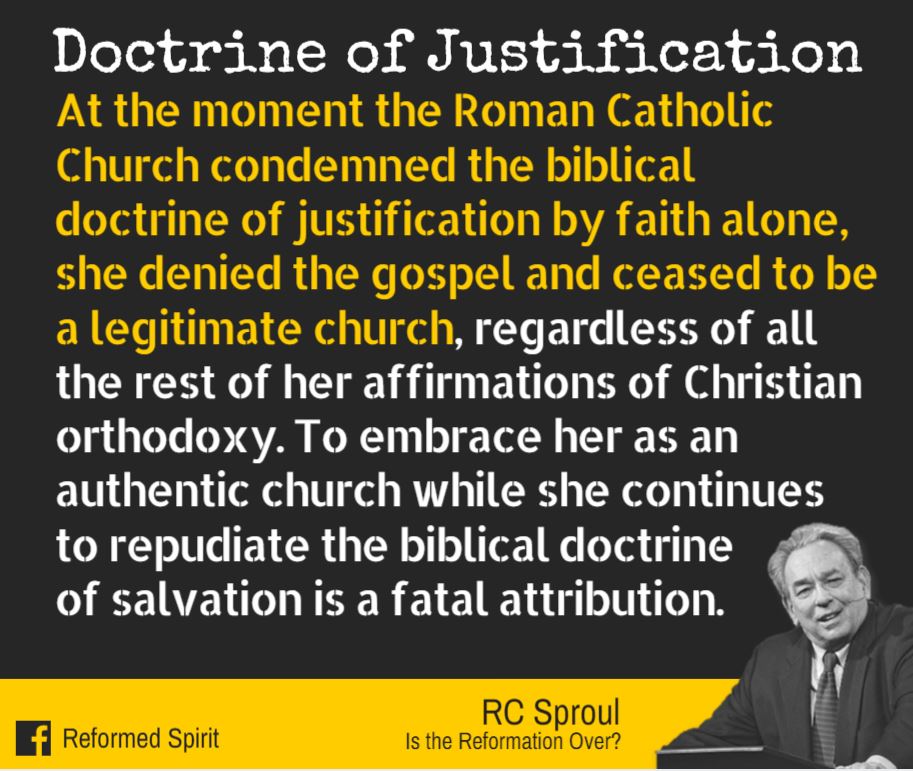
The notion that we are saved by faith alone is anchored in the teaching of Jesus. For instance, Jesus commends the faith of the centurion, noting that he did not find such faith in Israel (Matt. 8:5–13; Luke 7:1–10). We see in the account of the sinful woman who broke into Jesus’s dinner with Simon the Pharisee a stunning reminder of saving faith (Luke 7:36–50). This woman was well-known for her sin, and she expressed her sorrow with the tears that fell on Jesus’s feet, with her hair with which she washed them dry, and with the kisses and perfume lavished on his feet. Jesus commended her love, but her love flowed out of the forgiveness freely received. Hence, the story concludes with the declaration, “Your faith has saved you. Go in peace” (Luke 7:50). We have a dramatic indication in this story that forgiveness is by faith alone, and such faith brings peace.The story of the Pharisee and tax collector also indicates that forgiveness and justification are not granted to the Pharisee who was so proud of his acts of religious devotion (Luke 18:9–14). Instead, Jesus pronounces that the one who is right before God is the tax collector who realizes that his only hope is God’s mercy. Jesus also teaches that blessing belongs to the poor in spirit (Matt. 5:3), to those who mourn over their sin (Matt. 5:4), to those who are humble (Matt. 5:5), to those who hunger for a righteousness that isn’t their own (Matt. 5:6). Jesus’s meals with sinners and tax collectors (e.g., Matt. 9:9–13) point to the same truth. Such meals in the ancient world signified social acceptance, and by eating with tax collectors Jesus communicated acceptance, forgiveness, and love to those who had repented of their sins.
The Gospel of John emphasizes the importance of faith, using the verb “believe” (pisteuō) 98 times to underscore the importance of faith. At one point the Jews ask what they have to do to perform God’s works (John 6:28). Jesus replies that they are to “believe in the one he has sent” (John 6:29). John emphasizes repeatedly that those who believe enjoy eternal life (John 1:12; 3:16; 5:24, etc.). One is not saved by working for God but by believing in God.
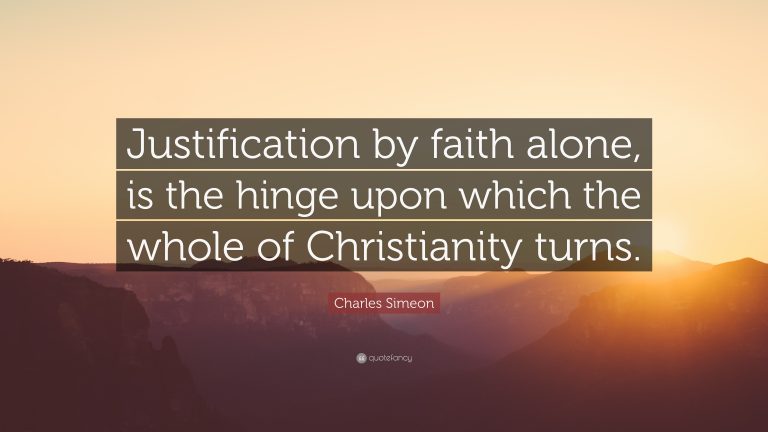
Paul teaches that justification and the gift of the Spirit are received by faith instead of by works of law (Rom. 3:20, 28; Gal. 2:16; 3:2, 5, 10). Luther rightly translates Romans 3:28 to say that we are justified “by faith alone,” and not by works of law. Some have argued that “works of law” refers to the ceremonial law or to the boundary markers of the law, but it is much more natural to understand works of law to refer to the whole law. In other words, justification doesn’t come through doing the law but by faith.
Such a reading is confirmed by other texts which teach that justification is by faith instead of works. English readers may fail to notice that Paul shifts from “works of law” in Romans 3 to “works” in Romans 4. We see in Romans 4 that Abraham was not justified by works but by faith (Rom. 4:1–5). The word “works” is fitting with respect to Abraham since he didn’t live under the Mosaic law. The case of Abraham validates the reading proposed for Romans 3 above. Justification can’t be obtained by works but only by faith. Works or works of law can’t bring justification since all people without exception are sinners (Rom. 1:18–3:20; Gal. 3:10). It is a staple of Pauline teaching that justification is by faith instead of through works (Phil. 3:2–9; Eph. 2:8–9; 2 Tim. 1:9; Titus 3:5).
We should not think that the intrinsic virtue of faith saves as if faith is our righteousness as if faith is a good work. What saves is the object of faith, which for Paul is Jesus Christ as the crucified and risen one (Rom. 3:21–26; 2 Cor. 5:18–21; Gal. 1:4; 2:21; 3:13). Faith unites believers to Christ, who became sin for our sakes, who has taken the curse we deserve, who has absorbed the wrath in our place. Paul clearly teaches, then, that salvation comes by believing not achieving, by resting in Christ instead of working for him, by trusting instead of performing.
Works and Salvation
This raises the question, however, of the role of works in salvation, for we see in a number of texts that works are necessary for eternal life. For instance, Jesus teaches that those who refuse to forgive others will not be forgiven by God (Matt. 6:14–15; 18:31–35), that those who practice lawlessness will not enter the kingdom (Matt. 7:21–23), that only those who bear good fruit are truly saved (Mark 4:1–20), that only true disciples belong to him (Luke 9:57–62; 14:25–35), and that those who practice good will be raised to life (John 5:29).
We find the same emphasis in Acts. Those who want to escape God’s wrath must repent of their sin (Acts 2:38; 3:19; 17:30), and they must “do works worthy of repentance” (Acts 26:21). Simon, for instance, isn’t truly saved since he hasn’t truly repented of his sins (Acts 8:9–24). Paul also says that those who practice the things of the flesh will not enter God’s kingdom (Gal. 5:19–21; cf. 1 Cor. 6:9–11). God is impartial and fair; those who do good will be rewarded with eternal life and those who practice evil will face final judgment (Rom. 2:6–11). Only those who sow to the Spirit will enjoy eternal life, while those who sow to the flesh will be destroyed (Gal. 6:8). Paul reminds his readers that God avenges evil (1 Thess. 4:6), that those who do what is good will be rewarded (2 Cor. 5:10).
Paul and JamesJames, at first glance, seems to contradict Paul’s theology of justification. Paul affirms that believers are justified by faith and not by works. James says that justification is by works “and not by faith alone” (James 2:24). James refers to the same verse about Abraham’s faith (James 2:23; Gen. 15:6) that Paul cites (Rom. 4:3; Gal. 3:6), but he seems to apply the verse in a radically different way, arguing that the works which followed Abraham’s faith justified him, while Paul contends that Abraham was justified by his faith, and not by his works.
Some scholars claim that Paul and James contradict one another, but such a view contradicts the inspiration of Scripture, and there is a plausible solution to our dilemma. We have already seen that both Jesus and Paul teach salvation by faith, and yet also emphasize the necessity of good works for salvation. The good works necessary for salvation can’t be the basis of one’s salvation since God is infinitely holy and demands perfection. Thus, the good works performed by believers aren’t the basis of salvation but should be understood as the necessary evidence of salvation. Such works are the fruit and product of our new life in Jesus Christ. We have an important confirmation that James himself believed this, for he says in James 3:2 that “we all stumble in many ways.” James means by this that we all sin in many ways. And he makes this comment immediately after insisting on justification by works (James 2:24)! Apparently, the works that justify are quite imperfect, and thus they could never be the basis of our justification since God demands perfection. Since we continue to stumble in a myriad of ways, our works function as evidence and indication that we have a new life. Justification is by faith alone, as we put our trust in Christ alone, and thus our salvation is by grace alone and for the glory of God alone, and our good works demonstrate that we are trusting in Christ for our salvation.
[I] answer, that not only works done before faith are excluded, but also works that follow faith and are done in the estate of grace. For Paul here reasons thus: If no flesh be justified by works, then not we believers; but no flesh at all is justified by works; therefore not we believers. David reasons of the same manner: “No flesh shall be justified in thy sight” (Ps. 143:2); therefore I cannot, though otherwise I be Thy servant in keeping Thy commandments. When Abraham was the father of all the faithful, and was come to the highest degree of faith, and abounded in good works, yet was he not then justified by works (Rom. 4:1–2). Paul kept “a good conscience before God and men” (Acts 23), and yet was he “not justified thereby” (1 Cor. 4:4). And he says that “we are not saved by the works which God hath ordained, that we should walk in them” (Eph. 2:9–10). And the works that God has ordained for us to walk in are the best works of all, even works of grace. Again, he says that ‘we are not saved by works of mercy’ (Titus 3:5). It may be objected that there is a cooperation of works and faith (James 2:22). I answer that this cooperation is not in the act of justification, nor in the work of our salvation, but in the manifestation of the truth and sincerity of our faith without hypocrisy. And for the declaration and approbation of this, faith and works jointly concur. Here then we see it is a pestilent and damnable doctrine of the papists when they teach justification by the works of the law. Let us here be warned to take heed of it.
William Perkins, Commentary on Galatians, in Works, 2:112–13Paul writes in Galatians 2:16, “…a person is not justified by the works of the law, but by faith in Jesus Christ. So we, too, have put our faith in Christ Jesus that we may be justified by faith in Christ and not by the works of the law, because by the works of the law no one will be justified.” In response, some people think we are justified by works, just not works of the Law. This means that Paul is excluding the works that are outlined in the Old Testament as capable of saving. But other works, such as the fruit of the Spirit (Galatians 5:22-23) can save. Are they right? Are we justified by works?
Most good works are in the Law. If we are justified by works, but not works of the Law, that would assume that there are some works that one can perform which are not found in the Law. It is these works that justify. But if you are performing works that are in the Law, and you think that they justify you, then you are guilty of precisely what Paul argued against when he said that we are not justified by works of the Law. The question is, what sort of works are we justified by? Are we justified when we love our neighbor as ourselves? Leviticus 19:8 (the Law) reads, “You shall love your neighbor as yourself.” Are we justified when we “love the Lord your God with all your heart, with all your soul, and with all of your mind”? That commandment is in the Law as well (Deuteronomy 6:5). This means that if you are trying to be justified by works, you would have to do that without being justified by loving God or loving your neighbor as yourself. How would one do that? Some people think we are justified by works, just not works of the Law, and this overlooks the fact that the good works that one would seek to be justified by being in the Law.

Paul only refers to the ceremony of circumcision? Some people think that we are justified by works, just not works of the Law, those works specifically being the ceremony of circumcision. Paul is arguing that we are not justified by our circumcision. A Christian can be saved without undergoing the process of circumcision. However, Paul often refers to the moral aspects of the Law while saying that we are not justified by the Law. In Romans 3:20, he writes, “…by the works of the Law no flesh will be justified in His sight; for through the Law comes the knowledge of sin.” If through the Law comes the knowledge of sin, then he is clearly referring to the moral precepts of the Law. He expands this point in Romans 7:7-12, where he uses the law against covetous as his example. Further, he often makes distinctions between the Law and circumcision. In 1 Corinthians 7:19, “Circumcision is nothing, and uncircumcision is nothing, but what matters is the keeping of the commandments of God.” In Romans 2:25, “Circumcision has value if you observe the law, but if you break the law, you have become as though you had not been circumcised.” Thus you will know that Paul is referring to circumcision when he mentions circumcision. But when he says that no flesh will be justified by works of the Law, he is referring to the moral aspects of the Law.
Is there a “higher order” morality? If we are justified by works, but not works of the Law, that would entail that there was a higher standard of morality that transcends the standard given by God. There are moral precepts that are of more value than that which is found in the Law. The question is where we can find them. They cannot be to love God or love their neighbor, because these are laws. It seems that the only answer that is forthcoming is that it is written on our conscience. So we are called to follow a standard of morality that is different for everybody, that can be changed based on culture and comported to circumstances as opposed to God’s perfect standard of morality. What good reasons are there to think that God would replace his law with our conscience? Why would that even be necessary, when Paul wrote in Romans 7:12, “So then, the Law is holy, and the commandment is holy and righteous and good.” Some people think we are justified by works, just not works of the Law. But if the Law is holy and the commandment is holy, righteous, and good, then why should we think that there is a higher-order system of morality that justifies us? Why would we not be justified by the Law if the Law is holy, righteous, and good?
God justifies the ungodly. When people say that we are justified by works, just not the works of the Law, they are forgetting the positive argument that Paul makes. Paul says more than what we are not justified by. He has more to say about justification than “we are not justified by the works of the Law.” He tells us how we are justified. He writes that God justifies the ungodly (Romans 4:5). If God justifies the ungodly, then in what sense could a person be justified by their works? Further, Paul writes in Ephesians 2:5 that God “even when we were dead in our transgressions, made us alive together with Christ (by grace you have been saved)…” God justifies the ungodly and makes those who are dead in their trespasses into new creatures. Accordingly, God makes us new creatures when we are dead in our sins, when we are ungodly. When we come to him with an empty hand of faith, then he makes us new creatures and we become godly and righteous. But upon justification, all of our outward actions are only ungodly, and God still justifies us. Yet some people think we are justified by works, just not works of the Law. If that were true, this would mean that God justifies the righteous who are not dead in their transgressions.
“For by grace you have been saved through faith; and that not of yourselves, it is the gift of God; not as a result of works, so that no one may boast.” Ephesians 2:8-9 Aside from Paul’s masterful treatise in the book of Romans and his impassioned rebuke in the book of Galatians, the second chapter of Ephesians is where the gospel is clearly presented. Paul explicitly denies that we are saved by grace through faith, and not of works. Of course, some people think that we are saved by works, just not works of the Law. The problem is that Paul negates any works by saying that this salvation is “not of yourselves.” If salvation is not of yourselves, all works are eliminated. Salvation is solely a gift of God.
Here is an excellent video presentation by Dr. R. C. Sproul. He thoroughly explains justification by faith alone.
The Reformed Doctrine of Good Works
The Protestant PulpitFor by grace are ye saved through faith; and that not of yourselves: it is the gift of God: (9) Not of works, lest any man should boast. (10) For we are his workmanship, created in Christ Jesus unto good works, which God hath before ordained that we should walk in them. Eph 2:8-10
Introduction
With the rediscovery of the doctrine of justification by faith alone during the Reformation, there arose several controversies over the issue of Good Works. In many ways, these controversies have continued, though the Protestant churches –Lutheran, Anglican and Reformed –have had a single voice on this matter.
Let us consider the controversy with Rome. Rome viewed works as essential to justification. While we must believe, we must also work to further our justification. In the words of Trent, a person, “through the observance of the commandments of God and of the Church, faith co-operating with good works, increase in that justice which they have received through the grace of Christ, and are still further justified” (Session Six, Chapter 10). In fact, Rome repudiates the idea that works are not involved: “If any one saith, that by faith alone the impious is justified, in such wise as to mean, that nothing else is required to cooperate in order to the obtaining the grace of Justification, and that it is not in any way necessary, that he be prepared and disposed by the movement of his own will: let him be anathema” (Session Six, Canon IX). To the Romanist, good works merit grace and eternal life:
If any one saith, that the good works of one that is justified are in such manner the gifts of God, that they are not also the good merits of him that is justified; or, that the said justified, by the good works which he performs through the grace of God and the merit of Jesus Christ, whose living member he is, does not truly merit increase of grace, eternal life, and the attainment of that eternal life,—if so be, however, that he depart in grace,—and also an increase of glory: let him be anathema (Session Six, Canon XXXII)
The Reformers steadfastly rejected this. The upheld the idea that we are justified apart from works, even as Paul teaches us. Luther explained this concept of “justification” in the Smalcald Articles:
The first and chief article is this: Jesus Christ, our God and Lord, died for our sins and was raised again for our justification (Romans 3:24-25). He alone is the Lamb of God who takes away the sins of the world (John 1:29), and God has laid on Him the iniquity of us all (Isaiah 53:6). All have sinned and are justified freely, without their own works and merits, by His grace, through the redemption that is in Christ Jesus, in His blood (Romans 3:23-25). This is necessary to believe. This cannot be otherwise acquired or grasped by any work, law or merit. Therefore, it is clear and certain that this faith alone justifies us … Nothing of this article can be yielded or surrendered, even though heaven and earth and everything else falls (Mark13:31). Luther, Martin. “The Smalcald Articles,” in Concordia: The Lutheran Confessions. Saint Louis: Concordia Publishing House, 2005, 289, Part two, Article 1.
However, because of this teaching and because of the way in which it was at times taught, papal apologists have made it seem that Protestants teach lawlessness. For example, Roberto Bellarmine in his book on Justification says that Protestants deny the necessity of good works (Book 4). But this can hardly be the case. And then Bellarmine goes on to say that Protestants lives and manners reveal that they believe themselves to be able to live wickedly, which is certainly not the case in contrast to the Romanists.
The Reformers were very clear about the necessity of good works. For example, Luther on Galatians 5, writes, “Both subjects, even faith and works, ought to be diligently taught and urged; yet so that each may remain within its own limits. For if works alone are taught, as is the case in the Papacy, faith is lost sight of; if faith alone is taught, immediately carnal men imagine that good works are not necessary.” From this we can easily see that Luther plainly pleads for the necessity of works and ascribes the contrary error to carnal men. In his disputation against John Eck or Eccius, he says, “Eccius knows that it is not a sentiment of mine, that good works are not necessary.”
Likewise, Calvin says in his Institutes (lib. 3. cap. 19. sect. 2), “The whole life of Christians indeed ought to be a sort of meditation of piety, since they are called to sanctification. The office of the law consists in this, namely, that by reminding us of our duty, it excites to the pursuit of holiness and innocence.” Many other statements by Calvin can easily cited here. Martin Chemnitz, often called the second Martin of the German Reformation says the same thing, remarking:
We teach that God does not allow any licence to the justified, whereby they would venture freely and securely to indulge in their depraved lusts; but that he requires from them good works, or fruits of faith, neither will he suffer them to be idle, and not to produce good works. Besides, we teach, that God does not merely recommend this new obedience to the justified, nor propose it as if it were a matter indifferent or optional, but he requires it as fully necessary, on the ground of his own command and will (3 parte loc. Theolog. loco de Bonis Operibus, quaest. 1).
I now select two other men, for they were influential in their own countries as well as in forming the 39 Articles of the English church. At the Conference at Ratisbon (pag. 537), Bucer observed, “Although life eternal is to be sought by us in the constant pursuit of good works, yet it is to be obtained altogether through faith by all who firmly believe in the Gospel of Christ.” He then writes in even clearer words:
We agree with our adversaries in this, that the justified person must necessarily live righteously. We agree likewise that they will perish eternally, who do not perform good works. But the question is, whether our good works are of themselves worthy of that glory which God promises (Enarrat. Epist. ad Ephes. cap. 2, pag. 69).
Peter Martyr, upon the 2nd chapter of the Epistle to the Romans, page 56, says, “God intended this connexion, namely, that blessedness should follow good works; yet not as the effect from its cause, but as something conjoined with them by the appointment of God.” The same author (ibid. pg. 58) goes on to say, “We must know that faith cannot be void of good works; therefore those who return at the last hour, if they believe, will not be destitute of good works.” As we see here, Peter Martyr maintains the necessity of good works in a twofold respect: one arising from the constitution or appointment of God himself, and the other from the very nature of faith.
Now, I quote all of these men not merely so that I may overwhelm you with quotes from the past, merely dealing with a dead controversy. Rather, I do so with a real intent. After the Reformers left, there were numerous controversies within Lutheranism and the Reformed churches over this very matter. The Antinomian and Majoristic Controversies are part of this.
In fact, we see the very same thing today in the Lordship Controversy that still affects our Evangelical churches. Now, the Non-Lordship position is that works are not necessary at all, and that by saying that they are is to destroy the doctrine of justification by faith alone. For example, one of the main proponents of this aberrant position states,
If good works were necessary to obtain salvation, then why would Paul say that salvation is ‘not of works, lest anyone should boast’? And why would he speak of the salvation of the Ephesians as an already accomplished fact, ‘You have been saved’? The answers are simple. Good works are not a condition. Faith is the only condition and salvation occurs at the moment of faith. No subsequent sins can change this. Salvation is a done deal at the moment one believes in Christ for eternal life (Bob Wilkin, Confident in Christ, pg 52).
In contrast, the Lordship position believes that good works are the necessary fruit of a living faith. Sam Storms writes:
The doctrine of Lordship Salvation views saving faith neither as passive nor fruitless. The faith that is the product of regeneration, the faith that embraces the atoning sacrifice of Jesus on the cross energizes a life of love and obedience and worship. The controversy is not a dispute about whether salvation is by faith only or by faith plus works. All agree that we are saved by grace through faith, apart from works (Eph. 2:8-10). But the controversy is about the nature of the faith that saves. (The Lordship Salvation Debate, November 6, 2006).
In all of these, there is decided parallel to the issue found in the Post-Reformation debates. And we are not left to decide what the Reformers thought about this. They were unanimous in their position. They believed that good works were necessary in some particular way; and the rejection of the necessity of good works is a rejection of what the Reformers clearly taught: good works are necessary in some way.
Now, in an attempt to define the way in which they are necessary, we must first define good works before we can address the necessity of good works. These all are fraught with difficulties and complexities. In a two part series, I can hardly be expected to cover this in any satisfactory manner. Yet, I hope to outline the issues and provide some answers.
Definition of Good Works
Now, the issue over goods works must begin with their definition. What constitutes a good work? Well, we may say that there are two things that every good work possesses, and if any one of them is not included, then it is a not a good work. The first deals with a conformity to an outward standard, and the second deals with the inner disposition.
Works Must Be Prescribed by Scripture
First, in order for a work to be good, it must be something that is prescribed by Scripture alone. It is the absolute maxim of Protestantism that Scripture alone is the perfect rule of faith and practice. As the Westminster Confession of Faith, Savoy Declaration, and 2nd London Baptist Confession states, “the Scriptures are the only rule to direct us how we may glorify God.” We are not left to find out what God expects from us; “He hath shewed thee, O man, what is good; and what doth the LORD require of thee, but to do justly, and to love mercy, and to walk humbly with thy God?” (Micah 6:8).
These Scriptures are the norm of the life of the believer; and, hence, they are also the rule for the good works which he is to do. Only those things which God has commanded are of the nature of good works. As A. A. Hodge says, “Every principle, every motive, and every end of right action, according to the will of God, may there be easily learned by the devout inquirer. God says to his Church: ‘What thing soever I command you, observe to do it: thou shalt not add thereto, nor diminish from it” (Deut. 12:32; cf. Rev. 22:18-19)’.”
This is norm is all-sufficient. On the positive side, this means that we need nothing else to guide us in doing good works. We are told by Paul that the inspired Word of God is profitable “that the man of God may be perfect, throughly furnished unto all good works” (2Ti 3:17). On a negative side, this means that that we must not invent things to please God. As Hodge puts it, “God very energetically declares his abhorrence of uncommanded services, of ‘voluntary humility’ and ‘will-worship’ (Isa. 1:11-12; Col. 2:16-23).
Now, in saying this, we must realize that we must stress three things. First, the standard of good works is not our reasons, our conscience, or any feelings that we might have. Rather, it is the revealed divine will; it is the personal authority without and above us –not in us.
Well, in our day this cannot be expressed strong enough. People often act that they have some ability to discern what is acceptable to God by their own reasoning, their own conscience, their own ideals, and their own feelings. And this has even found expression in the teaching of some wherein love is the absolute and only standard of the Christian, seeing that the Law is now passé.
But love is not the standard; it is a motive. A man say that something is good because love is his motive. But it may be a gross perversion. Obviously this is the case with same-sex marriages. Another example is the failed and flawed system of Situational Ethics, which says that the only absolute ethical standard is love.
In a dialogue over what was termed the New Morality, Leon Morris, Carl F. H. Henry, James Daane, and John Warwick Montgomery addressed this issue. And what they said in part is very helpful here. First, they remind us that love is motive; it does not in itself define the nature of obligations. Second, the Scriptural teaching on love cannot be separated from total situation of Scripture. Third, the Scripture never allows us to divorce love from the Law itself and obedience to the Law. “If ye love me, keep my commandments” (John 14:15). “By this we know that we love the children of God, when we love God, and keep his commandments. For this is the love of God, that we keep his commandments: and his commandments are not grievous” (1 Jn. 5:2). For this reason, A. A. Hodge wrote:
The law of absolute moral perfection to which we are held in subjection is not the law of our own reasons or consciences, but it is an all-perfect rule of righteousness, having its ground in the eternal nature of God, and its expression and obliging authority to us in the divine will.
It is important for us to realize that the Gospel and the Law are both needed to guide the Christian unto good works. Writing on this, the Lutheran Reformers said:
It is distinctly to be explained, what the Gospel contributes to the new obedience of believers, and what (as to the good works of believers) is the office of the Law. For the Law teaches that it is the will and command of God, that we should lead a new life; but it does not give us strength and faculties with which we can commence and afford the new obedience. But the Holy Spirit who is given and received by the preaching not of the Law but of the Gospel, renews the heart of man. Afterwards the same Spirit uses the ministration of the Law, that by it he may teach the regenerate, and show them in the decalogue what is that good and acceptable will of God (Rom. 12:2), that they may know that good works are to be observed, as those which God hath before ordained that we should walk in them (Eph. 2:10) (FORM. CONO. (Sol. Dec., VI, 10 seq.).
Second, the standard of good works is not traditionalism. The idea that good works is based upon the revealed will of God necessarily combats all efforts to create manmade standards. Remember what our Lord said about the Pharisees, “But in vain they do worship me, teaching for doctrines the commandments of men” (Matt. 15:9). God only has a right to declare what shall be done in his service; but they held their traditions to be superior to the written word of God, and they taught them as doctrines binding the conscience. What J. C. Ryle says here should be repeatedly remembered and frequently reflected upon:
We see this point brought out most strikingly in our Lord’s answer to the charge of the Pharisees against His disciples. He says, “Why do ye transgress the commandment of God by your traditions?” He strikes boldly at the whole system of adding anything, as needful to salvation, to God’s perfect word. He exposes the mischievous tendency of the system by an example. He shows how the vaunted traditions of the Pharisees were actually destroying the authority of the fifth commandment. In short, He establishes the great truth, which ought never be forgotten, that there is an inherent tendency in all traditions, to “make the word of God of none effect.” The authors of these traditions may have meant no such thing. Their intentions may have been pure. But that there is a tendency in all religious institutions of mere human authority, to usurp the authority of God’s word, is evidently the doctrine of Christ. It is a solemn remark of Bucer’s, that “a man is rarely to be found, who pays an excessive attention to human inventions in religion, who does not put more trust in them than in the grace of God.
And have we not seen melancholy proof of this truth, in the history of the Church of Christ? Unhappily we have seen only too much. As Baxter says, “men think God’s laws too many and too strict, and yet make more of their own, and are precise for keeping them.” Have we never read how some have exalted canons, rubrics, and ecclesiastical laws above the word of God, and punished disobedience to them with far greater severity than open sins, like drunkenness and swearing?—Have we never heard of the extravagant importance which the Church of Rome attaches to monastic vows, and vows of celibacy, and keeping feasts and fasts; insomuch that she seems to place them far above family duties, and the ten commandments?—Have we never heard of men who make more ado about eating meat in Lent, than about gross impurity of life, or murder?—Have we never observed in our own land, how many seem to make adherence to Episcopacy the weightiest matter in Christianity, and to regard “Churchmanship,” as they call it, as far outweighing repentance, faith, holiness, and the graces of the Spirit?—These are questions which can only receive one sorrowful answer. The spirit of the Pharisees still lives, after eighteen hundred years. The disposition to “make the word of God of none effect by traditions,” is to be found among Christians, as well as among Jews. The tendency practically to exalt man’s inventions above God’s word, is still fearfully prevalent. May we watch against it, and be on our guard! May we remember that no tradition or man-made institution in religion can ever excuse the neglect of relative duties, or justify disobedience to any plain commandment of God’s word.
Third, the standard of good works is not good intentions. Now, I realize that there is a bit of repetition here, but it is a slightly different emphasis. Too many will seek to argue that they will do things that merely voluntarily to help their piety. And this sounds feasible, and may even be true. Yet, great caution is required here. Voluntary worship or will worship, as Paul calls it in Colossians 2:23, is a dangerous thing. Albert Barnes explains:
Voluntary worship; i. e., worship beyond what God strictly requires-supererogatory service. Probably many of these things they did not urge as being strictly required, but as conducing greatly to piety. The plea doubtless was, that piety might be promoted by service rendered beyond what was absolutely enjoined, and that thus there would be evinced a spirit of uncommon piety – a readiness not only to obey all that God required, but even to go beyond this, and to render him voluntary service.
There is much plausibility in this; and this has been the foundation of the appointment of the fasts and festivals of the church; of penances and self-inflicted tortures; of painful vigils and pilgrimages; of works of supererogation, and of the merits of the “saints.” A large part of the corruptions of religion have arisen from this plausible but deceitful argument.
God knew best what things it was most conducive to piety for his people to observe; and we are most safe when we adhere most closely to what he has appointed, and observe no more days and ordinances than he has directed. There is much apparent piety about these things; but there is much wickedness of heart at the bottom, and there is nothing that more tends to corrupt pure religion.
It Must Spring from a Living Faith and Love for God and His Glory
Now, we have said that there must be a conformity to an outward standard –the Scriptures alone. Yet, having said this, we must with equal force assert that any work that is to be considered good must have an inner disposition. It must spring from a living faith in Christ and a love for God and His glory. Mere conformity to an external standard is not enough. We must not have only outward formality, but we must have inward intention that is good.
Now, we must all agree that for anything to be considered to be a good work, the act must spring for good motives. But as long a person does not believe that God is propitious to him, he cannot have pure motives. How can the human heart love God while it perceives Him to be dreadfully angry? We may fear God but we will not love Him. We will obey Him merely to gain His divine favor and escape wrath, not out of love for Him and desire to glorify Him. A. A. Hodge explains:
All men recognize that the moral character of an act always is determined by the moral character of the principle or affection which prompts to it. Unregenerate men perform many actions, good so far as their external relations to their fellow-men are concerned. But love to God is the foundation-principle upon which all moral duties rest, just as our relation to God is the fundamental relation upon which all our other relations rest. If a man is alienated from God, if he is not in the present exercise of trust in him and love for him, any action he can perform will lack the essential element which makes it a true obedience.
Therefore, God is not loved till after we have obtained mercy through faith. After we are justified by faith and regenerated, we begin to fear God, to love Him, to ask and expect assistance of Him; we begin likewise to love our neighbors, because our hearts have spiritual and holy emotions. These things cannot take place unless, being justified by faith and regenerated, we receive the Holy Spirit. Francis Beattie likewise highlights this, when he notes:
Good works are at once the fruits and the evidences of a true and lively faith. Where there is such faith there is peace with God, and a filial spirit towards him, on the one hand; and on the other, union with Christ, and the renewal of the heart. Out of this renewed heart faith, the inner principle of good works, comes. Hence, good works are done only by a regenerate heart, and they are the fruits of the faith of such a heart.
Now, this is vitally important to note. Only believers are able to produce good works because only they will love God and seek to glorify Him. The works of unbelievers have no value before God. This assertion caused no small among the Romanists. They flatly condemned it. At the Council of Trent, Romanists said:
If any one saith, that all works done before Justification, in whatsoever way they be done, are truly sins, or merit the hatred of God; or that the more earnestly one strives to dispose himself for grace, the more grievously he sins: let him be anathema (Session 6, Canon VII).
This is a real failure on the part of Rome to understand the nature of all work done outside of Christ. All our righteousness are filthy rags. As Bernard of Clarivuax
Our Righteousness (if we have any) is of little value; it is sincere, perhaps, but not pure; unless we believe ourselves to be belter than our fathers, who no less truly than humbly said, All our righteousnesses are as filthy rags. For how can that righteousness be pure, which cannot yet be free from imperfection? Serm. 5 de Verbis Esaias Prophette, vi., 1, 2.
Nothing pure comes from the unregenerate because their motives are impure. Faith has not purified their hearts. For this reason, the Lutheran Reformer John Andrew Quenstedt said:
Although, therefore, some of the actions of unregenerate men are not vicious in themselves and as to their substance, they are, nevertheless, by way of accident vicious, viz., because they are devoid of the requisites of really good works before God. Wherefore, when even the virtuous actions of unbelievers are called sins by Augustine, Luther, and others, it is not in respect to the very matter or substance of the actions, nor so far as they are undertaken and performed according to the views of right and wrong remaining in this corrupt nature since the fall (for in this manner we grant that they are good), but in respect to the efficient, formal, and final cause of works, by which their good or bad quality is to be estimated in God’s judgment, to wit, because their works are polluted and contaminated by sins, as they are not performed by a person reconciled to God, and regenerated by the Holy Spirit, nor to the glory and honor of God (IV. 312).
Now, this is important because it tells us that before any good work can be accomplished, the person must be converted. He must be right with God. We are told the plowing of the wicked is an abomination to the Lord. W. D Smith gives a wonderful illustration of this:
In a gang of pirates we may find many things that are good in themselves. Though they are in wicked rebellion against the laws of the government, they have their own laws and regulations, which they obey strictly. We find among them courage and fidelity, with many other things that will recommend them as pirates. They may do many things, too, which the laws of the government require, but they are not done because the government has so required, but in obedience to their own regulations. For instance the government requires honesty and they may be strictly honest, one with another, In their transactions, and the division of all their spoil. Yet, as respects the government, and the general principle, their whole life is one of the most wicked dishonesty. Now, it is plain, that while they continue in their rebellion they can do nothing to recommend them to the government as citizens. Their first step must be to give up their rebellion, acknowledge their allegiance to the government, and sue for mercy. So all men, in their natural state, are rebels against God, and though they may do many things which the law of God requires, and which will recommend them as men, yet nothing is done with reference to God and His law. Instead, the regulations of society, respect for public opinion, self-interest, their own character in the sight of the world, or some other worldly or wicked motive, reigns supremely; and God, to whom they owe their heart and lives, is forgotten; or, if thought of at all, His claims are wickedly rejected, His counsels spurned, and the heart, in obstinate rebellion, refuses obedience. Now it is plain that while the heart continues in this state the man is a rebel against God, and can do nothing to recommend him to His favor. The first step is to give up his rebellion, repent of his sins, turn to God, and sue for pardon and reconciliation through the Savior. This he is unwilling to do, until he is made willing. He loves his sins, and will continue to love them, until his heart is changed.
The good actions of unregenerate men, Smith continues,
are not positively sinful in themselves, but sinful from defect. They lack the principle which alone can make them righteous in the sight of God. In the case of the pirates it is easy to see that all their actions are sin against the government. While they continue pirates, their sailing, mending, or rigging the vessel and even their eating and drinking, are all sins in the eyes of the government, as they are only so many expedients to enable them to continue their piratical career, and are parts of their life of rebellion. So with sinners. While the heart is wrong, it vitiates everything in the sight of God, even their most ordinary occupations; for the plain, unequivocal language of God is, ‘Even the lamp of the wicked, is sin,’ Proverbs 21:4.” (What is Calvinism. pp. 125-127; quoted in Boettner, Reformed Doctrine of Predestination).
https://www.monergism.com/reformed-doctrine-good-works -
Advent Poem

It’s time for Christmas mirth
Christ has won us second birthOne of the most amazing events in history
Come see baby Jesus in the nativityThe God-Man has been incarnated
We should be elatedHe will go on to defeat death and sin
It’s our salvation He shall winSo rejoice
Lift up your voiceIn a humble manger, our Savior was born
Out of love for us, He would face man’s scornThe animals witnessed this miracle sublime
During the cold Bethlehem nighttimeThe Christmas star shined down below on the hay
Over the place where Jesus layTo Egypt would Joseph, Mary, and baby Jesus soon flee
Baby Jesus would survive a killing spreeThey escaped the murderous Herod’s wrath
God would show them the right pathJesus grew into a man
And enacted the Father’s planTo win us ransom from death and sin
Christ would be our propitiationOn that old rugged cross, He’d suffer and die
There was fierce lightning in the skyBut 3 days later, on a silent Sunday morn
Jesus was rebornFrom that dark grave, He did rise
There was no eternal demiseChrist the King of Kings was triumphant
In all of history, this was the greatest momentSo be joyful and of good cheer
As you celebrate our Savior’s birth this yearSing carols, dance and have a great feast
And look for the Christmas star in the eastChristmas is the beginning of our redemption
Christ shall secure His elect without exemptionSo rejoice during this Christmas season
In your heart know that Christ is the reasonby Zachary Uram
(c) 2022 -
Celebrating Holidays: Yay or Nay?

Do you agree or disagree with Durbin? I agree with him. I don’t believe the regulative principle should be applied to ALL areas of life. Just because a holiday isn’t in the Bible doesn’t mean it is improper or that it can’t be God-honoring. I have wonderful childhood memories of celebrating Christmas and Easter with my family. I cherish those memories and would feel deeply deprived and poorer had I not had the chance to have those experiences.
I respect Christians who believe the only holiday we should observe is the Christian Sabbath (Sunday). However I *strongly* disagree with them if they start criticizing those of us who do celebrate holidays not enumerated in Scripture explicitly, or if they assert those of us who celebrate them are somehow sinning. I can’t fathom how a Christian could object to someone celebrating the birth, death, and resurrection of Christ!! What is more worthy of a joyful celebration than that? I would argue that holidays like Christmas and Easter *are* biblical. Because they are real events that happened and are defined in Scripture. To say that God prohibits us from celebrating any holiday except the Sabbath is to go too far.
I am an outlier as a Reformed believer on this issue. Most Reformed apply the regulative principle strictly and eschew celebrating holidays like Christmas and Easter. I usually find myself in agreement with the beliefs of the Puritans, however, on this issue, I think they had a very severe and reactionary attitude towards such celebrations due to their historic association with the Catholic church.
The debate about whether holidays like Christmas or Easter should be celebrated by Christians will likely keep raging till Christ returns. In my experience, online debates are often heated and lack charity. I hope we can discuss this issue in a respectful way and stay focused on biblical support.
-
Politics in America: Destructive, Divisive and Demonic

The following is a discussion I had today with a friend on Facebook. She is a Reformed believer.
I initially posted:
I’m absolutely disgusted by politics! I refuse to waste another second of my life discussing Republicans or Democrats! With the Republican support in Congress for the so-called same-sex marriage bill, the bill was able to pass and Biden will sign it into law! This is a total abomination and mockery of God’s law!! Republicans and Democrats have more in common than they do differences! All politics is a corrupt and dirty business predicated on greed, deceit, selfish interests, and deception! Every single Senator is either a millionaire or is very wealthy!! Politicians are pathological liars!! The vast majority of them are more concerned with their personal accumulation of wealth and power than they are with the interests of most Americans!! I’m also thoroughly disgusted with the media and their machinations with politics! Big money has had a horrible and corrosive effect on our political process! It has poisoned everything!! I see so few politicians who genuinely care about the interests of poor people like myself. We’re not even on their radar!! Another aspect of American politics I’m sick of is the hyper-partisan nature of discourse, debate, and behavior. Politicians treat their opponents as enemies to be destroyed. FROM NOW ON, DO NOT BRING UP POLITICS WITH ME ON MY TIMELINE OR IN PERSONAL MESSAGES!! And before anyone says Trump is different, I personally witnessed him thanking the LGBT community for their support, and how he supports their ”rights”!! This same-sex marriage bill was the last straw. I’ve reached my limit! Also, political discussion raises my blood pressure which is already too high!!
She replied:

Next, I responded:
You are not respecting my opinion. Please don’t try to invalidate my life experiences. I’ve lived in abject poverty my entire life, for 47 years! I also paid attention closely to the news during that time. I listened and read what politicians said and promised to do once elected. You don’t see it as a problem that the poor and middle class have virtually NO representation in our entire Senate? Scripture is clear that wealth is a great burden and a great hindrance to living for Christ alone. Yes, there are some great wealthy Christians, but they are the exception, not the rule. Also, you must understand how detrimental Big Money has been to our political process. It has poisoned it. Things have not always been this way in America. What I have also noticed is virtually every Representative and Senator leaves office substantially wealthier than when they took office. If you don’t think that reflects poorly on the state of politics in America, then I can’t help you. I never said all politicians are evil, or that all wealthy politicians are evil. Please don’t strawman me. The mainstream media is also part of the problem. They feed into the hyper-partisanship of politics. There has been very little coverage of issues that would enhance my life as a poor person, compared to the coverage and positive media attention given to programs like the trillion dollars of tax cuts for the richest Americans which Trump saw through. They make laws that personally enrich their own wealth and power. It is not government by the people, for the people. It’s now government by the lobbyists, corporate interests, and wealthy politicians for themselves! I am just totally disgusted by politics now in America. Nearly 50 years is long enough. It is outrageous for you to accuse me of slander. I did not slander anyone. I stated objective FACTS. I do speak with grace, by saying that you have just in fact slandered me!!
America, Americans, Biden, Big Money, bill, Christian, Christianity, Congress, Democrats, electorate, gay marriage, gay rights, government, grace, homosexual, House, hyper-partisan, Jesus, Jesus Christ, law, laws, lesbian, LGBT, lobbyists, mainstream media, media, political process, politicians, politics, poor, poverty, President, Representatives, Republicans, rich, same-sex marriage, Senate, Senators, slander, tax cuts, transgender, trillions of dollars, Trump, United States, United States of America, US, USA, wealth, wealthy -
The Sad State of American Evangelicalism

It may be no surprise to Christians who are well-informed and careful observers of the spiritual landscape of America, but still the results of the surveys of evangelicals referenced in this post are both shocking and depressing. They reveal a fractured evangelical body in America, one that is rife with all manner of heresies and false teachings. This stems from theological ignorance and failure to preach the full counsel of God. The evangelical church in America is eroding before our eyes.
Cultural Research Center at Arizona Christian University survey
Referring to a recent survey conducted earlier this year by the Cultural Research Center at Arizona Christian University. The data from this latest report came from a nationwide study of about 1,000 Christian pastors across several segments of churches and/or denominational families and was conducted between February and March of 2022.
Franklin Graham said, “I don’t know which 1,000 pastors this group surveyed, but the results are concerning. 39% of evangelical pastors surveyed recently said there is no absolute moral truth and that “each individual must determine their own truth.” What a lie. They also said that, shockingly, 30% of evangelical pastors do not believe that their salvation is based on having confessed their sins and accepting Jesus Christ as their Savior. Researchers also found that one-third or more of the senior pastors they surveyed said they believe that people can merit salvation based solely on their good works. These are all lies, and this kind of false teaching is what is leading people and churches astray. The Bible is God’s Word, from cover to cover. It is the absolute truth—we should live by it, and we can die by it. On Christ, the Solid Rock, I stand.”
The American Worldview Inventory 2022 examined more than three dozen beliefs held by pastors. Researchers found that in addition to believing that people can merit salvation based solely on their good works, one-third or more of senior pastors surveyed also believe the Holy Spirit is not a person but rather “a symbol of God’s power.” Others said that moral truth is subjective; sexual relations between two unmarried people who love each other is “morally acceptable” and biblical teaching on abortion is “ambiguous.” Over a third of senior pastors believe ‘good people’ can earn their way to Heaven.
At least a third of those surveyed also said they believe “socialism is preferable to capitalism and that allowing property ownership facilitates economic injustice,” which researchers say could point to the “increase of cultural and political influence into the church.”
After data reported earlier this year found just 37% of Christian pastors have a biblical worldview, the latest CRC report analyzed that research across all major U.S. denominations, and found that a “loss of biblical belief is prevalent among pastors in all denominational groupings.”
The current report focuses on roughly half of those beliefs, revealing that a shockingly large percentage reject biblical teaching on some of the most basic Christian beliefs.
Among Evangelical pastors, for example, around 43% said they do not believe that the personal accumulation of wealth is provided by God for the individual to manage those resources for God’s purposes.
Another 39% of Evangelical pastors surveyed said there is no absolute moral truth and that “each individual must determine their own truth.” Roughly the same percentage (38%) didn’t answer in the affirmative when asked if “human life is sacred,” while 37% said having faith, in general, is more important than in what — or more specifically, Whom — one has faith.
Perhaps most startlingly, three in 10 Evangelical pastors (30%) didn’t answer in the affirmative if their salvation is based on having confessed their sins and accepting Jesus Christ as their savior.
George Barna, CRC’s director of research, said the results could be linked to another trend he observed in the data.
“While studying the spiritual behavioral patterns of pastors, it became evident that a large share of them do not have a regular spiritual routine,” Barna said. “There was a correlation between possessing biblical beliefs and a consistent regimen of Bible reading, prayer, worship, and confession.
“In some of the denominational groupings, a majority of pastors do not engage in those foundational spiritual practices on a regular basis,” he added. “Yet, among the pastors who have the most consistently biblical beliefs, there is also a daily routine that incorporates all of those disciplines.”
https://www.christianpost.com/news/third-of-evangelical-pastors-say-people-can-get-heaven-just-by-being-good.htmlRemember, this survey was of evangelical pastors, not just regular churchgoers. They should be theologically informed after completing seminary education, but apparently, most of these seminaries have gone woke and been taken over by liberal forces. The theologically conservative majority that evangelicals once held for so long in this great country is no more.
2022 Ligonier Ministries’ State of Theology survey
Sadly, the results of this survey are more of the same, with even more evidence of heretical beliefs.
In John 14:6, Jesus declares, “I am the way, and the truth, and the life. No one comes to the Father except through me.” Tragically, the 2022 Ligonier Ministries’ State of Theology survey, a biennial survey conducted by LifeWay Research that takes “the theological temperature of the United States to help Christians better understand today’s culture and to equip the church with better insights for discipleship”, reveals that the majority of American evangelicals seem to reject this teaching from Christ.
This survey reveals the theological beliefs of Americans about God, sin, salvation, heaven and hell, the church, and the Bible. And the results show many evangelicals hold unorthodox and heretical beliefs. The full report.
The Bible reveals that God is pleased only by the worship of those who approach Him through Jesus Christ, since He alone is the “one mediator between God and man” (1 Tim. 2:5). It is startling enough that 56 percent of U.S. evangelicals believe God accepts the worship of all religions. Yet more concerning is the fact that this percentage has increased by a soaring 14 percent in only the last two years.
While the results include all Americans and are even broken down by a range of categories (age, religious affiliation, sex, income, education level, and so on), the most interesting findings are those for evangelicals. The survey categorized people as having evangelical beliefs if they strongly agreed with the following four statements:
- The Bible is the highest authority for what I believe.
- It is very important for me personally to encourage non-Christians to trust Jesus Christ as their Savior.
- Jesus Christ’s death on the cross is the only sacrifice that could remove the penalty of my sin.
- Only those who trust in Jesus Christ alone as their Savior receive God’s free gift of eternal salvation.
A significant number of evangelicals surveyed (i.e., those identified as having evangelical beliefs) have a profound misunderstanding about the nature and character of God.
- Almost three out of four (73 percent) agree with the claim that Jesus is the “first and greatest being created by God.”
- More than half (58 percent) believe that God accepts the worship of all religions, including Christianity, Judaism, and Islam.
- More than half (56 percent) agree that worshiping alone or with one’s family is a valid replacement for regularly attending church.
- More than half (55 percent) believe the Holy Spirit is a force but is not a personal being.
- More than half (55 percent) agree that “everyone sins a little, but most people are good by nature.”
- More than half (53 percent) disagree with the claim that even the smallest sin deserves eternal damnation.
- More than one in four (46 percent) disagree that every Christian has an obligation to join a local church.
- Almost half (44 percent) say that Jesus was a great teacher, but he was not God.
- Almost one-third (29 percent) agreed with the statement that God learns and adapts to different circumstances, while only 43 percent disagreed.
What It Means: As this and other surveys have shown, the label “evangelical” can often tell us more about a person’s sociological and political convictions than what he believes about the Christian faith.
Indeed, we often use political views as a proxy for religious views—especially when we connect it to geography. If you know that a person is a conservative Republican from Louisiana you might assume she rejects the claim that “God accepts the worship of all religions, including Christianity, Judaism, and Islam.” Similarly, if you know he’s a liberal Democrat from New York City you’re more likely to presume he’d agree with the statement that “gender identity is a matter of choice.”
The result is that we often dismiss people as having unbiblical theological views because of their politics or we assume they’re orthodox because they vote the “right way” (i.e., the way you vote). But that’s not always the case. Unorthodox views are shared by a broad range of people who hold “evangelical belief.”
A better approach is for church leaders to simply ask those in their congregation what they believe about these theological statements. Fortunately, Ligonier has made it possible to easily create a group survey for free in less than a minute.
Once you have the answer, you can steer them in the direction of orthodox belief. Since a key criterion of being an evangelical, as the survey notes, is claiming “the Bible is the highest authority for what I believe,” we should be able to use simple statements based on the Bible to persuade them of the proper biblical response to the questions. Some people, of course, may require more convincing. But for many evangelicals, simply clarifying the issue will be sufficient.
To aid in this process, I’ve provided an example of how you might provide a biblically based response for each of the true/false statements on the survey.
God is a perfect being and cannot make a mistake.
True. Scripture says God is omniscient, meaning he knows all things and he’s immutable, meaning he cannot and does not change (Isa. 46:10; Mal. 3:6; James 1:17; 1 John. 3:20).
There is one true God in three persons: God the Father, God the Son, and God the Holy Spirit.
True. There are three persons in the Godhead: the Father, the Son, and the Holy Ghost; and these three are one God, the same in substance, equal in power and glory (Matt. 3:16–17, 28:19; 2 Cor. 13:14; 1 Pet. 1:2).
God accepts the worship of all religions, including Christianity, Judaism, and Islam.
False. Jesus said he alone is “the way, and the truth, and the life,” and “no one comes to the Father except through me” (John 14:6).
God learns and adapts to different circumstances.
False. Scripture says God is immutable, meaning that he cannot and does not change (James 1:17; 1 John 3:20).
Biblical accounts of the physical (bodily) resurrection of Jesus are completely accurate. This event actually occurred.
True. Scripture says Jesus physically rose from the dead (Mark 16:6).
Jesus is the first and greatest being created by God.
False. Scripture says Jesus is the “firstborn of all creation” (Col. 1:15) because he is exalted to the highest place, but as God he was not created but always existed (John 1:1).
Jesus was a great teacher, but he was not God.
False. Scripture says that Jesus is God (John 1:1; 8:58; Rom. 9:5; Heb. 1:1–4).
God created male and female.
True. Scripture says God created humans as male and female (Gen. 1:27).
The Holy Spirit is a force but is not a personal being.
False. Scripture makes it clear that the Holy Spirit is a personal being who can be sinned against (Isa. 63:10), lied to (Acts 5:3), and grieved (Eph. 4:30). Scripture also says we are to obey and honor him (Acts 10:19–21; Ps. 51:11).
The Holy Spirit gives a spiritual new birth or new life before a person has faith in Jesus Christ.
True. Scripture says it’s the Spirit who gives life (John 3:8, 6:63).
The Holy Spirit can tell me to do something which is forbidden in the Bible.
False. Scripture says the Holy Spirit is God and that God himself tempts no one to sin (James 1:13).
Everyone sins a little, but most people are good by nature.
False. Scripture tells us no human is good by nature (Ps. 14:3).
Even the smallest sin deserves eternal damnation.
True. Scripture tells us that “every transgression or disobedience received a just retribution” (Heb. 2:2).
God counts a person as righteous not because of one’s works but only because of one’s faith in Jesus Christ.
True. Scripture tells us a person is righteous not because of his own work but because he believes in Jesus who justifies the ungodly, and his faith is credited as righteousness (Rom 4:1–5).
Everyone is born innocent in the eyes of God.
False. Scripture says that every human inherits a sin nature from the time of his or her conception (Ps. 51:5; Rom. 5:12).
The Bible, like all sacred writings, contains helpful accounts of ancient myths but is not literally true.
False. Scripture is God’s Word and God’s Word is true (2 Tim. 3:16; John 17:17).
The Bible is 100 percent accurate in all that it teaches.
True. Scripture is God’s Word and God’s Word is true (2 Tim. 3:16; John 17:17).
Modern science disproves the Bible.
False. Scripture is God’s Word and God’s Word is true (2 Tim. 3:16; John 17:17).
God chose the people he would save before he created the world.
True. God chose whom he would save even before he created the world (Rom. 9:23; Eph. 1:4; Titus 1:2).
Hell is a real place where certain people will be punished forever.
True. Jesus made it clear that hell is a real place where punishment would be as everlasting as life in heaven (Matt. 25:46).
There will be a time when Jesus Christ returns to judge all the people who have lived.
True. Jesus said everyone who has died will be raised from the dead and judged (John 5:26–29).
Worshiping alone or with one’s family is a valid replacement for regularly attending church.
False. Scripture presumes all disciples of Jesus will join a local body of believers (1 Cor. 5:12–13; 11:18; 1 Pet. 5:1–5).
Christians should be silent on issues of politics.
False. Being silent on issues of politics may cause us to disobey certain requirements of Scripture. For example, Christians are commanded to speak up and judge fairly and to defend the rights of the poor and needy (Prov. 31:9). We’re also called, as we have the opportunity, to do good to everyone (Gal. 6:10).
Every Christian has an obligation to join a local church.
True. Scripture presumes all disciples of Jesus will join a local body of believers (1 Cor 5:12–13; 11:18; 1 Pet. 5:1–5).
Sex outside of traditional marriage is a sin.
True. Scripture says God instituted marriage to be a covenant relationship between one biological man and one biological woman, and this relationship is the only appropriate place for sexual activity (Heb. 13:4).
Abortion is a sin.
True. Scripture teaches the personhood of those in the womb (Ps. 139:13, 16; Luke 1:41, 44) and that God prohibits the taking of innocent life (Ex. 20:13).
Gender identity is a matter of choice.
False. Scripture says God created humans as male and female (Gen 1:27).
The Bible’s condemnation of homosexual behavior doesn’t apply today.
False. Scripture consistently declares homosexual activity is sinful (Rom. 1:26–27; 1 Cor. 6:9; 1 Tim. 1:10).
God is unconcerned with my day-to-day decisions.
False. Scripture commands that we “walk in a manner worthy of the Lord, fully pleasing to him” (Col. 1:10).
The Bible has the authority to tell us what we must do.
True. As Paul tells us, “All Scripture is breathed out by God and profitable for teaching, for reproof, for correction, and for training in righteousness, that the man of God may be complete, equipped for every good work” (2 Tim. 3:16–17).
Religious belief is a matter of personal opinion; it is not about objective truth.
False. As Scripture makes clear, many religious beliefs held by followers of Christ are based on objective truth. For example, as Paul said, “If Christ has not been raised, your faith is futile” (1 Cor. 15:17).
The Bible is the highest authority for what I believe.
True. As Paul tells us, “All Scripture is breathed out by God and profitable for teaching, for reproof, for correction, and for training in righteousness, that the man of God may be complete, equipped for every good work” (2 Tim. 3:16–17).
It is very important for me personally to encourage non-Christians to trust Jesus Christ as their Savior.
True. Scripture tells us God so loved the world that he gave his only Son, that whoever believes in him should not perish but have eternal life (John 3:16).
Jesus Christ’s death on the cross is the only sacrifice that could remove the penalty of my sin.
True. Scripture says that by a single offering—the sacrifice of Jesus on the cross—he has perfected for all time those who are being sanctified (Heb. 10:14)
Only those who trust in Jesus Christ alone as their Savior receive God’s free gift of eternal salvation.
True. Jesus said he was the only way to heaven and that whoever puts their faith in him shall have eternal life (John 14:6; John 11:25).
https://www.thegospelcoalition.org/article/state-theology-2022/Closing Thoughts
So by analyzing all this data from the various surveys, a clear picture emerges, an evangelical church in America on life support. Heresy and apostasy seem to be the norm now. Those holding to orthodox theology are becoming smaller and smaller every year. Evangelicals have turned have allowed popular culture and theological liberalism to dictate the church. Pastors are not being trained properly in seminaries, and a huge number of evangelicals who attend university quickly shed their conservative values and adopt liberal positions at these bastions of liberalism.
The result is a deeply compromised, lukewarm, weak, and pathetic evangelical church that only brainwashes more Christians every year into bad theology.
Readers of my blog may recall my post on the scandal of the evangelical mind. This fear seems to be validated in these survey results.
The days of conservative theology dominating public life, the popular culture, seminaries, universities, and most churches are long gone. We must be realistic. We now live, in America, in a post-Christian society. Conservative evangelicals will see their numbers and influence continue to plummet. But God always has a righteous remnant of those who are faithful to the Word of God.
Evangelicals must realize that well-formed and effective apologetics are more vital than ever before in this nation. Churches must invest in orthodox seminaries, parents must send their children to conservative schools teaching sound theology, and pastors must stand boldly on the inerrancy and sufficiency of Scripture, and be true witnesses for Christ to the darkness of this world.
America, apologetics, Bible, Christian theology, Christianity, education, Evangelical, Protestant, Reformed, theologyAmerica, apostasy, beliefs, Bible, Biblical inerrancy, Church, churches, churchgoers, decline, doctrines, Evangelical, Evangelical church, Evangelicalism, Evangelicals, heresy, heretical teachings, inerrancy, mind, orthodoxy, pastors, post-Christian, Scripture, society, The Scandal of the Evangelical Mind, United States, United States of America, USA -
Dental Torment: Pain Beyond Belief

My tooth is in excruciating pain
It’s driving me insaneMore than half the molar decayed
I wish it had stayedEvery second it does throb
I’d rather be beaten by a mobSearing discomfort
I’m desperateI took two Vicodin for relief
But the reduction in pain was briefNow it’s nearly 4am in the morn
I’m filled with woe and forlornThis damn tooth must come out
When it does I’ll give you a shoutPull it out quick I say
Do not delayThe Pitt dental clinic is my only hope
I’m at the end of my ropeI implore you to remember me in prayer
Do me this favorby Zachary Uram
(c) 2022 -
My Favorite Gospel Songs by Elvis Presley
When you hear Elvis sing gospel music, his love for Jesus is quite apparent. He sang gospel from his heart, with so much passion and conviction! No one can come close to him in gospel music, except for Mahalia Jackson. Elvis recorded dozens of gospel songs, in this post are 7 of my favorites! I hope you are as touched by them as I have been.
Songs
Take My Hand, Precious Lord
Take My Hand, Precious Lord recorded by Elvis on Sunday, 13 January 1957; written by Thomas Dorsey. Originally recorded by Heavenly Gospel Singers in 1937.
This song was written out of grief by Dorsey when he lost his wife giving birth to his son who died later that night.
He had just turned 22 less than a week before he recorded this, and to me, he sings it like he would with the mastery of something he might have done in the 70s. His voice is pristine in this and gives me goosebumps every time. Elvis sang gospel straight from his heart
Lyrics
Precious Lord, take my hand
Lead me on, let me stand
I’m tired, I’m weak, I’m lone
Through the storm, through the night
Lead me on to the light
Take my hand precious Lord, lead me homeIn my way grows drear precious Lord linger near
When my light is almost gone
Hear my cry, hear my call
Hold my hand lest I fall
Take my hand precious Lord, lead me homeWhen the darkness appears and the night draws near
And the day is past and gone
At the river, I stand
Guide my feet, hold my hand
Take my hand precious Lord, lead me homePrecious Lord, take my hand
Lead me on, let me stand
I’m tired, I’m weak, I’m lone
Through the storm, through the night
Lead me on to the light
Take my hand precious Lord, lead me homeIn The Garden
In The Garden recorded by Elvis on Friday, 27 May 1966; RCA Studio B – Nashville. Written by Miles. Originally recorded by Rodeheaver and Asher in 1916.
Lyrics
I come to the garden alone
While the dew is still on the roses
And the voice I hear falling on my ear
The song of God disclosesAnd He walks with me
And He talks with me
And He tells me I am his own
And the joy we share as we tarry there
None other has ever knownHe speaks and the sound of His voice
Is so sweet the birds hush their singing
And the melody that He gave to me
Within my heart is ringingAnd He walks with me
And He talks with me
And He tells me I am his own
And the joy we share as we tarry there
None other has ever known(They’ll Be) Peace in the Valley (For Me)
The song achieved mass coverage during Elvis Presley‘s third and final appearance on The Ed Sullivan Show on January 6, 1957. Before an audience estimated at 54.6 million viewers, Presley closed the show by dedicating the song to the 250,000 refugees fleeing Hungary after the 24 and 31 October 1956 double-invasion of that country by the Soviet Union. Because he also requested that immediate aid be sent to lessen their plight, the appeal in turn yielded contributions amounting to US$6 million, or the equivalent of US$49.5 million in today’s money. Over the next 11 months, the International Red Cross in Geneva, with the help of the US Air Force, organized the distribution of both perishables and non-perishables purchased with the above-mentioned funds (Swiss Francs 26.2 million, at the then 4.31 CHFR-US$ exchange) to the refugees in both Austria and England where they settled for life. On October 15, 1957, Presley’s first Christmas album, containing a master studio recording of the song, was released, topping the Billboard Charts for four weeks and selling in excess of three million copies, as certified by the RIAA on July 15, 1999. Because of these developments, István Tarlós, the Mayor of the city of Budapest, in 2011 and as a gesture of belated gratitude, named a park after him, as well as making him an honorary citizen. This song was requested by Elvis’ mother Gladys who was watching on TV. Elvis promised he would sing it just for her. That was her favorite song.
Lyrics
Oh well, I’m tired and so weary
But I must go alone
Till the lord comes and calls, calls me away, oh yes
Well the morning’s so bright
And the lamp is alight
And the night, night is as black as the sea, oh yesThere will be peace in the valley for me, someday
There will be peace in the valley for me, oh Lord I pray
There’ll be no sadness, no sorrow
No trouble, trouble I see
There will be peace in the valley for me, for meWell the bear will be gentle
And the wolves will be tame
And the lion shall lay down by the lamb, oh yes
And the beasts from the wild
Shall be lit by a child
And I’ll be changed, changed from this creature that I am, oh yesThere will be peace in the valley for me, someday
There will be peace in the valley for me, oh Lord I pray
There’ll be no sadness, no sorrow
No trouble, trouble I see
There will be peace in the valley for me, for meHow Great Thou Art
“How Great Thou Art” is a Christian hymn based on an original Swedish hymn entitled “O Store Gud” written in 1885 by Carl Boberg (1859–1940). The English version of the hymn and its title are a loose translation by the English missionary Stuart K. Hine from 1949. his hymn was the title track of Elvis Presley‘s second gospel LP How Great Thou Art, which was released in March 1967. The song won Presley a Grammy Award for “Best Sacred Performance” in 1967, and another Grammy in 1974 for “Best Inspirational Performance (Non-Classical)” for his live performance album Recorded Live on Stage in Memphis (Released: June 1974) recorded on 20 March 1974 at the Mid-South Coliseum in Memphis, Tennessee.
Lyrics
O Lord, my God,
When I in awesome wonder
Consider all the worlds
Thy Hands have made
I see the stars,
I hear the rolling thunder
Thy power throughout the universe displayedWhen Christ shall come with shout of acclamation
And take me home, what joy shall fill my heart
Then I shall bow with humble adoration
And then proclaim, my God, how great Thou artThen sings my soul, my Saviour God, to Thee
How great Thou art, (how great Thou art)
How great Thou art, (how great Thou art)
Then sings my soul, my Saviour God, to Thee
How great Thou art, (how great Thou art)Crying in the Chapel
The hymn ‘Crying in the Chapel’ was written by Artie Glen for his son Darrell to sing. Darrell recorded it with his father’s band, Rhythm Riders, in 1953. The song became a local hit and then went nationwide.
On October 31, 1960, Elvis Presley recorded his version of the song and planned to put it on his gospel record, His Hand in Mine. Elvis used The Jordanaires as background vocals on the ‘Crying in the Chapel’ recording, but after three takes, neither party was satisfied with the outcome. They decided to shelf the recording and move on.
It wasn’t until April 6, 1965, that the ‘Crying in the Chapel’ recording was released as a special Easter single for Elvis. And even though the song was held back from release for five years, it became Elvis’ most successful gospel song, quickly selling millions of copies.
Lyrics
You saw me crying in the chapel
The tears I shed were tears of joy
I know the meaning of contentment
Now I am happy with the LordJust a plain and simple chapel
Where humble people go to pray
I pray the Lord that I’ll grow stronger
As I live from day to dayI’ve searched and I’ve searched
But I couldn’t find
No way on earth
To gain peace of mindNow I’m happy in the chapel
Where people are of one accord
(One accord)
Yes, we gather in the chapel
Just to sing and praise the LordYou’ll search and you’ll search
But you’ll never find
No way on earth
To gain peace of mindTake your troubles to the chapel
Get down on your knees and pray
(Knees and pray)
Then your burdens will be lighter
And you’ll surely find the way
(And you’ll surely find the way)Amazing Grace
This is my favorite hymn! No one sings it like Elvis!
Lyrics
Amazing Grace
How sweet the sound
That saved a wretch like me
I once was lost but now am found,
Was blind but now I see‘Twas Grace that taught my heart to fear
And Grace my fears relieved
How precious did that grace appear
The hour I first believedThrough many dangers, toils and snares
I have already come
‘Tis Grace has brought me safe thus far
And Grace will lead me homeThe Lord has promised good to me
His word my hope secures;
He will my shield and portion be,
As long as life enduresYet, when this flesh and heart shall fail,
And mortal life shall cease,
I shall possess within the veil,
A life of joy and peace.When we’ve been there ten thousand years
Bright shining as the sun,
We’ve no less days to sing God’s praise
Than when we’ve first begunHe Touched Me
This song brings me to tears! It is so touching and heart-rending. I first heard this song on the radio as a 5-year-old. After over 40 years the song is still fresh and moving!
Lyrics
Shackled by a heavy burden
‘Neath a load of guilt and shame
Then the hand of Jesus touched me
And now I am no longer the sameFor He touched me, He touched me
He touched me and what a wonderful joy
What wonderful joy that foods my soul
Something happened and now I know
He touched me and made me wholeOh since I met this blessed Savior
Since He cleansed and made me whole
Oh I never cease, never cease to praise Him
I’ll shout it while eternity rollsOh He touched me, oh He touched me
And oh what a joy that floods my soul
Something happened and now I know
He touched me and made me wholeDocumentary
I found this wonderful documentary about Elvis and his love for gospel music, titled, “He Touched Me: The Gospel Music Of Elvis Presley“.
-
Subscribe
Subscribed
Already have a WordPress.com account? Log in now.
 Zach Uram's Blog