The Lost Generations: Christians in America to Become a Minority by 2070
The Problem
I’ve noticed recently some polling showing that young people aged 18-25 are leaving the faith they were raised in record droves! These young apostates are the Millennials and Gen-Z’ers.
Some Context
Let’s be frank, the real issue here is not that these churches (Orthodox, Catholic, and Protestant) didn’t have a good enough youth pastor, the senior pastor didn’t capture their attention and keep them entertained, they didn’t have the trendiest worship music, or any other superficial metric is to blame. The truth is that these people left the Church because they were never converted! In other words as Scripture says, “they were never of us.”
Also I think a good number of the pastors and elders were also unconverted. In many churches in America you can attend numerous times without once hearing the authentic Gospel preached.
What To Do?
We need to drop the seeker sensitive garbage, put away all forms of entertainment – whether it be in preaching or in praise and worship, and preach the pure Gospel and let the Holy Spirit do His work to raise up a new generation of believers.
Parents have a huge impact on their children. I think it is a very good thing when the whole family worships together: I mean participating in the Church or public services, in addition to having an active and constant prayer life at home. Such a foundation is extremely important for the future adult, especially if they are separated later on, during the teen years and early adulthood.
Some Sobering Statistics
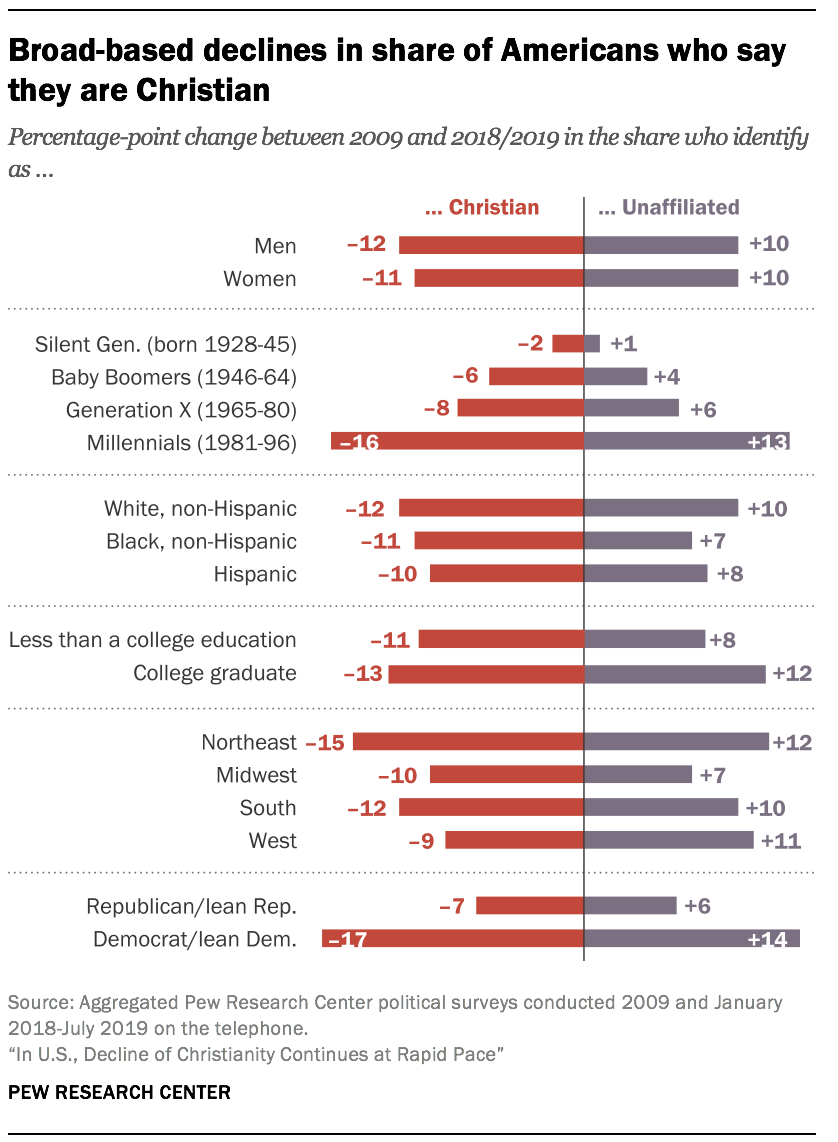
The religious landscape of the United States continues to change at a rapid clip. In Pew Research Center telephone surveys conducted in 2018 and 2019, 65% of American adults describe themselves as Christians when asked about their religion, down 12 percentage points over the past decade. Meanwhile, the religiously unaffiliated share of the population, consisting of people who describe their religious identity as atheist, agnostic or “nothing in particular,” now stands at 26%, up from 17% in 2009.
Both Protestantism and Catholicism are experiencing losses of population share. Currently, 43% of U.S. adults identify with Protestantism, down from 51% in 2009. And one-in-five adults (20%) are Catholic, down from 23% in 2009. Meanwhile, all subsets of the religiously unaffiliated population – a group also known as religious “nones” – have seen their numbers swell. Self-described atheists now account for 4% of U.S. adults, up modestly but significantly from 2% in 2009; agnostics make up 5% of U.S. adults, up from 3% a decade ago; and 17% of Americans now describe their religion as “nothing in particular,” up from 12% in 2009. Members of non-Christian religions also have grown modestly as a share of the adult population.
The data shows that just like rates of religious affiliation, rates of religious attendance are declining.3 Over the last decade, the share of Americans who say they attend religious services at least once or twice a month dropped by 7 percentage points, while the share who say they attend religious services less often (if at all) has risen by the same degree. In 2009, regular worship attenders (those who attend religious services at least once or twice a month) outnumbered those who attend services only occasionally or not at all by a 52%-to-47% margin. Today those figures are reversed; more Americans now say they attend religious services a few times a year or less (54%) than say they attend at least monthly (45%).
The changes underway in the American religious landscape are broad-based. The Christian share of the population is down and religious “nones” have grown across multiple demographic groups: white people, black people and Hispanics; men and women; in all regions of the country; and among college graduates and those with lower levels of educational attainment. Religious “nones” are growing faster among Democrats than Republicans, though their ranks are swelling in both partisan coalitions. And although the religiously unaffiliated are on the rise among younger people and most groups of older adults, their growth is most pronounced among young adults.
Furthermore, the data shows a wide gap between older Americans (Baby Boomers and members of the Silent Generation) and Millennials in their levels of religious affiliation and attendance. More than eight-in-ten members of the Silent Generation (those born between 1928 and 1945) describe themselves as Christians (84%), as do three-quarters of Baby Boomers (76%). In stark contrast, only half of Millennials (49%) describe themselves as Christians; four-in-ten are religious “nones,” and one-in-ten Millennials identify with non-Christian faiths.
Only about one-in-three Millennials say they attend religious services at least once or twice a month. Roughly two-thirds of Millennials (64%) attend worship services a few times a year or less often, including about four-in-ten who say they seldom or never go. Indeed, there are as many Millennials who say they “never” attend religious services (22%) as there are who say they go at least once a week (22%).
Of the Christians who do identify as Christian, fewer are attending church.
The number of Millennials who identify as Christians has shrunk considerably in a decade.
Fewer Millennial Christians are attending church.
The number of “nones” (those without a religious affiliation such as atheists and agnostics) has skyrocketed in a decade.
Since the 1990s, large numbers of Americans have left Christianity to join the growing ranks of U.S. adults who describe their religious identity as atheist, agnostic or “nothing in particular.” This accelerating trend is reshaping the U.S. religious landscape, leading many people to wonder what the future of religion in America might look like.
What if Christians keep leaving religion at the same rate observed in recent years? What if the pace of religious switching continues to accelerate? What if switching were to stop, but other demographic trends – such as migration, births and deaths – were to continue at current rates? To help answer such questions, Pew Research Center has modeled several hypothetical scenarios describing how the U.S. religious landscape might change over the next half century.
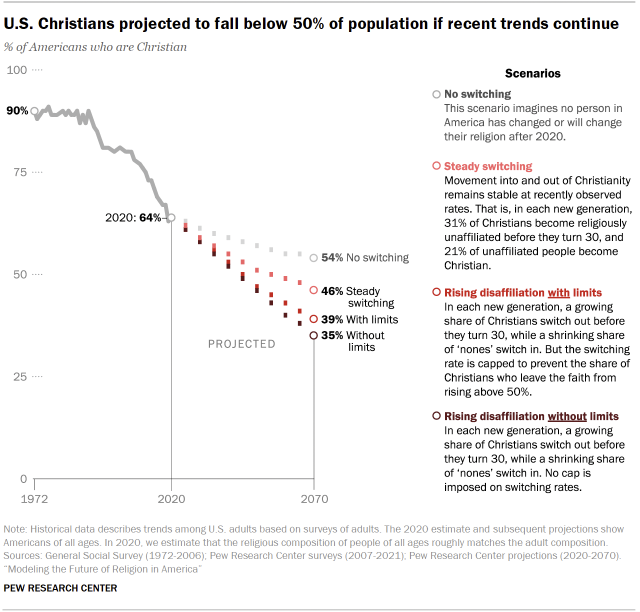
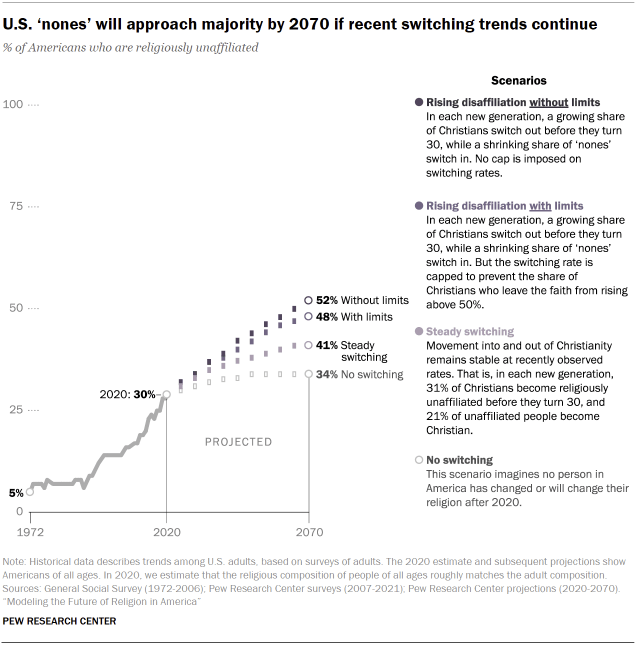
The Center estimates that in 2020, about 64% of Americans, including children, were Christian. People who are religiously unaffiliated, sometimes called religious “nones,” accounted for 30% of the U.S. population. Adherents of all other religions – including Jews, Muslims, Hindus and Buddhists – totaled about 6%.1
Depending on whether religious switching continues at recent rates, speeds up or stops entirely, the projections show Christians of all ages shrinking from 64% to between a little more than half (54%) and just above one-third (35%) of all Americans by 2070. Over that same period, “nones” would rise from the current 30% to somewhere between 34% and 52% of the U.S. population.
As you can see, by 2070 Christians would fall into a minority position and so-called nones (atheists, agnostics, etc.) would be in a majority position. I don’t want to live in America ruled by atheism! This is not the nation my grandparents fought for, this is not the nation I want to live in. I can only imagine the horrific laws the atheists/agnostics will enact once they control virtually every American institution! Thank God I will be in Heaven by then!!! I WEEP FOR YOUR CHILDREN AND GRANDCHILDREN SAINTS!
Parental & Church Influence
The number one developmental factor in children’s lives are their parents. Second is their churches. Sadly many parents no longer attend church; so thus, their children also don’t attend. And they never hear the Gospel (faith comes by hearing), and thus they are never given the gifts of repentance and faith through sovereign election. Sadly, even for the children who do regularly attend church, many are never exposed to the true saving Gospel. And the hard truth is that for many who are raised the so-called “right” way by godly parents, they will never be regenerate because they are not a member of God’s Elect. You can have 10 Doctor of Theology degrees worth of head knowledge, but that doesn’t count for a single iota in terms of salvation. Many a learned soul has been damned to Hell.
Infant Baptism & Covenant Children
I am strongly against infant baptism and the whole concept of so-called “covenant children” that is popular with many Presbyterian Reformed believers. You can be exposed to the Gospel and godly influences your entire life, from baptism to old age. But, unless you are one of the Elect, chosen by God without any consideration of or basis in any qualities or merits of yourself, then you will die as a reprobate and go to Hell. The only truly covenant child is a child who at age 7 (the age of reason), or older, is granted repentance and saving faith after hearing the Gospel. Baptism does absolutely nothing to change our spiritual state. And raising our children to love and fear God, teaching them doctrine, teaching them how to read and study the Bible, these are all noble things. But don’t kid yourself and think your child has a greater chance at being regenerate than some kid in China raised under atheistic communism. How many millions upon millions have been baptized as infants who go on to prove by their lives that they were never Christ’s. And consider all the millions of souls raised in godly Christian homes, who turned out to be reprobates.

 Zach Uram's Blog