
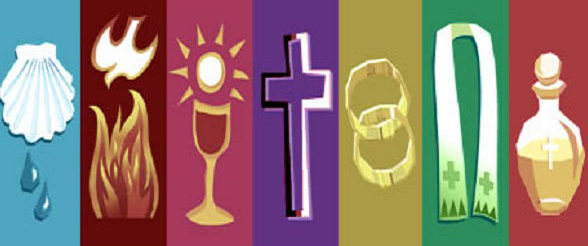
The Roman Catholic and Eastern Orthodox Churches both have 7 sacraments, they are roughly the same.
The 7 Sacraments celebrated in the Catholic Church are Baptism, Confirmation, Eucharist, Penance and Reconciliation, Anointing of the Sick, Holy Orders, and Matrimony.
Contemporary Orthodox catechisms and textbooks all affirm that the church recognizes seven mystēria (“sacraments”): baptism, chrismation, Communion, holy orders, penance, anointing of the sick, and marriage.
The word sacrament comes from the Latin word sacrare, meaning “hallow” or “consecrate.” In its most literal sense, sacrament means “holy obligation.” In practice, a sacrament is an act or ritual that is believed to grant or bestow God’s grace. According to the Roman Catholic Church, “The sacraments are efficacious signs of grace, instituted by Christ and entrusted to the Church, by which divine life is dispensed to us, the visible rites by which the sacraments are celebrated signify and make present the graces proper to each sacrament” (Catechism of the Catholic Church, 1131).
Sacramentalism is the teaching that the sacraments are efficacious in and of themselves and necessary for salvation. The doctrine is common to both the Roman Catholic Church and the Orthodox Church, which teach that participation in the rites confers God’s grace upon the participants.
Is sacramentalism correct? Is salvation attained by the keeping of the sacraments? The answer is a resounding no, for, as the apostle Paul wrote, “For by grace you have been saved through faith. And this is not your own doing; it is the gift of God, not a result of works, so that no one may boast” (Ephesians 2:8–9, ESV). Salvation is a gift that cannot be earned. The very meaning of grace is “undeserved favor.” To insist eternal life can be gained through ritualism frustrates the grace of God and negates Jesus’ finished work on the cross.
Let us consider these other passages:
• “For we hold that one is justified by faith apart from works of the law” (Romans 3:28, ESV).
• “Therefore, since we have been justified by faith, we have peace with God through our Lord Jesus Christ” (Romans 5:1, ESV).
• “But if it is by grace, it is no longer on the basis of works; otherwise grace would no longer be grace” (Romans 11:6, ESV).
• “Now it is evident that no one is justified before God by the law, for ‘The righteous shall live by faith’” (Galatians 3:11, ESV).Sacramentalism has its roots in Judaism; in ancient Israel, the rituals of circumcision, the observance of the Sabbath, and bathing for purification were common practices. The sect of the Pharisees placed great emphasis on handwashing, not so much for sanitary purposes, but as a ritual against personal defilement. The practice of ritualistic handwashing was seen as a restorative measure against defilement, but were the Pharisees truly honoring God by the keeping of their traditions? In the following passage, we see the manner in which our Lord Jesus responded to their religious customs:“Now when the Pharisees gathered to him, with some of the scribes who had come from Jerusalem, they saw that some of his disciples ate with hands that were defiled, that is, unwashed. (For the Pharisees and all the Jews do not eat unless they wash their hands properly, holding to the tradition of the elders, and when they come from the marketplace, they do not eat unless they wash. And there are many other traditions that they observe, such as the washing of cups and pots and copper vessels and dining couches.) And the Pharisees and the scribes asked him, ‘Why do your disciples not walk according to the tradition of the elders, but eat with defiled hands?’ And he said to them, ‘Well did Isaiah prophesy of you hypocrites, as it is written,
“This people honors me with their lips,
but their heart is far from me;
in vain do they worship me,
teaching as doctrines the commandments of men.”You leave the commandment of God and hold to the tradition of men’” (Mark 7:1–8, ESV).
Outwardly, the performing of elaborate rituals gave the Pharisees the appearance of piety, but Jesus, knowing the hardness of their hearts, condemned these hypocrites for “making void the word of God by your tradition that you have handed down. And many such things you do” (Mark 7:13, ESV).
Sacramentalism is unbiblical, for, if the performance of rites and rituals is necessary for salvation, the gospel’s message of grace is made void and Christianity becomes just another works-based religion. As believers in Christ Jesus, we joyfully partake in the ordinances of baptism and communion, but we do so because we are saved and not in order to be saved.
https://www.gotquestions.org/sacramentalism.html
This sacramental system of theology developed over time. Some of these are found in Scripture, but most are foreign to it.
We Reformed actually have sacraments ourselves. In the Reformed tradition, there are two sacraments: baptism and the Lord’s Supper, also known as communion. These sacraments, instituted by Christ, are a means of grace within the covenant community.
We recognize these 2 sacraments of baptism and the Lord’s Supper as channels of God’s grace. But, unlike the sacramentalism of the Roman Catholics and Eastern Orthodox, we don’t view this grace we receive through the sacraments as being saving grace. It is not salvific.
The Catechisms of both the Roman Catholic and Eastern Orthodox churches both teach that these sacraments are not only needed for salvation for an individual. But further, they believe it is impossible to be saved in the normal course without them. They still believe God is free to act and save individuals, but it would be extraordinary and very risky to the given soul. Sacramentalism is the tracks that keep their train running smoothly.
Now, let’s examine each of the 7 sacraments of the two sacramental churches I mentioned:
- Baptism – This is valid Scripturally, however, it is not valid in the form observed by Catholics and Eastern Orthodox. They believe baptism is salvific (baptismal regeneration). We Reformed believe baptism is a means of grace, but that is all.
- Confirmation – This is not biblical. In the New Testament there is no doctrine of confirmation.
- Communion – This is biblical. However there is wide divergence on how our respective churches view it. Orthodox and Catholics affirm that the bread and wine are the true mystical Body and Blood of Christ. This is known as the Real Presence. Catholics believe in the process of transubstantiation (developed in the Medieval church) to describe the mechanics of what is taking place once the priest consecrates the bread and wine. The Orthodox have various theories, but most Orthodox leave it as an unexplained and unknowable mystery. The Reformed church believes that Christ is present in a real way, but spiritually, not physically.
- Penance and Reconciliation – Scripture certainly encourages us to make peace with people who we’ve wronged or vice versa. But it doesn’t need to be made a sacrament. It’s just part of a normative Christian life. Penance is unbiblical. Christ paid the price for every single sin we would ever commit – past, present, and future. There is nothing in Scripture which says we must atone for our personal sin via penance. Many people the Catholic and Orthodox churches recognize as saints believed in harsh physical penance which they inflicted upon their bodies through self-flagellation, jumping into ice cold water, and other ways. This is not biblical at all.
- Anointing of the Sick – There is nothing in the New Testament which instructs Christians to anoint the sick. We are exhorted to pray for the sick and minister to them as best we can physically. In the Old Testament prophets were anointed, but that practice didn’t carry over into the New Testament Church.
- Holy Orders – There is absolutely no precedent in Scripture for this. No where in Scripture do we find men becoming monks or women becoming nuns, and taking on certain vows such as poverty, chastity and obedience. On the contrary the normative experience for Christian men and women is marriage and to produce offspring. God wants us to be fruitful and multiply. Some monks and nuns lived on just bread and water for years, or subjected themselves to cruel physical deprivations or harsh living environments. These things have no intrinsic value, and one doesn’t become holier than a normal Christian by doing these things. A normal Christian has the very perfect righteousness of Christ imputed to them, so varying degrees of holiness is simply an illusion. I am just as holy as any person that the Orthodox or Catholic church deems as saints. I should also mention that the goal of these sacramental systems is sainthood for Catholics, and theosis (a process where we become divinized) for Orthodox. We are already saints, and Scripture refers to all Christians as saints so the Catholic position is wrong. And theosis is deeply blasphemous. Even when we receive our glorified bodies someday we still won’t be as little gods or divinized. There is nothing in Scripture which says we should have the goal of theosis for ourselves as believers. This is a spurious doctrine of man, it’s not from God and should be rejected categorically.
- Matrimony – Certainly marriage is biblical, and it’s both honorable and encouraged. God instituted marriage. However it need not be a sacrament. A marriage is a covenant before God between a man and woman. It does not confer grace.
As you can see from my analysis above, the rigid structure of sacramentalism cannot save, and is actually antithetical to the Gospel. Sacramental theology is man made and is not rooted in Scripture. It is a great deceit and falsehood, developed by Satan, to lure people away from the saving Gospel of salvation by grace alone, through faith alone, in Christ alone, according to Scripture alone, for the glory of God alone. People in sacramental churches may hear the Gospel, but it’s taught almost as an addendum or afterthought.
People in the Catholic and Orthodox churches are taught from a young age that the life of the Church and the normative way of living for Christ is through the sacramental system. This is a lie from Hell! In these churches one is not taught that true salvation is monergistic and only possible through the God-given gifts of true repentance and believe in the authentic Gospel. They are not taught that they must be born again.
Sacramental churches teach that the rites and rituals of sacramental theology are absolutely essential to salvation. What you end up with is a works-based system (works righteousness) which is totally false and against the true path to salvation. I’ve talked with literally thousands of people who were raised in sacramental churches and left, or who are actively still in those churches. And one thing I noticed is that, over time, they came to rely on the rigid strictures and formalism of the sacramental system as their hope for salvation. Priests will even tell you if you don’t participate in sacramentalism you are outside the Church! This is a false gospel from Satan.
This discourse should have demonstrated to you how vitally important the 5 Solas of the Protestant Reformation are. If these sacramental churches had been guided by Sola Scriptura at a foundational level from the very beginning, this awful system of sacramental theology would never have developed. Another illustrative case of what can happen when a church abandon’s God’s Word as the primary and final authority!
Sadly, I must conclude that churches which practice and teach sacramental theology are actually teaching “another gospel” which Scripture warned us of, a false gospel that has no power to save men’s souls. I exhort Catholics and Orthodox to flee this wicked man made system and embrace Reformed theology!
 Zach Uram's Blog
One response to “A Critical Examination of Sacramental Theology: Another Gospel?”
[…] A Critical Examination of Sacramental Theology: Another Gospel? […]
LikeLike